AI's real-world impact will accelerate in 2026, particularly in "conservative" professional services and fundamental sciences, despite market volatility.
Builders should focus on truly novel consumer agent experiences and niche robotics applications, while investors should eye AI IPOs with caution and consider energy efficiency plays.
The next 6-12 months will clarify the geopolitical AI race and expose the true infrastructure bottlenecks, shaping the industry's long-term trajectory.
Strategic Shift: The fintech market is moving from "digitizing everything" to "optimizing everything with AI." This means a focus on efficiency, personalization, and solving deep-seated financial problems.
Builder/Investor Note: Opportunities abound in B2B AI software for financial institutions and in consumer fintechs that prioritize "excellence" over mere access. However, the escalating AI fraud threat demands significant investment in defensive technologies.
The "So What?": Over the next 6-12 months, expect a surge in AI-powered financial products and services, but also a corresponding increase in the sophistication and volume of financial fraud. The battle for trust and security will define the winners.
Strategic Shift: The market will increasingly demand AI models evaluated on human-centric metrics, not just technical benchmarks. Companies prioritizing user experience and safety will gain a competitive edge.
Builder/Investor Note: Investigate companies developing or utilizing advanced, demographically representative human evaluation frameworks. These are crucial for building defensible, user-aligned AI products.
The "So What?": Over the next 6-12 months, expect a growing focus on AI safety, ethical alignment, and nuanced human preference data. The "Wild West" of AI evaluation is ending, paving the way for more robust, trustworthy systems.
Strategic Implication: The next frontier in AI is agentic, and progress hinges on fundamental pre-training innovation, not just post-training optimizations.
Builder/Investor Note: Focus on teams with deep experience in scaling and debugging large models, as this is a high-capital, high-risk endeavor. Builders should prioritize developing new benchmarks for agentic capabilities.
The "So What?": The industry needs to move beyond next-token prediction and static benchmarks to unlock truly capable, self-correcting AI agents in the next 6-12 months.
Shift in AI Development: The focus moves from syntax-aware code generation to execution-aware reasoning, enabling more robust and intelligent code agents.
Builder/Investor Note: Prioritize tools and platforms that support explicit execution modeling and highly asynchronous, high-throughput RL training for agentic systems.
The "So What?": AI that can simulate complex systems internally will drastically reduce development and testing costs, accelerating innovation in software and distributed systems over the next 6-12 months.
Strategic Shift: AI-driven kernel generation is not replacing human genius but augmenting it, allowing experts to focus on novel breakthroughs while AI automates the application of known optimizations across a complex hardware landscape.
Builder/Investor Note: Focus on robust validation and hardware-in-the-loop systems. Claims of "AI inventing new algorithms" in this domain are premature. The real value is in automating the "bag of tricks" for heterogeneous compute.
The "So What?": This technology is critical for scaling agentic AI workloads. Expect significant investment in tools that abstract hardware complexity and enable efficient, automated optimization, driving down the cost of AI inference in the next 6-12 months.
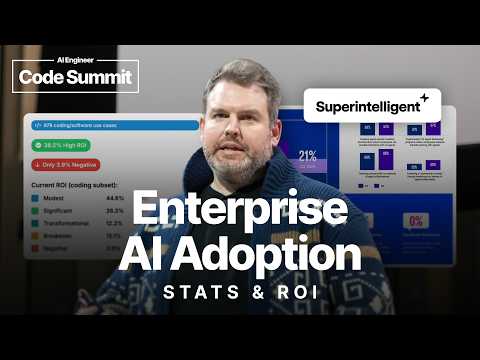
The Agent Economy is Here: Enterprises are moving past pilots with AI agents. Builders should focus on orchestration layers and human-agent interaction design.
ROI Measurement is the Next Frontier: Investors should look for solutions that help organizations accurately track and attribute AI value beyond traditional metrics.
Strategic AI, Not Spot Solutions: The biggest wins come from systematic, cross-organizational AI strategies that target new capabilities and revenue growth, not just incremental time savings.
The 100% AI adoption threshold is a step-function change, not incremental. Companies that commit fully will outpace those with partial integration.
Builders should prioritize "compounding engineering" by codifying knowledge into reusable prompts. This builds an organizational memory that accelerates future development exponentially.
Re-evaluate team structures and roles. Single engineers can own complex products, and even technical managers can contribute code, shifting how organizations operate.
Effective crime reduction requires a shift from reactive punishment to proactive, intelligence-driven deterrence, making it highly probable for criminals to be caught.
The market for AI-powered public safety technology, particularly solutions that integrate data for precision and accountability, presents a significant opportunity. Public-private partnerships are a key funding mechanism.
Over the next 6-12 months, expect to see more cities adopt advanced surveillance and AI tools, driven by private funding, as they seek to improve safety and address staffing shortages without resorting to ineffective, broad-stroke policies.
Revenue Accrual is King. Hyperliquid's model of directing nearly all top-line revenue to token buybacks creates an aggressive and constant bid for the HYPE token, a feature most crypto projects can only dream of.
Product-First Beats VC-First. Its explosive growth comes from building a superior product that attracted a loyal user base first, then leveraging that traction to build an L1 ecosystem—a stark contrast to the typical VC-funded playbook.
A Bet on the Middle Ground. Investing in HYPE is a bet that CEX-level performance and on-chain transparency can outweigh significant centralization and regulatory risks. It’s a category-defining play that sits squarely between DeFi and CeFi.
Hyperliquid is a Cash Flow Machine. It is a rare crypto asset with quantifiable fundamentals, generating over $1B in annualized free cash flow with an automated, daily 99% buyback mechanism.
Access is the Arbitrage. The NASDAQ-listed vehicle’s core value proposition is providing regulated access to an asset that US investors cannot easily buy, creating a structural opportunity.
Innovation is Now Permissionless. Hyperliquid’s open architecture allows anyone to build on its rails, enabling new markets like pre-IPO equity trading and accelerating growth without traditional gatekeepers.
**Quantum for the Masses.** Subnet 48 is set to offer free public access to quantum computers, a service that costs thousands per hour, by leveraging Bittensor's tokenomics to subsidize the cost.
**The Crypto Abstraction Playbook.** The Open Quantum platform provides a blueprint for onboarding mainstream users by hiding the blockchain behind a simple web interface with fiat payments, while still rewarding TAO stakers with platform credits.
**The Bitcoin Countdown.** The threat of quantum computing cracking Bitcoin is a tangible, medium-term risk. The migration to quantum-safe encryption is a complex challenge that the industry must begin preparing for now.
**Regulation by Enforcement is Over.** The SEC has abandoned its strategy of using lawsuits to create policy. The new focus is on providing clear guidance *before* bringing the hammer down, creating a more predictable environment for builders.
**Liquid Staking Gets the Green Light.** In a major win for DeFi, the SEC has confirmed liquid staking tokens are not securities. This clears the path for protocols like Jito and could accelerate the approval of staked ETFs.
**Build Now or Regret It Later.** Commissioner Peirce delivered a clear ultimatum to the industry: use this favorable regulatory window to build legitimate products. The long-term survival of crypto in the US depends on proving its utility *now*.
Ethena's strategy provides a compelling look into the future of crypto-native finance, where on-chain efficiency meets the scale of traditional capital markets.
**The New Carry Trade is Here.** DATs are evolving from simple holding vehicles into sophisticated structures designed to execute a powerful TradFi-to-DeFi carry trade, arbitraging global interest rate differentials at scale.
**Finance Finally Scales Like Software.** Ethena’s model proves that on-chain finance can achieve massive profitability with minimal headcount, creating unparalleled operational leverage that traditional finance can't match.
**Partnerships Require Surgical Precision.** The path to scale isn't about broad outreach. It's about surgically identifying and capturing the few key partners who can drive the vast majority of growth.
Weaponized Capital: With nearly $2 billion on its balance sheet, pump.fun sees capital as a "weapon" for strategic acquisitions and user incentives to methodically capture market share from both crypto and Web2 incumbents.
Creators Are the New Go-To-Market: The entire growth strategy hinges on a simple, powerful premise: pay creators exponentially more than anyone else. This is their path to onboarding millions of mainstream users who have never touched crypto.
The Anti-VC Play: The platform’s raw, unfiltered nature is a direct response to a crypto industry viewed as rife with opaque, VC-backed projects. Its honesty and fun resonate with a generation tired of being retail exit liquidity.