Meta's Jacob Kahn introduces the Code World Model (CWM), an AI architecture that simulates program execution, fundamentally redefining software development and even approximating solutions to undecidable computer science problems.
Beyond Syntax: Modeling Program Execution
- CWM predicts future observations given past observations and actions, forming a computational world model.
- Kahn distinguishes world models from Large Language Models (LLMs), asserting LLMs are a parameterization of a problem, while world models define the problem itself.
- The model processes code by tokenizing input and predicting output, but CWM seeks to model the transition function (a mathematical function describing how a system's state changes over time based on inputs) of program states during execution.
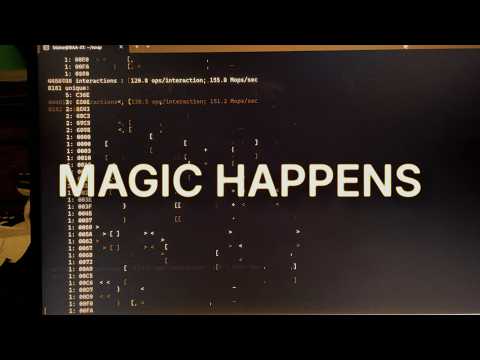
- This involves explicit execution tracing, detailing local variables, memory, and line-by-line program flow, extending to repository or distributed system levels.
- “What does it mean to model code? Is code literally the syntax in your editor or is it something else?”
Agentic Reasoning and Simulated Environments
- The model views problems, takes actions, receives feedback (e.g., failure), and iteratively refines its approach.
- Crucially, CWM can generate execution traces without actual execution, simulating program behavior internally.
- This simulation capability dramatically boosts efficiency, allowing agents to refine strategies before interacting with real-world environments.
- LLMs can autoregressively (predicting the next item in a sequence based on preceding items) generate token-by-token state and action transitions, using program executions as a starting point for this "chain of thought."
- “With a world model, maybe we can actually simulate. We can imagine that action, we can get feedback in our imagined environment.”
CWM Architecture and Asynchronous Training
- CWM is a 32 billion parameter dense transformer (a type of neural network where all inputs are connected to all outputs in subsequent layers), trained end-to-end on trillions of tokens from GitHub data, including pull requests and CI/test runs.
- The model is "bash-oriented," learning to use the terminal effectively with fewer tools than other models, mimicking an engineer's environment.
- Post-training scales significantly using an asynchronous Reinforcement Learning (RL) (a machine learning paradigm where an agent learns to make decisions by performing actions in an environment and receiving rewards or penalties) setup with samplers, environments, and trainers.
- A key innovation involves updating models mid-trajectory during sampling, leveraging high throughput to maintain strong performance despite temporary off-policy behavior.
- “CWM is a very bash-oriented model. It has fewer tools than do other models and it has to learn how to use the terminal pretty well to solve a lot of the tasks we give it.”
Neural Debugging and Approximating the Halting Problem
- CWM functions as a "neural debugger," accurately tracing line-by-line execution and variable values within functions.
- Users can express desired program structure and semantics loosely in code, and CWM fills in the rest by implicitly simulating execution.
- The model can approximate solutions to the Halting Problem (a fundamental undecidable problem in computer science that asks whether it is possible to determine, for any arbitrary program and input, whether the program will eventually stop or continue to run forever).
- By simulating execution internally, CWM can reason about program dynamics and high-level patterns without expensive real-world execution, even for complex distributed systems.
- “The ability to have an implicit world model internally where I'm simulating what's happening with a piece of code or a broader system gives me the ability to reason about it without executing otherwise expensive things.”
Investor & Researcher Alpha
- Capital Reallocation: Investment shifts from purely generative AI models to those capable of simulating and understanding program execution. This prioritizes infrastructure for robust simulation environments and advanced agentic training paradigms.
- Emerging Bottleneck: The critical resource becomes high-quality, large-scale execution trace data for complex, multi-file, and distributed systems, moving beyond simple code snippets.
- Obsolete Research Trajectories: Purely syntax-based code generation models without deep execution understanding face obsolescence. Research must now focus on semantic understanding, verifiable execution, and the approximation of undecidable computational problems.
Strategic Conclusion
CWM represents a significant leap in AI's ability to understand and interact with code, moving from pattern matching to explicit execution simulation. The industry must now focus on building robust, scalable simulation environments and agentic training paradigms to fully realize the potential of code world models.