AI's real-world impact will accelerate in 2026, particularly in "conservative" professional services and fundamental sciences, despite market volatility.
Builders should focus on truly novel consumer agent experiences and niche robotics applications, while investors should eye AI IPOs with caution and consider energy efficiency plays.
The next 6-12 months will clarify the geopolitical AI race and expose the true infrastructure bottlenecks, shaping the industry's long-term trajectory.
Strategic Shift: The fintech market is moving from "digitizing everything" to "optimizing everything with AI." This means a focus on efficiency, personalization, and solving deep-seated financial problems.
Builder/Investor Note: Opportunities abound in B2B AI software for financial institutions and in consumer fintechs that prioritize "excellence" over mere access. However, the escalating AI fraud threat demands significant investment in defensive technologies.
The "So What?": Over the next 6-12 months, expect a surge in AI-powered financial products and services, but also a corresponding increase in the sophistication and volume of financial fraud. The battle for trust and security will define the winners.
Strategic Shift: The market will increasingly demand AI models evaluated on human-centric metrics, not just technical benchmarks. Companies prioritizing user experience and safety will gain a competitive edge.
Builder/Investor Note: Investigate companies developing or utilizing advanced, demographically representative human evaluation frameworks. These are crucial for building defensible, user-aligned AI products.
The "So What?": Over the next 6-12 months, expect a growing focus on AI safety, ethical alignment, and nuanced human preference data. The "Wild West" of AI evaluation is ending, paving the way for more robust, trustworthy systems.
Strategic Implication: The next frontier in AI is agentic, and progress hinges on fundamental pre-training innovation, not just post-training optimizations.
Builder/Investor Note: Focus on teams with deep experience in scaling and debugging large models, as this is a high-capital, high-risk endeavor. Builders should prioritize developing new benchmarks for agentic capabilities.
The "So What?": The industry needs to move beyond next-token prediction and static benchmarks to unlock truly capable, self-correcting AI agents in the next 6-12 months.
Shift in AI Development: The focus moves from syntax-aware code generation to execution-aware reasoning, enabling more robust and intelligent code agents.
Builder/Investor Note: Prioritize tools and platforms that support explicit execution modeling and highly asynchronous, high-throughput RL training for agentic systems.
The "So What?": AI that can simulate complex systems internally will drastically reduce development and testing costs, accelerating innovation in software and distributed systems over the next 6-12 months.
Strategic Shift: AI-driven kernel generation is not replacing human genius but augmenting it, allowing experts to focus on novel breakthroughs while AI automates the application of known optimizations across a complex hardware landscape.
Builder/Investor Note: Focus on robust validation and hardware-in-the-loop systems. Claims of "AI inventing new algorithms" in this domain are premature. The real value is in automating the "bag of tricks" for heterogeneous compute.
The "So What?": This technology is critical for scaling agentic AI workloads. Expect significant investment in tools that abstract hardware complexity and enable efficient, automated optimization, driving down the cost of AI inference in the next 6-12 months.
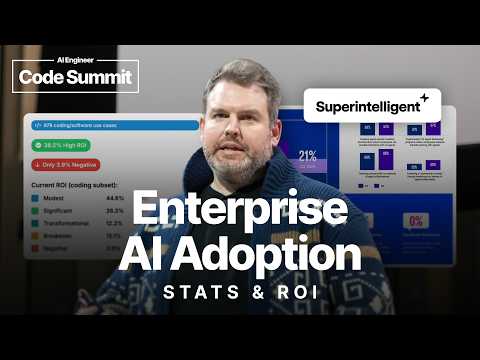
The Agent Economy is Here: Enterprises are moving past pilots with AI agents. Builders should focus on orchestration layers and human-agent interaction design.
ROI Measurement is the Next Frontier: Investors should look for solutions that help organizations accurately track and attribute AI value beyond traditional metrics.
Strategic AI, Not Spot Solutions: The biggest wins come from systematic, cross-organizational AI strategies that target new capabilities and revenue growth, not just incremental time savings.
The 100% AI adoption threshold is a step-function change, not incremental. Companies that commit fully will outpace those with partial integration.
Builders should prioritize "compounding engineering" by codifying knowledge into reusable prompts. This builds an organizational memory that accelerates future development exponentially.
Re-evaluate team structures and roles. Single engineers can own complex products, and even technical managers can contribute code, shifting how organizations operate.
Effective crime reduction requires a shift from reactive punishment to proactive, intelligence-driven deterrence, making it highly probable for criminals to be caught.
The market for AI-powered public safety technology, particularly solutions that integrate data for precision and accountability, presents a significant opportunity. Public-private partnerships are a key funding mechanism.
Over the next 6-12 months, expect to see more cities adopt advanced surveillance and AI tools, driven by private funding, as they seek to improve safety and address staffing shortages without resorting to ineffective, broad-stroke policies.
Predictable Risk Management is Paramount: DeFi's long-term success hinges on building transparent, predictable, and fair risk management systems that demonstrably outperform TradFi, especially for institutional players.
Incentive Alignment is Critical: Investors and builders must scrutinize the relationship between DevCo equity and protocol tokens. Misaligned incentives can lead to value destruction for token holders during M&A or other strategic shifts.
The "So What?": The next 6-12 months will see continued innovation in DEX fee models (Lighter's zero-fee tier for retail), RWA derivatives (FX, fixed income), and composability (Lighter's ZKVM sidecar). However, the underlying tension between decentralization ideals and market realities will persist, demanding robust solutions for ADL, governance, and value accrual.
Productive Stablecoins are Key: The transition from unproductive to productive stablecoins like hUSD is a significant catalyst for Solana DeFi growth, attracting capital by offering intrinsic yield.
Builders, Simplify Leverage: Hylo's success with xSOL demonstrates the demand for simplified, liquidation-proof leverage products. Builders should focus on making complex DeFi primitives accessible through intuitive design.
The X-Asset Frontier: Hylo's move into XBTC and other X-assets signals a broader trend: tokenizing leverage for diverse crypto assets will be a major growth driver for DeFi in the next 6-12 months.
Institutional Inevitability: Major financial institutions will continue tokenizing traditional assets, creating a clear, low-risk entry point for TradFi into crypto.
Builder Focus: Build infrastructure that bridges TradFi and crypto, or specialize in high-throughput retail solutions. Regulatory compliance and education are paramount.
Market Patience: Expect continued pressure on high-beta crypto assets until a clear market shift occurs, likely requiring high-beta assets to become oversold and the "value" rally to top out.
Strategic Implication: The future of crypto is increasingly defined by institutional adoption, driven by the need for verifiable, private, and compliant digital assets and systems.
Builder/Investor Note: Focus on foundational technologies like ZK proofs and secure interoperability. Avoid speculative retail trends that lack long-term utility.
The "So What?": The convergence of AI and blockchain will redefine trust. Builders who integrate ZKPs to authenticate AI outputs and ensure agent accountability will capture significant value in the next 6-12 months.
Strategic Implication: Crypto is transitioning from a niche, retail-driven asset class to a mainstream, institutionally-backed financial infrastructure. This shift will drive sustained growth, reduced volatility, and lower correlation with traditional assets.
Builder/Investor Note: Re-evaluate crypto allocations, recognizing the shift from retail-driven cycles to institutional adoption. Explore diversified exposure beyond Bitcoin, including ETH, Solana, and high-quality DeFi tokens as their economic capture improves. The rise of on-chain vaults indicates demand for professional, diversified asset management strategies on-chain.
The "So What?": The market is vastly underestimating the fundamental progress and institutional acceptance of crypto. The "suit coiners" are bullish for a reason, and their capital will reshape the landscape in 2026 and beyond.
Strategic Implication: The crypto market is maturing. Expect smaller percentage returns and less volatile swings, but a stronger foundation for assets with real value.
Builder/Investor Note: Focus on Bitcoin accumulation in the identified value zone. Avoid speculative altcoin bets unless they demonstrate clear utility and sustainable economics.
The "So What?": The market is in a temporary lull due to year-end flows and M2 divergence. Position for a potential rebound in January, driven by fresh capital and anticipated Western stimulus.