AI's real-world impact will accelerate in 2026, particularly in "conservative" professional services and fundamental sciences, despite market volatility.
Builders should focus on truly novel consumer agent experiences and niche robotics applications, while investors should eye AI IPOs with caution and consider energy efficiency plays.
The next 6-12 months will clarify the geopolitical AI race and expose the true infrastructure bottlenecks, shaping the industry's long-term trajectory.
Strategic Shift: The fintech market is moving from "digitizing everything" to "optimizing everything with AI." This means a focus on efficiency, personalization, and solving deep-seated financial problems.
Builder/Investor Note: Opportunities abound in B2B AI software for financial institutions and in consumer fintechs that prioritize "excellence" over mere access. However, the escalating AI fraud threat demands significant investment in defensive technologies.
The "So What?": Over the next 6-12 months, expect a surge in AI-powered financial products and services, but also a corresponding increase in the sophistication and volume of financial fraud. The battle for trust and security will define the winners.
Strategic Shift: The market will increasingly demand AI models evaluated on human-centric metrics, not just technical benchmarks. Companies prioritizing user experience and safety will gain a competitive edge.
Builder/Investor Note: Investigate companies developing or utilizing advanced, demographically representative human evaluation frameworks. These are crucial for building defensible, user-aligned AI products.
The "So What?": Over the next 6-12 months, expect a growing focus on AI safety, ethical alignment, and nuanced human preference data. The "Wild West" of AI evaluation is ending, paving the way for more robust, trustworthy systems.
Strategic Implication: The next frontier in AI is agentic, and progress hinges on fundamental pre-training innovation, not just post-training optimizations.
Builder/Investor Note: Focus on teams with deep experience in scaling and debugging large models, as this is a high-capital, high-risk endeavor. Builders should prioritize developing new benchmarks for agentic capabilities.
The "So What?": The industry needs to move beyond next-token prediction and static benchmarks to unlock truly capable, self-correcting AI agents in the next 6-12 months.
Shift in AI Development: The focus moves from syntax-aware code generation to execution-aware reasoning, enabling more robust and intelligent code agents.
Builder/Investor Note: Prioritize tools and platforms that support explicit execution modeling and highly asynchronous, high-throughput RL training for agentic systems.
The "So What?": AI that can simulate complex systems internally will drastically reduce development and testing costs, accelerating innovation in software and distributed systems over the next 6-12 months.
Strategic Shift: AI-driven kernel generation is not replacing human genius but augmenting it, allowing experts to focus on novel breakthroughs while AI automates the application of known optimizations across a complex hardware landscape.
Builder/Investor Note: Focus on robust validation and hardware-in-the-loop systems. Claims of "AI inventing new algorithms" in this domain are premature. The real value is in automating the "bag of tricks" for heterogeneous compute.
The "So What?": This technology is critical for scaling agentic AI workloads. Expect significant investment in tools that abstract hardware complexity and enable efficient, automated optimization, driving down the cost of AI inference in the next 6-12 months.
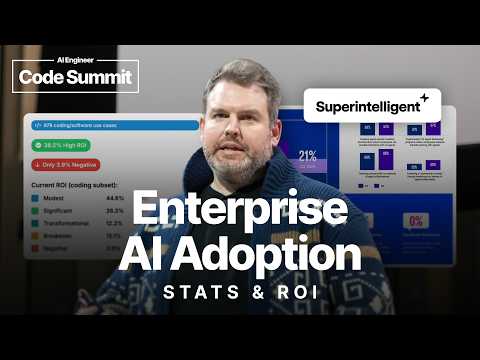
The Agent Economy is Here: Enterprises are moving past pilots with AI agents. Builders should focus on orchestration layers and human-agent interaction design.
ROI Measurement is the Next Frontier: Investors should look for solutions that help organizations accurately track and attribute AI value beyond traditional metrics.
Strategic AI, Not Spot Solutions: The biggest wins come from systematic, cross-organizational AI strategies that target new capabilities and revenue growth, not just incremental time savings.
The 100% AI adoption threshold is a step-function change, not incremental. Companies that commit fully will outpace those with partial integration.
Builders should prioritize "compounding engineering" by codifying knowledge into reusable prompts. This builds an organizational memory that accelerates future development exponentially.
Re-evaluate team structures and roles. Single engineers can own complex products, and even technical managers can contribute code, shifting how organizations operate.
Effective crime reduction requires a shift from reactive punishment to proactive, intelligence-driven deterrence, making it highly probable for criminals to be caught.
The market for AI-powered public safety technology, particularly solutions that integrate data for precision and accountability, presents a significant opportunity. Public-private partnerships are a key funding mechanism.
Over the next 6-12 months, expect to see more cities adopt advanced surveillance and AI tools, driven by private funding, as they seek to improve safety and address staffing shortages without resorting to ineffective, broad-stroke policies.
The shift from centralized AI development to decentralized, incentive-driven networks like Bittensor demands a rigorous focus on economic mechanism design. The core challenge is translating a desired AI capability into a quantifiable, ungameable benchmark that ensures genuine progress, not just benchmark-specific optimization.
Prioritize benchmark design and transparency. Builders should immediately define a precise, copy-resistant, and low-variance benchmark, then launch on mainnet quickly with open-source validator code.
Over the next 6-12 months, the subnets that win will be those that master incentive alignment through robust, transparent benchmarking and rapid, mainnet-first iteration. Investors should look for subnets demonstrating clear auditability and a willingness to confront and fix miner exploits openly, as these indicate long-term viability and genuine progress towards their stated AI goals.
The industry is undergoing a forced re-alignment, moving from a broad "world computer" vision to a focused "financial utility machine" reality. This means capital and talent are increasingly flowing to projects that deliver tangible financial value and robust infrastructure.
Prioritize projects building core financial primitives, robust L1/L2 infrastructure, or those leveraging AI for financial automation. Investigate prediction market platforms and their regulatory positioning, as they represent a proven, high-growth revenue stream.
The current market downturn is a cleansing fire, forcing crypto to shed non-viable narratives and double down on its core strength: programmable finance. Success will accrue to those who build for financial utility and AI-driven users, not just human consumers.
The pursuit of optimal market microstructure is driving a wedge between L1s and specialized execution environments, forcing L1s like Solana to either adapt their core protocol or risk losing high-value DeFi activity to custom solutions.
Monitor Solana's validator stake distribution for Jito's BAM and Harmonic, as increasing adoption of MEV-mitigating clients will directly impact onchain trading profitability and the viability of sophisticated DeFi applications.
Solana's ability to scale throughput and implement protocol-enforced MEV solutions will determine if it can reclaim its position as the preferred L1 for high-frequency DeFi, or if specialized applications will continue to build off-chain, fragmenting the ecosystem.