AI's real-world impact will accelerate in 2026, particularly in "conservative" professional services and fundamental sciences, despite market volatility.
Builders should focus on truly novel consumer agent experiences and niche robotics applications, while investors should eye AI IPOs with caution and consider energy efficiency plays.
The next 6-12 months will clarify the geopolitical AI race and expose the true infrastructure bottlenecks, shaping the industry's long-term trajectory.
Strategic Shift: The fintech market is moving from "digitizing everything" to "optimizing everything with AI." This means a focus on efficiency, personalization, and solving deep-seated financial problems.
Builder/Investor Note: Opportunities abound in B2B AI software for financial institutions and in consumer fintechs that prioritize "excellence" over mere access. However, the escalating AI fraud threat demands significant investment in defensive technologies.
The "So What?": Over the next 6-12 months, expect a surge in AI-powered financial products and services, but also a corresponding increase in the sophistication and volume of financial fraud. The battle for trust and security will define the winners.
Strategic Shift: The market will increasingly demand AI models evaluated on human-centric metrics, not just technical benchmarks. Companies prioritizing user experience and safety will gain a competitive edge.
Builder/Investor Note: Investigate companies developing or utilizing advanced, demographically representative human evaluation frameworks. These are crucial for building defensible, user-aligned AI products.
The "So What?": Over the next 6-12 months, expect a growing focus on AI safety, ethical alignment, and nuanced human preference data. The "Wild West" of AI evaluation is ending, paving the way for more robust, trustworthy systems.
Strategic Implication: The next frontier in AI is agentic, and progress hinges on fundamental pre-training innovation, not just post-training optimizations.
Builder/Investor Note: Focus on teams with deep experience in scaling and debugging large models, as this is a high-capital, high-risk endeavor. Builders should prioritize developing new benchmarks for agentic capabilities.
The "So What?": The industry needs to move beyond next-token prediction and static benchmarks to unlock truly capable, self-correcting AI agents in the next 6-12 months.
Shift in AI Development: The focus moves from syntax-aware code generation to execution-aware reasoning, enabling more robust and intelligent code agents.
Builder/Investor Note: Prioritize tools and platforms that support explicit execution modeling and highly asynchronous, high-throughput RL training for agentic systems.
The "So What?": AI that can simulate complex systems internally will drastically reduce development and testing costs, accelerating innovation in software and distributed systems over the next 6-12 months.
Strategic Shift: AI-driven kernel generation is not replacing human genius but augmenting it, allowing experts to focus on novel breakthroughs while AI automates the application of known optimizations across a complex hardware landscape.
Builder/Investor Note: Focus on robust validation and hardware-in-the-loop systems. Claims of "AI inventing new algorithms" in this domain are premature. The real value is in automating the "bag of tricks" for heterogeneous compute.
The "So What?": This technology is critical for scaling agentic AI workloads. Expect significant investment in tools that abstract hardware complexity and enable efficient, automated optimization, driving down the cost of AI inference in the next 6-12 months.
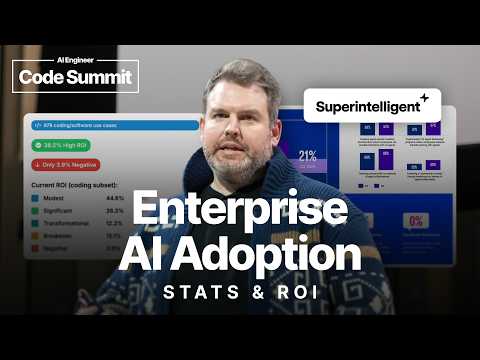
The Agent Economy is Here: Enterprises are moving past pilots with AI agents. Builders should focus on orchestration layers and human-agent interaction design.
ROI Measurement is the Next Frontier: Investors should look for solutions that help organizations accurately track and attribute AI value beyond traditional metrics.
Strategic AI, Not Spot Solutions: The biggest wins come from systematic, cross-organizational AI strategies that target new capabilities and revenue growth, not just incremental time savings.
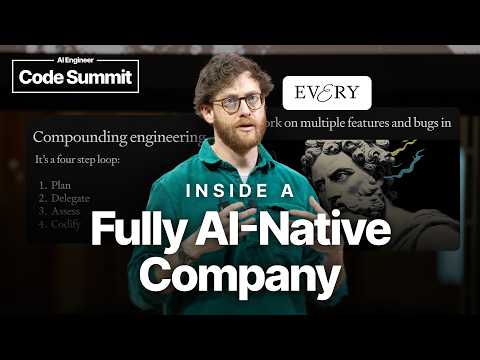
The 100% AI adoption threshold is a step-function change, not incremental. Companies that commit fully will outpace those with partial integration.
Builders should prioritize "compounding engineering" by codifying knowledge into reusable prompts. This builds an organizational memory that accelerates future development exponentially.
Re-evaluate team structures and roles. Single engineers can own complex products, and even technical managers can contribute code, shifting how organizations operate.
Effective crime reduction requires a shift from reactive punishment to proactive, intelligence-driven deterrence, making it highly probable for criminals to be caught.
The market for AI-powered public safety technology, particularly solutions that integrate data for precision and accountability, presents a significant opportunity. Public-private partnerships are a key funding mechanism.
Over the next 6-12 months, expect to see more cities adopt advanced surveillance and AI tools, driven by private funding, as they seek to improve safety and address staffing shortages without resorting to ineffective, broad-stroke policies.
Monetary Sovereignty Migration. When states weaponize the financial system, capital migrates to censorship-resistant stablecoin layers.
Monitor Remittance Corridors. Watch for the growth of non-custodial stablecoin wallets in high-inflation regions as a leading indicator for broader DeFi adoption.
The Venezuelan story proves that while state-led crypto projects fail, the utility of Bitcoin and stablecoins is a permanent fixture in the global south.
Verifiable intelligence is replacing black-box predictions. As AI agents become the primary participants in prediction markets, the value moves from the prediction itself to the verifiable logic behind it.
Integrate real-time news APIs like Darch to give agents a qualitative edge over pure quant models.
Forecasting is the ultimate utility for LLMs. If Numinous succeeds, Bittensor becomes the world's most accurate, explainable source of truth for investors and researchers.
The transition from human-centric interfaces to agent-first protocols. As agents become the primary users, the internet will be rebuilt around machine-readable data and crypto-native payment rails.
Integrate Model Context Protocol (MCP) servers into your workflow immediately. Use parallel Claude instances to act as both programmer and reviewer to bypass context window degradation.
Software is no longer a product: it is a utility. Over the next year, the winners will be those who control the data graphs and the distribution channels, not the ones writing the code.
The Macro Pivot: Proprietary data and enterprise switching costs are the only walls left standing as AI commoditizes the act of writing code.
The Tactical Edge: Build internal tools using natural language agents to automate specific, low-volume workflows that third-party vendors ignore.
The Bottom Line: The billion-dollar company with a single employee is no longer a fantasy; it is a mathematical certainty for those who master the prompt over the next twelve months.