The automotive industry is undergoing a significant architectural change, moving from fragmented, hardware-centric systems to vertically integrated, AI-powered software-defined vehicles. This demands re-platforming, making legacy automakers vulnerable.
Invest in or build companies controlling their full technology stack: custom silicon, sensor arrays, data collection, AI model training. Vertical integration is key to cost efficiency and rapid iteration for mass-market AI autonomy.
The next few years will see dramatic divergence. Companies mastering AI-driven autonomy and software-defined architectures, like Rivian with its R2, will capture significant market share by offering compelling, continuously improving vehicles at scale. Others face obsolescence.
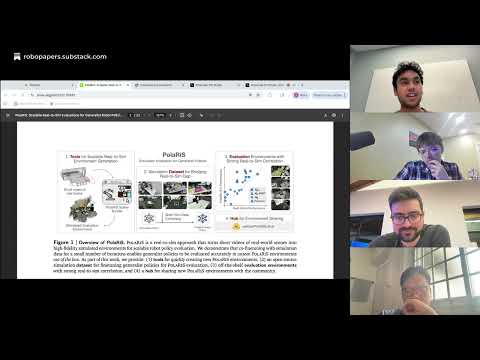
The robotics community is moving beyond task-specific benchmarks towards generalist policy evaluation, mirroring the LLM trend of testing off-the-shelf models on unseen tasks. This demands scalable, high-fidelity simulation tools that can quickly generate diverse test environments.
Builders and researchers should prioritize evaluation tools that offer strong real-to-sim correlation, even if it means a hybrid approach (like PolaRiS) over purely data-driven world models. Utilize real-to-sim environment generation (Gaussian splatting) and strategic sim data co-training to accelerate policy iteration.
PolaRiS offers a path to community-driven, crowdsourced robot benchmarks, making policy development faster and more robust. Expect a future where robot policies are evaluated across a broad suite of easily created, diverse simulated environments, pushing the boundaries of generalization and real-world applicability.
Generalist robot policies need robust, scalable evaluation. The shift is from bespoke, real-world-only testing to a hybrid real-to-sim approach that leverages modern 3D reconstruction and minimal sim data to create highly correlated, reproducible benchmarks.
Builders should adopt PolaRiS's real-to-sim environment generation and "sim co-training" methodology. This allows for rapid, cost-effective iteration on robot policies, ensuring that improvements in simulation translate directly to real-world gains.
Over the next 6-12 months, the ability to quickly and reliably evaluate robot policies in simulation will be a critical differentiator. PolaRiS provides the tools to build diverse, generalization-focused benchmarks, moving robotics closer to the rapid iteration cycles of other AI fields.
Tesla's core identity shifted from EV maker to autonomous AI and robotics. Its cars are devices for deploying its advanced AI brain; competitors miss this.
Tesla's 8 million cars collect real-world driving data. This massive dataset, combined with in-house AI processing, creates an unparalleled moat impossible for competitors to replicate.
This convergence creates an abundance of labor and transportation, driving down costs. Robo-taxis and humanoid robots automate tasks, making goods and services cheaper, even as Tesla's profitability soars.
Robotics is moving towards generalist policies that need broad, diverse evaluation. PolaRiS enables this by making it easy to create and share new, correlated benchmarks, cultivating a community-driven evaluation ecosystem similar to LLMs.
Adopt PolaRiS for rapid policy iteration on pick-and-place and articulated object tasks. Use its browser-based scene builder and existing assets to quickly create new evaluation environments, then fine-tune policies with a small amount of unrelated sim data to boost real-to-sim correlation.
Investing in tools like PolaRiS now means faster development cycles and more reliable policy improvements. This accelerates the path to robust, real-world robot deployment by providing a scalable, trustworthy intermediate testing ground.
PolaRiS enables a shift towards LLM-style generalization benchmarks, where models are tested on unseen environments and tasks, accelerating robot capabilities.
Use its browser-based scene builder and Gaussian splatting to quickly create diverse, real-world correlated evaluation environments, significantly reducing the cost and time of real robot testing.
Cheap, reliable robot policy evaluation in simulation, with strong real-world correlation, means faster development cycles, more robust generalist robots, and a path to crowdsourced, diverse benchmarks that will push the entire field forward.
AI is forcing a fundamental architectural change in automotive, moving from fragmented, rules-based systems to vertically integrated, neural network-powered platforms. This technical reality dictates market survival, favoring companies that control their entire software and hardware stack to build a continuous data flywheel.
Invest in or partner with companies demonstrating deep vertical integration in AI hardware and software for mobility. Prioritize those with a clear path to mass-market data collection and rapid iteration cycles.
Autonomy will be a must-have feature in cars within the next few years. Companies without a software-defined architecture and a vertically integrated AI stack will struggle to compete, creating a market share shift towards those few players who can deliver true self-driving at scale.
The automotive industry is undergoing a fundamental re-architecture, moving from hardware-centric, rules-based systems to software-defined, AI-powered platforms. This shift favors companies with deep vertical integration and proprietary data flywheels.
Invest in companies demonstrating full-stack control over their vehicle's software, hardware, and AI training data. This verticality is the moat against commoditization and the engine for rapid, continuous improvement.
Autonomy will be a non-negotiable feature by 2030, making software-defined vehicles the only viable path for mass-market automakers. Companies that fail to build or acquire this capability will face market irrelevance.
Tesla's core business is AI and autonomous robotics. This means its value comes from its software and data moat, not just vehicle sales.
Tesla is sunsetting Model S and X production to convert factories for humanoid robots. This signals a full commitment to autonomous devices beyond cars.
Unsupervised FSD is expected in select US states by Q2. This will enable cars to operate without human oversight, unlocking the robo-taxi network.
Don't Mistake Sideways for Collapse. The market is in a period of accumulation. On-chain data shows long-term Bitcoin holders are at all-time highs, forming a powerful price floor.
Buy the Hate. Abysmal sentiment in altcoins is a strong contrarian signal. "Fair value" metrics like MVRV for ETH and SOL indicate a prime buying window is open now, ahead of a potential rally.
Watch the Fed. The ultimate catalyst is global liquidity. A cut in the Fed funds rate, which markets price with a ~75% chance for September, is the primary trigger for crypto's next major leg up.
Ignore the Noise: Founder success is judged by market cycles, not actual progress. The primary challenge is maintaining conviction in a long-term vision while resisting the pressure to chase short-term narratives.
Institutions Play the Long Game: The institutional floodgates are opening, but it's a slow trickle, not a tidal wave. The immediate future is stablecoins and basic yield products, not a full-scale DeFi revolution within banks. Patience is the ultimate competitive advantage.
The Future is a Tokenized IPO: The most aligned path to liquidity for a crypto company is to tokenize its own equity and list on-chain. This is the endgame, and projects are already experimenting with precursor products like liquid staking tokens to pave the way.
Private Markets Unleashed: Robinhood is weaponizing tokenization to give retail investors access to previously unobtainable private giants like OpenAI, tackling a core inequity of modern finance.
A Purpose-Built RWA Chain: The "Robinhood Chain" on Arbitrum is a strategic moat, designed specifically for real-world assets by prioritizing regulatory compliance and military-grade robustness over speculative hype.
The New Financial Stack: By combining its app (distribution), chain (settlement), and Bitstamp (24/7 liquidity), Robinhood is building a powerful, integrated machine to challenge both crypto exchanges and legacy stock markets.
Financials First, Consumer Later: Bet on financial primitives like stablecoins and DeFi today. They are most likely to gain traction first, paving the way for consumer apps once crypto's brand is repaired.
Solana's Mandate is Stablecoins: Solana’s technical achievements are a means to an end. Its success now hinges on aggressively capturing the stablecoin market to anchor its ecosystem and drive network effects.
Proof of Humanity is the AI Counterweight: In an internet flooded with AI, decentralized identity solutions like Worldcoin become critical infrastructure, representing a powerful synergy between crypto and AI.
The Super App War is On. Robinhood and Coinbase aren't just adding crypto; they're building all-in-one platforms to own the entire user financial journey. The winner will be whoever provides the most seamless, abstracted experience.
Perps Are Coming to TradFi. The purely financial, leverage-on-demand nature of perpetual futures is a killer product. While regulatory and mechanical hurdles remain, expect them to become a staple outside of crypto.
Staking is the Next ETF Battleground. The real game is integrating staking yield into ETFs. The winner will be determined not just by the SEC, but by the IRS, with Liquid Staking Tokens positioned as the most elegant technical solution.
Bitcoin Treasury Companies Are The New Altcoins. They offer BTC beta through traditional stock markets, tapping into massive distribution and bypassing crypto-native hurdles. This is not a fad; it’s a structural shift.
Stablecoins Are A Geopolitical Tool. Amidst soaring global debt, stablecoins provide a crucial, captive audience for US T-bills, making issuers like Circle exceptionally profitable as they absorb all the yield.
DeFi's UX Is Its Achilles' Heel. As firms like Robinhood enter the fray with superior user experience, DeFi protocols must prove their value beyond regulatory arbitrage or risk being consumed by the centralized players using their own open-source tech.