The automotive industry is undergoing a significant architectural change, moving from fragmented, hardware-centric systems to vertically integrated, AI-powered software-defined vehicles. This demands re-platforming, making legacy automakers vulnerable.
Invest in or build companies controlling their full technology stack: custom silicon, sensor arrays, data collection, AI model training. Vertical integration is key to cost efficiency and rapid iteration for mass-market AI autonomy.
The next few years will see dramatic divergence. Companies mastering AI-driven autonomy and software-defined architectures, like Rivian with its R2, will capture significant market share by offering compelling, continuously improving vehicles at scale. Others face obsolescence.
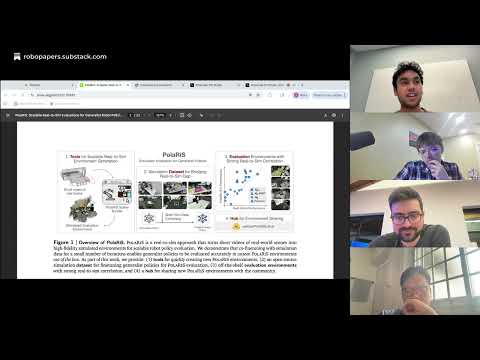
The robotics community is moving beyond task-specific benchmarks towards generalist policy evaluation, mirroring the LLM trend of testing off-the-shelf models on unseen tasks. This demands scalable, high-fidelity simulation tools that can quickly generate diverse test environments.
Builders and researchers should prioritize evaluation tools that offer strong real-to-sim correlation, even if it means a hybrid approach (like PolaRiS) over purely data-driven world models. Utilize real-to-sim environment generation (Gaussian splatting) and strategic sim data co-training to accelerate policy iteration.
PolaRiS offers a path to community-driven, crowdsourced robot benchmarks, making policy development faster and more robust. Expect a future where robot policies are evaluated across a broad suite of easily created, diverse simulated environments, pushing the boundaries of generalization and real-world applicability.
Generalist robot policies need robust, scalable evaluation. The shift is from bespoke, real-world-only testing to a hybrid real-to-sim approach that leverages modern 3D reconstruction and minimal sim data to create highly correlated, reproducible benchmarks.
Builders should adopt PolaRiS's real-to-sim environment generation and "sim co-training" methodology. This allows for rapid, cost-effective iteration on robot policies, ensuring that improvements in simulation translate directly to real-world gains.
Over the next 6-12 months, the ability to quickly and reliably evaluate robot policies in simulation will be a critical differentiator. PolaRiS provides the tools to build diverse, generalization-focused benchmarks, moving robotics closer to the rapid iteration cycles of other AI fields.
Tesla's core identity shifted from EV maker to autonomous AI and robotics. Its cars are devices for deploying its advanced AI brain; competitors miss this.
Tesla's 8 million cars collect real-world driving data. This massive dataset, combined with in-house AI processing, creates an unparalleled moat impossible for competitors to replicate.
This convergence creates an abundance of labor and transportation, driving down costs. Robo-taxis and humanoid robots automate tasks, making goods and services cheaper, even as Tesla's profitability soars.
Robotics is moving towards generalist policies that need broad, diverse evaluation. PolaRiS enables this by making it easy to create and share new, correlated benchmarks, cultivating a community-driven evaluation ecosystem similar to LLMs.
Adopt PolaRiS for rapid policy iteration on pick-and-place and articulated object tasks. Use its browser-based scene builder and existing assets to quickly create new evaluation environments, then fine-tune policies with a small amount of unrelated sim data to boost real-to-sim correlation.
Investing in tools like PolaRiS now means faster development cycles and more reliable policy improvements. This accelerates the path to robust, real-world robot deployment by providing a scalable, trustworthy intermediate testing ground.
PolaRiS enables a shift towards LLM-style generalization benchmarks, where models are tested on unseen environments and tasks, accelerating robot capabilities.
Use its browser-based scene builder and Gaussian splatting to quickly create diverse, real-world correlated evaluation environments, significantly reducing the cost and time of real robot testing.
Cheap, reliable robot policy evaluation in simulation, with strong real-world correlation, means faster development cycles, more robust generalist robots, and a path to crowdsourced, diverse benchmarks that will push the entire field forward.
AI is forcing a fundamental architectural change in automotive, moving from fragmented, rules-based systems to vertically integrated, neural network-powered platforms. This technical reality dictates market survival, favoring companies that control their entire software and hardware stack to build a continuous data flywheel.
Invest in or partner with companies demonstrating deep vertical integration in AI hardware and software for mobility. Prioritize those with a clear path to mass-market data collection and rapid iteration cycles.
Autonomy will be a must-have feature in cars within the next few years. Companies without a software-defined architecture and a vertically integrated AI stack will struggle to compete, creating a market share shift towards those few players who can deliver true self-driving at scale.
The automotive industry is undergoing a fundamental re-architecture, moving from hardware-centric, rules-based systems to software-defined, AI-powered platforms. This shift favors companies with deep vertical integration and proprietary data flywheels.
Invest in companies demonstrating full-stack control over their vehicle's software, hardware, and AI training data. This verticality is the moat against commoditization and the engine for rapid, continuous improvement.
Autonomy will be a non-negotiable feature by 2030, making software-defined vehicles the only viable path for mass-market automakers. Companies that fail to build or acquire this capability will face market irrelevance.
Tesla's core business is AI and autonomous robotics. This means its value comes from its software and data moat, not just vehicle sales.
Tesla is sunsetting Model S and X production to convert factories for humanoid robots. This signals a full commitment to autonomous devices beyond cars.
Unsupervised FSD is expected in select US states by Q2. This will enable cars to operate without human oversight, unlocking the robo-taxi network.
The Call Option's Double Edge: The standard call-option deal is an elegant solution to crypto's volatility, but it becomes toxic when the loan is too large. An oversized option creates a "magnet effect" where the price gets pinned to the strike, killing healthy price discovery.
"Active Market Making" Is a Trap: Selling the future to pump the present is a fool's game. This structure leverages a project’s future token supply for a short-term price pump that almost always ends in a perp-driven death spiral, destroying credibility.
Launch Price Is Vanity, Momentum Is Sanity: The initial TGE price is an illusion driven by retail FOMO. Projects should focus on establishing a fair pre-launch price and using stabilization mechanisms to build sustained momentum, rather than chasing a fleeting, sky-high valuation on day one.
Stablecoin Infrastructure is the New Gold Rush: The Genius Act fired the starting gun. The most significant opportunities lie not in issuing stablecoins, but in building the ecosystem around them—from payment rails to wallet design and tokenized money market funds.
Narrative is the Ultimate Catalyst: ETH’s rally wasn’t driven by a tech breakthrough but by a potent cocktail of treasury-driven demand and a leadership refresh. In crypto, momentum creates its own demand.
The Great Convergence is Accelerating: With Coinbase in the S&P 500 and a wave of crypto IPOs, traditional capital can no longer sit on the sidelines. The primary battleground is now for public market mindshare.
We are in a high-risk, high-reward phase where liquidity is the primary driver. The cycle's ultimate peak remains uncertain and heavily dependent on macro-economic policy.
Brace for the Parabola. This is the late-stage bull market, where the most significant gains historically occur in short, violent bursts. Being out of the market means risking missing the entire cycle's payoff.
Rotation Is in Motion. Capital has started flowing from Bitcoin to Ethereum. The next domino to watch for is a pop in large-cap alts, which would confirm a full-blown alt season is underway.
**Stablecoins are now institutional grade.** The Genius Act provides a clear regulatory framework, unlocking enterprise adoption and integration into traditional payment rails. Expect a wave of innovation in stablecoin infrastructure.
**The future of DeFi is the next battleground.** While the Clarity Act offers key protections for developers, traditional finance incumbents are actively lobbying to limit DeFi's scope. The fight will be fierce in the Senate.
**Capital formation is being supercharged.** The Clarity Act’s new token sale exemption will legitimize and streamline ICO-style fundraising, providing a powerful new tool for founders to raise capital with crypto-native efficiency.
Proof-of-Human is Becoming Non-Negotiable. The internet is on a trajectory where >99% of activity will be AI-driven, making sybil-resistant "proof of human" a fundamental infrastructure layer, not a niche feature.
Hardware is the Moat. Worldcoin bets that a specialized, secure hardware device (the Orb) is the only method resilient enough against sophisticated AI to scale a global human network, a concept crypto pioneer Hal Finney foresaw.
A New GTM: Web3 Incentives, Web2 Integrations. Worldcoin’s strategy blends token airdrops to bootstrap its network (14M+ verified users) with integrations into mainstream apps (social, dating, gaming) to drive long-term, real-world utility.
**Fiscal, Not Fed:** This melt-up is fueled by government spending, not central bank easing. Expect momentum to push assets higher before a sharp, painful correction. Have your exit plan ready.
**Trade the Politics:** The cleanest narrative trade isn’t just Bitcoin; it’s politically reflexive “hated” coins (like XRP) that benefit from deregulation and have built-in, retail-heavy communities.
**Beware the Treasury Trap:** Publicly traded crypto treasury companies are an attention game designed to prey on retail liquidity. While you can dance while the music plays, know that the exit door is small.