The Macro Shift: Celebrity capital is moving from transactional endorsements to strategic equity investments, driven by a desire for long-term wealth creation and the recognition that personal brand power can significantly accelerate startup growth.
The Tactical Edge: Cultivate a diverse network of mentors and partners, prioritizing those who bring complementary expertise and can challenge your assumptions.
The Bottom Line: The future of wealth creation for high-profile individuals and savvy investors lies in strategic, long-term equity plays, supported by strong teams and a willingness to partner.
AI agents with system-level access are shifting the core value proposition of software from discrete applications to fluid, context-aware personal assistants.
Cultivate "agent empathy" by learning to guide AI models effectively, understanding their limitations, and designing projects for agent-first navigation.
The rise of autonomous agents will redefine software's purpose and value.
Adopt PolaRiS for rapid policy iteration. Leverage its real-to-sim environment generation and minimal sim data co-training to quickly validate robot policies in diverse, unseen environments before committing to expensive real-world deployments.
The era of generalist robot policies demands a new paradigm for evaluation. The shift is from bespoke, real-world testing to scalable, high-fidelity sim-to-real correlation, enabling faster iteration and broader generalization testing.
Reliable sim-to-real evaluation is the missing link for accelerating robot AI. PolaRiS offers a pragmatic, community-driven path to unlock faster development cycles and more robust generalist robot policies over the next 6-12 months.
Generalist robot policies demand evaluation that tests true generalization across diverse, unseen environments. The shift is from hand-tuned, task-specific benchmarks to scalable, community-driven evaluation suites that can keep pace with rapidly improving model capabilities. This requires tools that make environment creation cheap and ensure real-world predictive power.
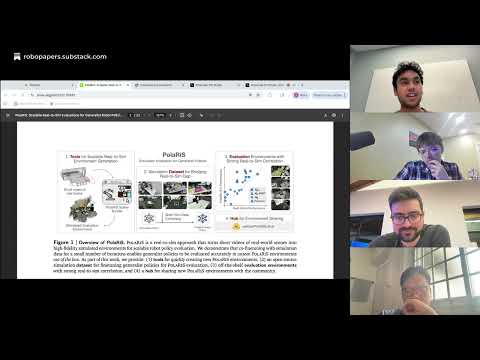
Adopt PolaRiS for rapid, correlated policy iteration. Builders should leverage its real-to-sim environment generation (Gaussian splatting for scenes, generative models for objects) and the "sim co-training" trick to quickly validate policy improvements against real-world performance, especially for pick-and-place tasks. Contribute new environments to the Polaris Hub to expand the collective benchmark.
The future of robotics hinges on fast, reliable evaluation. PolaRiS offers a pragmatic, immediate solution to accelerate policy development by providing high-fidelity, correlated sim environments. Over the next 6-12 months, expect this hybrid approach to become a standard for iterating on generalist robot policies, while fully learned world models continue to improve for more complex, deformable tasks.
The push for generalist robot policies demands scalable, trustworthy evaluation. PolaRiS democratizes high-fidelity sim evaluation, moving robotics closer to rapid iteration cycles seen in other AI fields.
Builders should explore PolaRiS's open-source tools and pre-trained checkpoints to quickly test policies in diverse, real-world-correlated environments. Prioritize visual fidelity and use small, unrelated sim data for alignment.
Rapid, reliable sim evaluation with strong real-world correlation is a significant advancement. This tool enables faster policy iteration, broader generalization, and community-driven benchmarking, setting the stage for the next generation of robot capabilities.
Generalist robot policies demand community-driven, scalable evaluation, mirroring LLM benchmarking. PolaRiS provides the technical foundation by making high-fidelity, correlated sim environments accessible.
Adopt PolaRiS for rapid policy iteration. Use its browser-based scene builder and Gaussian splatting for quick environment creation, incorporating minimal, unrelated sim co-training data for strong real-world correlation.
PolaRiS accelerates robot development with a reliable, scalable simulation tool. This means faster iteration, more robust policies, and a clearer path to real-world deployment for your robot applications over the next 6-12 months.
The era of generalist robot policies demands evaluation tools that can keep pace with rapid development and broad generalization. PolaRiS pushes robotics toward the LLM benchmark paradigm, where models are tested on unseen environments and tasks, rather than being trained on specific benchmarks.
For builders, leverage PolaRiS's browser-based scene builder and Gaussian splatting pipeline to quickly create diverse, high-fidelity evaluation environments from real-world scans. This enables faster policy iteration and more reliable real-world deployment.
PolaRiS offers a pragmatic, scalable path to more effective robot policy development. By providing a tool that makes sim performance a reliable predictor of real-world success, it accelerates the journey from lab to real-world application, especially for pick-and-place tasks, and sets the stage for community-driven benchmarking.
Celebrity capital is evolving from passive endorsements to active, strategic equity investment, transforming athletes and entertainers into powerful venture partners who bring more than just money to the table.
Prioritize building a diverse, expert team that can challenge your assumptions and vet opportunities, especially when entering new sectors like AI or overlooked geographic markets.
Long-term thinking, a willingness to invest in growth, and a focus on strategic partnerships are non-negotiable for building lasting wealth and influence in both traditional and emerging industries over the next 6-12 months.
Structure Over Speed: In the DAT gold rush, avoid the shells. Reverse takeovers are fraught with hidden liabilities; cleaner de-novo SPACs are built for long-term institutional trust and better financing.
Stick to the Winners: The DAT market will consolidate. Bet on pure-play vehicles for top-tier, liquid assets like ETH, as "Frankenstein" and illiquid-token DATs are destined for M&A or failure.
Distribution is Destiny: In the payments war, Stripe’s direct ownership of millions of merchants gives it a crushing advantage over Circle’s middleware approach. Owning the customer is the only moat that matters.
Incoming Institutional Tsunami: An estimated $1.5 billion in institutional capital is poised to enter the ecosystem in the next six months, which could single-handedly 5x the price due to limited exchange liquidity.
The Subnet Demand Spiral: The core mechanics of registering and participating in subnets create a flywheel effect where ecosystem growth directly translates into increased demand and reduced circulating supply for $TAO.
The Halving Supply Shock: A December halving will slash new $TAO emissions by 50%, tightening supply just as multiple demand vectors are peaking, creating a potentially explosive supply-demand imbalance.
**Right vs. Rich:** Stop trying to be right; focus on being profitable. Buy things you think are stupid if you believe the market will value them. The best trades often feel viscerally wrong.
**Master the Modes:** The market operates in two modes. In "Easy Mode," go hard on early trends with concentrated size. In "Hard Mode," your only job is capital preservation. Hit the sell button and wait.
**De-Risk Like a Pro:** When you feel like a genius and start looking at houses, it's time to cash out. Aggressively take 80%+ off the table to lock in your life-changing gains and protect your mental health. Opportunity is constant; your capital is not.
Mission Over Markets: Phantom will only consider an IPO if it directly serves its primary mission of bringing crypto mainstream. The decision is strategic, not reactive to market trends or a desire for validation.
Discipline by Default: The company operates with the financial and operational rigor of a public entity, modeling itself after Coinbase, without taking on the regulatory burdens of an actual IPO.
Complexity is a Cost: Avoiding the operational complexity of a public listing is a competitive advantage, enabling the team to allocate 100% of its resources toward building the business.
Bet on the ETH Ecosystem. The bounce off cycle lows signals the start of an ETH-centric alt season. Look for opportunities within its ecosystem, as rising ETH prices create positive feedback loops for its native DeFi protocols.
Aerodrome is a Top Pick on Base. AERO presents a compelling investment case due to its superior tokenomics, strong product-market fit on Base, lack of VC overhang, and recent technical breakout. It is positioned to capture massive value as Base grows.
On-Chain Adoption Will Come Through CEXs. The most significant long-term catalyst is the seamless integration of on-chain ecosystems into centralized exchanges. This makes Base-native projects the primary beneficiaries of the next wave of retail adoption, driven by Coinbase.
The conversation has shifted from "Can we build this?" to "How do we grow this?" Founders are now focused on shipping products, forging partnerships, and hiring talent, signaling a decisive move from infrastructure to business execution.
Regulation is focusing on code, not conduct. The move to a "control-based" decentralization framework means what matters is how technically neutral your system is, not who is in your Slack channel.
With scaling solved, UX is the new bottleneck. The industry has moved past the gas wars; the next great challenge is creating intuitive user experiences through better wallet design and key management.