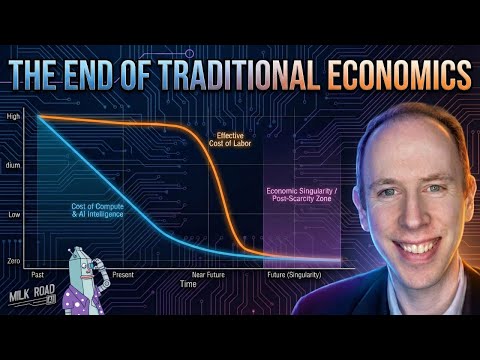
The Macro Shift: AI-driven hyperdeflation is colliding with the technical reality of autonomous AI agents creating their own crypto-backed economies, threatening a decoupling from human fiat systems.
The Tactical Edge: Investigate and build infrastructure that bridges human and AI economies, focusing on fiat-to-crypto rails that can accommodate agent-driven transactions to prevent a complete split.
The Bottom Line: The next 5-10 years will see an unprecedented economic transformation. Understanding AI's deflationary power and the emerging AI agent economy is critical for navigating a world where traditional economic models may no longer apply.
The time of practical AI agents is here, moving compute demand beyond pure GPU inference to a significant reliance on CPUs for coordination, data handling, and security.
Evaluate your agent deployment strategy now, prioritizing sandboxed environments (VPS, dedicated local servers) and exploring cost-optimized model routing to manage API expenses.
Prepare for a future where AI agents become integral to workflows, but recognize the hidden infrastructure costs and security implications, particularly the growing importance of CPU capacity and robust access controls.
The shift from "how" to "why" in AI agent capabilities creates a new, multi-trillion-dollar market for companies that can capture institutional decision logic.
Invest in or build agentic systems that are in the "right path" of business processes, actively capturing decision traces from unstructured data.
Hundreds of context graphs will be in production at scale within a year, defining a new "context graph stack." The winning companies will be those that master this flywheel, extracting value to accelerate automation and build deep, defensible moats.
The shift from linear, bottleneck-driven technological progress to a multi-layered, interconnected advancement model in AI has rendered traditional forecasting obsolete, forcing a re-evaluation of what "singularity" truly represents.
Prioritize adaptability: Invest in modular, composable AI infrastructure and tools that thrive in multi-layered, unpredictable environments, rather than betting on single-bottleneck solutions.
The inability to narrate AI's future means traditional roadmaps are obsolete; success hinges on navigating simultaneous, interconnected advancements and embracing the emergent.
The era of infrastructure-heavy tech deployment is over; AI's internet-native nature means immediate, widespread application. This shifts the competitive advantage from capital-intensive builds to rapid iteration and data leverage.
Invest in companies that are not just using AI, but are fundamentally rethinking their business models around AI's ability to collapse traditional cost structures and accelerate product development.
AI is a force multiplier for both individual opportunity and national power. Understanding its immediate deployability and the new rules of company building is crucial for investors and builders aiming to lead in the next wave of innovation over the next 12-24 months.
Unprecedented fiscal and monetary stimulus, coupled with a deregulatory environment, creates a powerful tailwind for financial assets and tech, driving a capital investment super cycle.
Investors should prioritize companies with proprietary data and GPU access, as these are the new moats in an AI-driven world where traditional software leads are eroding.
The convergence of a stimulative macro environment and AI's disruptive force means capital will flow to those who can scale, innovate, and navigate complex policy landscapes, making strategic positioning now critical for future relevance.
The macro trend of autonomous AI agents is shifting compute demand beyond GPUs, creating an unexpected CPU crunch and forcing a re-evaluation of on-premise inference and cost-optimized model routing for security and efficiency.
Investigate hybrid compute strategies, combining secure local environments (Mac Minis, home servers) with cloud-based LLMs, and explore multi-model API gateways like OpenRouter to optimize agent costs and performance.
AI agents are here, demanding a rethink of your compute stack and security protocols. Prepare for a future where CPU capacity, not just GPU, becomes a critical bottleneck, and strategic cost management for diverse AI models is non-negotiable for competitive advantage.
The move from general-purpose LLMs to specialized AI agents demands a new data architecture that captures the *why* of decisions, not just the *what*. This creates a new, defensible layer of institutional memory, moving value from raw model IP to proprietary decision intelligence.
Invest in or build agentic systems that are in the *orchestration path* of specific business processes. This allows for the organic capture of decision traces, forming a proprietary context graph that incumbents cannot easily replicate.
Over the next 12 months, the ability to build and extract value from context graphs will define the winners in the enterprise AI space, creating a new "context graph stack" that will be 10x more valuable than the modern data stack.
The Old Playbooks Are Obsolete. This isn't your 2021 bull run. The four-year cycle is broken, institutional flows have altered market dynamics, and historical patterns are no longer reliable predictors of future performance.
Ethereum Is Entering Hyper-Scale. A relentless upgrade cadence is simultaneously scaling both L1 (via gas limit increases) and L2s (via blob scaling), even before the ZK revolution delivers another 100x+ throughput boost to the mainnet.
Adaptability Is the Ultimate Security. Existential threats like quantum computing are moving from science fiction to near-term reality. Ethereum's culture of continuous improvement is its greatest defense, while chains resistant to change face a brewing crisis.
**ETH is Overvalued and Avoidable.** Its fundamentals do not justify its sky-high valuation. View it as a flawed asset, not a mandatory portfolio holding for crypto investors.
**Farm, Don't Trade.** The most reliable retail edge isn't trading, but airdrop farming. It allows you to acquire assets from overvalued launches without providing exit liquidity.
**Cash is a Position.** In a market defined by negative reflexivity and dwindling liquidity, the winning strategy is capital preservation. Avoid the casino, raise cash, and wait for the market to present clear, undervalued opportunities.
Stop Obsessing Over the Halving. The four-year cycle is a narrative, not a driver. The real signal is the macro business cycle, driven by debt refinancing and central bank liquidity. Track the ISM index: historically, buying below 50 and selling above 57 has been a winning strategy.
Invest in Networks, Not Spreadsheets. Value crypto protocols based on network effects (active users and transaction value), not discounted cash flows. The long-term bet is on the growth of the network itself, as this is where wealth has compounded most dramatically.
Survive to Compound. Structure your portfolio to withstand volatility. Have external cash flow so you’re never a forced seller, and take "lifestyle chips" off the table during rallies to manage psychological stress. Drawdowns are a feature, not a bug—use them to add to your long-term positions.
**The Trend is Up, The Cycle is Peaking.** Relentless government spending ensures long-term monetary inflation, making assets like Bitcoin and gold essential core holdings. However, the 65-month cycle is nearing its peak, signaling a time to reduce risk and prepare for turbulence.
**Own Both Sides of the Capital War.** The future is a bipolar monetary world. An optimal portfolio holds both Bitcoin (representing the US digital collateral system) and gold (representing China’s hard money strategy) to hedge against persistent inflation from both sides.
**Watch the Repo Market for the Spark.** The immediate flashing red light is in the repo markets, where interest rate spreads are blowing out. An unwind of leveraged positions here could be the catalyst that ends the current cycle, creating a prime buying opportunity for patient, long-term investors.
Fundamentals Are Coming Home to Roost. Valuations for Layer 1s are untethered from reality. Scrutinize value-capture mechanisms and stop treating staking rewards as revenue.
Follow the Smart Money's Feet, Not Their Mouths. While headlines scream adoption, crypto VCs are quietly pivoting to AI and fintech. This "disbelief" phase in venture often precedes a broader market bottom.
Macro Is the Main Character. Crypto is still on the far end of the risk curve. The sell-off is a macro-driven flight to safety, not a crypto-specific crisis. Until liquidity returns, expect continued correlation with traditional markets.
The Four-Year Cycle is Dead. The market is no longer driven by simple cyclical hype. Macro headwinds and competition for attention from AI mean investors must focus on projects with demonstrable utility, not just memetic potential.
Ethereum Gets Pragmatic. The Ethereum ecosystem is ditching idealism for execution, re-focusing on scaling its core infrastructure (L1) and building products with clear, real-world use cases for both consumers and institutions.
Institutions are Buying the Dip. Don't mistake retail fear for institutional exit. From Harvard's massive ETF allocation to Kraken's IPO plans, smart money is using the downturn to secure its position in the industry's foundational layers.