The Macro Shift: The Great Re-Shoring. National security now depends on domestic production of critical minerals and semiconductors.
The Tactical Edge: Build for Scale. Prioritize manufacturing competence over pure software features to win government contracts.
The Bottom Line: The defense industrial base is being rebuilt from the ground up. The next decade belongs to the builders who can merge Silicon Valley speed with the Pentagon's scale.
The Macro Trend: Biological Sovereignty. As global systems destabilize, the Amazon remains the most critical piece of biological infrastructure on the planet.
The Tactical Edge: Support Jungle Keepers. Direct capital to organizations that convert loggers into rangers to secure land concessions.
The Amazon is a finite asset under active siege. Protecting it requires a blend of primitive survival skills and high-tech surveillance over the next 18 months.
The Macro Pivot: As generative AI masters simulation, the physical world becomes a high-fidelity playground for software.
The Tactical Edge: Invest in the "brain" layer rather than the "limb" layer. Software that can generalize across different hardware forms will capture the most value.
The next decade belongs to embodied AI that reasons in real time. If you are waiting for the hardware to look perfect before paying attention, you will miss the moment the software takes over the physical world.
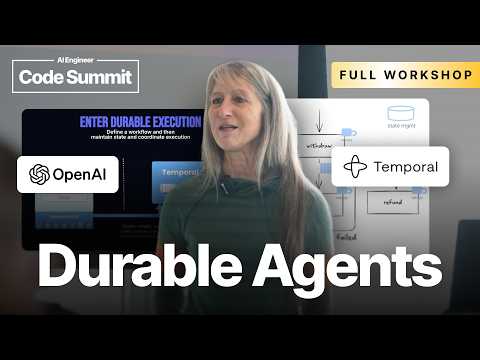
The industry is moving from "Agent as a Script" to "Agent as a Durable Service" where state management is handled by the infrastructure.
Wrap your existing API tools in the `activity_as_tool` function to gain automatic retries and execution history.
Reliability is the only moat in the agentic economy. If your agent cannot survive a server restart during a three-day task, it is not ready for the enterprise.
The Macro Trend: The move from fragmented content libraries to integrated health systems where AI synthesizes biomarkers and movement.
The Tactical Edge: Construct internal LLM tools to categorize qualitative feedback. This turns thousands of raw reviews into a precise roadmap.
The Bottom Line: Building a $100M ARR consumer app requires mastery of both growth loops and product retention. Solve for the daily habit to win the long game.
The transition from general-purpose AI to specialized application layers. As foundation models commoditize, value migrates to the "fat tail" of human-centric complexity.
Prioritize building or investing in "DNA of the future" companies that incumbents must eventually acquire to survive. Focus on winning the "point of attack" by staying deep in the technical details.
We are in a unique market where demand growth justifies high valuations. Success over the next year depends on identifying founders who are the absolute best in the world at one specific thing.
The Macro Shift: AI's exponential growth creates unprecedented demand for high-throughput, low-cost blockchain infrastructure. TradFi's direct investment in specific altcoins signals crypto's maturation as a utility layer.
The Tactical Edge: Invest in protocols and tokens offering genuine utility for AI agent payments and high-volume transaction processing, or attracting long-term institutional capital.
The Bottom Line: Institutional crypto adoption and accelerating AI will reshape token value and blockchain necessity. Position your portfolio and building efforts towards infrastructure handling AI-scale demand and assets with clear utility.
The market is moving towards tokenized financial products that abstract complexity and offer diversified exposure, bypassing traditional financial friction for a broader, international user base.
Builders should focus on creating transparent, single-token yield products with diversified, underwritten strategies that offer enterprise-grade access to global users, rather than relying on unsustainable incentive models or monolithic yield sources.
Over the next 6-12 months, capital will consolidate around projects that prioritize transparency, diversification, and real-world utility, particularly those serving underserved global markets.
The global demand for accessible, risk-adjusted USD yield is colliding with crypto's need for sustainable economic models. This pushes the industry towards tokenized, diversified financial products that abstract complexity and offer enterprise-grade solutions to a worldwide audience.
Prioritize protocols building liquid yield tokens with transparent, diversified backing strategies and a single-token model. For builders, focus on abstracting away chain and contract complexity to deliver smooth user experiences that rival TradFi.
The next 6-12 months will see a flight to quality in crypto. Projects offering genuine utility, robust risk management, a clear path to sustainable yield will capture market share, especially those serving global users who lack traditional financial access.
The crypto industry is actively re-evaluating the balance between decentralized governance and centralized execution, recognizing that efficient value capture often requires streamlined decision-making and clear economic alignment between core contributors and token holders.
Investors should scrutinize protocols for clear revenue-sharing models that benefit token holders and identify platforms that effectively monetize "uninformed" retail flow, as these often hide significant, sustainable profit margins for market makers and the platforms themselves.
The next 6-12 months will test which protocols can successfully transition from pure technical innovation to sustainable economic models. Watch for Aave's fintech execution, Polymarket's continued retail monetization, and LayerZero's ability to establish its chain as a primary asset issuance layer.
The Macro Shift: DeFi's maturation is driving a consolidation of value capture, moving from diffuse governance tokens to integrated, revenue-generating token models that mirror traditional finance.
The Tactical Edge: Evaluate DeFi protocols based on their explicit revenue-sharing mechanisms and product-to-protocol alignment, prioritizing those with clear, token-centric economic models.
The Bottom Line: Aave's strategic shift creates a powerful flywheel where product innovation directly boosts AAVE token value, positioning it as a leading, investable DeFi asset for the next market cycle.
"The tokenization of RWAs is expected to be the primary driver of onchain asset growth over the next 10 years."
"The core underlying driver of I need stable coins and I now need yield on those stable coins is unstoppable in my opinion and is all weather doesn't matter the macro conditions."
"What's happening is you just you you're you're messing up one of the components and you hear all of the components end to end need to line up right the stars need to align so to speak and then you start to really unlock an economic engine that is just at a completely different level."