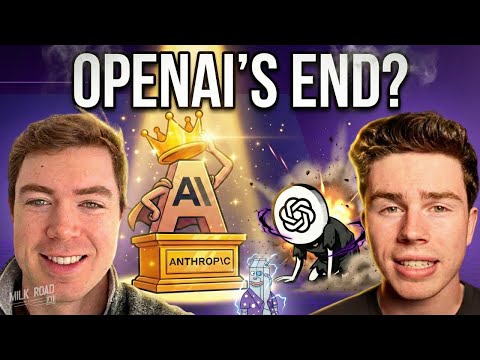
Trillion-dollar AI compute investments create market divergence: immediate monetization (Meta) is rewarded, while slower conversion (Microsoft) faces skepticism, as geopolitical tensions rise over open-source model parity.
Prioritize AI models balancing raw intelligence with superior user experience and collaborative features, as developer loyalty and enterprise adoption increasingly hinge on usability.
The AI landscape is rapidly reordering. Investors and builders must assess monetization pathways, geopolitical implications, and AI's social contract over the next 6-12 months.
The Macro Trend: The transition from opaque scaling to verifiable reasoning.
The Tactical Edge: Audit your models for brittleness by testing them on edge cases that require first principles logic rather than historical data.
The Bottom Line: The next winners in AI will not have the biggest models but the most verifiable ones. If you cannot prove how a model reached a conclusion, you cannot trust it in production.
The transition from more data to better thinking via inference-time compute. Reasoning is becoming a post-training capability rather than a pre-training byproduct.
Use AI for anti-gravity coding to automate bug fixes and data visualization. Treat the model as a passive aura that buffs the productivity of every senior engineer.
AGI will not be a collection of narrow tools but a single model that reasons its way through any domain. The gap between closed labs and open source is widening as these reasoning tricks compound.
The transition from static LLMs to interactive world models marks the move from AI as a tool to AI as a persistent environment.
Monitor the Hugging Face release of the 2B model to build custom image-to-experience wrappers for niche training or spatial entertainment.
Local world models will become the primary interface for spatial computing within the next year, making high-end local compute more valuable than cloud-based streaming.
The Strategic Pivot: The transition from "Understanding-First" science to "Prediction-First" engineering. We are building artifacts that work perfectly but remain theoretically opaque.
The Tactical Edge: Audit your AI stack for "Leaky Abstractions." Don't assume a model's reasoning capabilities in one domain will hold when the underlying causal structure changes.
AGI isn't just an engineering milestone; it's a philosophical wager. If the brain isn't a computer, we are building a very powerful helicopter, not a synthetic human.
The pivot from "Understanding-First" science to "Prediction-First" engineering creates massive technical liability in our models.
Audit your AI implementations for "Leaky Abstractions" where the model fails to account for physical edge cases.
High-performance automation is not the same as sentient reasoning. Builders who recognize this distinction will avoid the cultural illusion of inevitable AGI.
The transition from deterministic software to agentic networks. Companies are moving from rigid workflows to fluid systems that plan and execute autonomously.
Build an internal LLM gateway early. Centralizing model routing and cost monitoring allows you to swap providers as the model horse race changes without refactoring your product.
AI is not just a feature but a fundamental restructuring of the corporate cost center. Efficiency gains allow a static headcount of 300 engineers to support a business growing 5x.
Policy Stalled: The prospects for comprehensive crypto market structure law are deteriorating, with political finger-pointing hindering progress. This means continued uncertainty for builders and investors, forcing operations into a legal gray area with unpredictable outcomes.
Custody Failures: The US government's handling of seized crypto assets, like the alleged $40 million theft from a Bitfinex hack wallet by a contractor's son, reveals alarming security gaps. This highlights that even state actors struggle with basic digital asset security, raising questions about their ability to regulate the space effectively.
Misplaced Focus: Trump's $5 billion lawsuit against JP Morgan for account closures is not true debanking, which impacts ordinary individuals and crypto businesses. This lawsuit distracts from the systemic issue of banks cutting off access to financial services for legitimate businesses without transparency or recourse.
The Macro Shift: AI's recursive self-improvement is compressing innovation cycles and dissolving engineering moats, creating an urgent demand for crypto infrastructure that can adapt to unforeseen technological advancements.
The Tactical Edge: Prioritize protocols and platforms that demonstrate a proactive approach to long-term technical risks, such as quantum computing, over those with rigid, unadaptable architectures.
The Bottom Line: The convergence of AI and crypto will redefine security and value. Ethereum's strategic investment in quantum resistance positions it to capture a significant narrative and technical advantage, while Bitcoin's inertia could become a critical liability over the next 6-12 months.
Monitor institutional capital flows into BitTensor subnets, particularly the DNA Fund's $300M DAT. Significant subnet acquisitions will likely precede sharp upward movements in TAO's price, offering a leading indicator for investors.
BitTensor is architecting a decentralized AI economy where market incentives and Darwinian selection drive innovation, effectively crowdsourcing the world's best AI talent to solve complex problems.
BitTensor is in its "sausage factory" phase, building the infrastructure for a $10,000+ TAO valuation. The current market irrationality and interface challenges are temporary.
The AI compute market is moving from opaque, centralized providers to verifiable, decentralized networks. Nodeexo's model forces real pricing and competition by embedding cryptographic trust directly into the infrastructure layer.
Evaluate Bittensor subnets not just for speculative yield, but for their ability to convert subnet tokens into real-world utility and verified infrastructure. Prioritize those building tangible, trust-minimized services.
Nodeexo's approach to verifiable GPU compute establishes a new standard for trust in decentralized AI infrastructure. This creates a compelling investment thesis for those identifying real utility and transparent value in the Bittensor ecosystem over the next 6-12 months.
The Macro Shift: Geopolitical tensions and economic uncertainty are driving a global re-allocation of capital, with Eastern wealth increasingly favoring hard assets and localized crypto rails. This challenges Western-centric market analysis and demands a broader, more nuanced view of global finance.
The Tactical Edge: Cultivate deep domain expertise and critical thinking, using AI as an amplification tool, not a replacement for learning. Focus on areas where human judgment, taste, and the ability to translate AI insights into real-world value remain irreplaceable.
The Bottom Line: The next 6-12 months will see continued divergence in global capital flows and accelerating AI integration. Investors must track opaque Eastern market signals, while builders should prioritize AI applications that augment human capability rather than simply automate, ensuring their skills remain relevant in an increasingly AI-driven world.
The Macro Shift: Monetary Escapism: As fiat debases and geopolitical tensions rise, capital is rotating from traditional tech to hard-capped assets and AI infrastructure.
The Tactical Edge: Reallocate Capital: Prioritize real assets and cyclical commodities (gold, silver, oil, copper) while selectively shorting overvalued software companies facing AI disruption and increasing capital expenditures.
The Bottom Line: The market is re-pricing value based on true scarcity and capital intensity. Position for a volatile environment where traditional narratives fail, and tangible assets or essential AI infrastructure dictate returns.