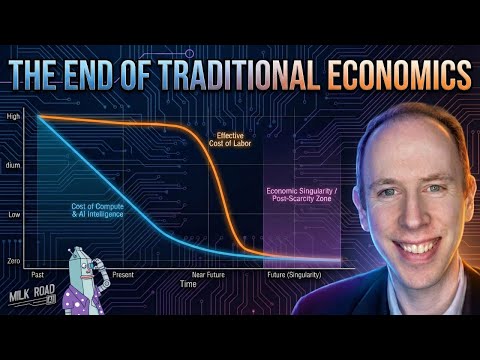
The Macro Shift: AI-driven hyperdeflation is colliding with the technical reality of autonomous AI agents creating their own crypto-backed economies, threatening a decoupling from human fiat systems.
The Tactical Edge: Investigate and build infrastructure that bridges human and AI economies, focusing on fiat-to-crypto rails that can accommodate agent-driven transactions to prevent a complete split.
The Bottom Line: The next 5-10 years will see an unprecedented economic transformation. Understanding AI's deflationary power and the emerging AI agent economy is critical for navigating a world where traditional economic models may no longer apply.
The time of practical AI agents is here, moving compute demand beyond pure GPU inference to a significant reliance on CPUs for coordination, data handling, and security.
Evaluate your agent deployment strategy now, prioritizing sandboxed environments (VPS, dedicated local servers) and exploring cost-optimized model routing to manage API expenses.
Prepare for a future where AI agents become integral to workflows, but recognize the hidden infrastructure costs and security implications, particularly the growing importance of CPU capacity and robust access controls.
The shift from "how" to "why" in AI agent capabilities creates a new, multi-trillion-dollar market for companies that can capture institutional decision logic.
Invest in or build agentic systems that are in the "right path" of business processes, actively capturing decision traces from unstructured data.
Hundreds of context graphs will be in production at scale within a year, defining a new "context graph stack." The winning companies will be those that master this flywheel, extracting value to accelerate automation and build deep, defensible moats.
The shift from linear, bottleneck-driven technological progress to a multi-layered, interconnected advancement model in AI has rendered traditional forecasting obsolete, forcing a re-evaluation of what "singularity" truly represents.
Prioritize adaptability: Invest in modular, composable AI infrastructure and tools that thrive in multi-layered, unpredictable environments, rather than betting on single-bottleneck solutions.
The inability to narrate AI's future means traditional roadmaps are obsolete; success hinges on navigating simultaneous, interconnected advancements and embracing the emergent.
The era of infrastructure-heavy tech deployment is over; AI's internet-native nature means immediate, widespread application. This shifts the competitive advantage from capital-intensive builds to rapid iteration and data leverage.
Invest in companies that are not just using AI, but are fundamentally rethinking their business models around AI's ability to collapse traditional cost structures and accelerate product development.
AI is a force multiplier for both individual opportunity and national power. Understanding its immediate deployability and the new rules of company building is crucial for investors and builders aiming to lead in the next wave of innovation over the next 12-24 months.
Unprecedented fiscal and monetary stimulus, coupled with a deregulatory environment, creates a powerful tailwind for financial assets and tech, driving a capital investment super cycle.
Investors should prioritize companies with proprietary data and GPU access, as these are the new moats in an AI-driven world where traditional software leads are eroding.
The convergence of a stimulative macro environment and AI's disruptive force means capital will flow to those who can scale, innovate, and navigate complex policy landscapes, making strategic positioning now critical for future relevance.
The macro trend of autonomous AI agents is shifting compute demand beyond GPUs, creating an unexpected CPU crunch and forcing a re-evaluation of on-premise inference and cost-optimized model routing for security and efficiency.
Investigate hybrid compute strategies, combining secure local environments (Mac Minis, home servers) with cloud-based LLMs, and explore multi-model API gateways like OpenRouter to optimize agent costs and performance.
AI agents are here, demanding a rethink of your compute stack and security protocols. Prepare for a future where CPU capacity, not just GPU, becomes a critical bottleneck, and strategic cost management for diverse AI models is non-negotiable for competitive advantage.
The move from general-purpose LLMs to specialized AI agents demands a new data architecture that captures the *why* of decisions, not just the *what*. This creates a new, defensible layer of institutional memory, moving value from raw model IP to proprietary decision intelligence.
Invest in or build agentic systems that are in the *orchestration path* of specific business processes. This allows for the organic capture of decision traces, forming a proprietary context graph that incumbents cannot easily replicate.
Over the next 12 months, the ability to build and extract value from context graphs will define the winners in the enterprise AI space, creating a new "context graph stack" that will be 10x more valuable than the modern data stack.
The Altcoin Graveyard Is Bitcoin's Tailwind. Capital is fleeing "useless" tokens and the defunct VC model, creating steady inflows for Bitcoin. The primary trade is now long BTC, short everything else.
From HODL to Tactical Alpha. The days of 100x returns on random tokens are gone. Generating alpha now requires sophisticated strategies like pairs trading, selling options volatility against spot holdings, and capitalizing on short-term macro events.
S&P is the New Dollar, Bitcoin is the New S&P. As the dollar loses its luster, the S&P 500 has become the default savings vehicle. Bitcoin has cemented its role as the premier risk-on asset within that new paradigm—a bet that “probably won’t” fail.
Wallets are Dead, Long Live Wallets: The future isn't a separate wallet app. It's an embedded, invisible experience inside the consumer apps themselves, just like friend.tech demonstrated.
From Gatekeepers to Curators: Centralized exchanges are becoming obsolete as gatekeepers. The new frontier is building sophisticated curation engines to help users discover signal in a sea of noise.
AI Agents are the Next Big User Base: The most forward-thinking founders aren't just building for humans; they're building for a future where AI agents drive the majority of on-chain trading volume.
**Stop Chasing Max Decentralization.** The market has voted with its volume. Users prioritize performance over ideological purity. "Verifiable Finance"—with centralized sequencers but guaranteed withdrawals—is the pragmatic path forward.
**Market Structure Is Destiny.** Inefficient L1s with toxic MEV force sophisticated teams to build workarounds (like the proprietary AMM Sulfi) or entirely new, controlled environments (like Atlas). The base layer's design dictates the quality of applications built on top.
**The Real Game Is Efficient Markets, Not Memecoins.** The long-term vision for crypto finance depends on building infrastructure that can attract institutional capital with fair, reliable, and highly efficient execution. The current system that incentivizes "bad fills" is a dead end.
Go-to-Market > Tech Specs: In the race between new chains, attracting a single breakout app is more critical than marginal performance gains. Value accrues to whoever owns the user relationship.
Bet on Improvable Niches: The biggest startup opportunities are in high-demand but clunky sectors like prediction markets and memecoin launchpads, where superior UX can create a dominant new player.
Look Forward, Not Sideways: Don't get trapped by the "revenue meta." Successful investing requires a forward-looking view of a project’s potential to capture future value, a lesson exemplified by the early thesis for Solana.
**The Real Bull Case is Boring.** The most significant trend isn't the next memecoin, but the "boring" migration of real-world finance onto blockchains via stablecoins. The winners will be those who solve for on-chain credit and build seamless user experiences, not just hype.
**Tokenization is a Double-Edged Sword.** While providing access to new assets, current tokenized stocks are riddled with counterparty risk, thin liquidity, and opaque structures. They are a step forward but risk backfiring if not communicated with radical transparency.
**The Altcoin Shakeout is Here.** Institutional interest is hyper-focused, leaving most altcoins without a bid. Protocols must now justify their existence with real revenue and utility, as the era of "liquidity-as-a-product" is over.
Tokenized Stocks Are Here, But Imperfect. Major players are live, but the current products are IOUs, not direct equity. The real test will be liquidity, price tracking, and regulatory endurance.
Tom Lee Is Creating the "MicroStrategy for ETH." He's pitching ETH to Wall Street not on decentralist ideals, but as the indispensable settlement layer for the coming stablecoin boom, front-running demand from major banks.
The US Is Pumping Crypto Bags. A massive deficit bill combined with an expected dovish Fed creates a perfect storm for liquidity, positioning assets like BTC and ETH as a necessary hedge against currency debasement.