The automotive industry is undergoing a significant architectural change, moving from fragmented, hardware-centric systems to vertically integrated, AI-powered software-defined vehicles. This demands re-platforming, making legacy automakers vulnerable.
Invest in or build companies controlling their full technology stack: custom silicon, sensor arrays, data collection, AI model training. Vertical integration is key to cost efficiency and rapid iteration for mass-market AI autonomy.
The next few years will see dramatic divergence. Companies mastering AI-driven autonomy and software-defined architectures, like Rivian with its R2, will capture significant market share by offering compelling, continuously improving vehicles at scale. Others face obsolescence.
The robotics community is moving beyond task-specific benchmarks towards generalist policy evaluation, mirroring the LLM trend of testing off-the-shelf models on unseen tasks. This demands scalable, high-fidelity simulation tools that can quickly generate diverse test environments.
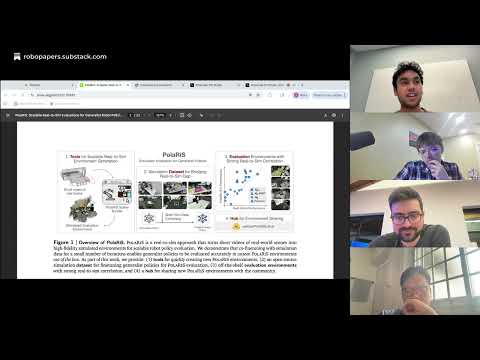
Builders and researchers should prioritize evaluation tools that offer strong real-to-sim correlation, even if it means a hybrid approach (like PolaRiS) over purely data-driven world models. Utilize real-to-sim environment generation (Gaussian splatting) and strategic sim data co-training to accelerate policy iteration.
PolaRiS offers a path to community-driven, crowdsourced robot benchmarks, making policy development faster and more robust. Expect a future where robot policies are evaluated across a broad suite of easily created, diverse simulated environments, pushing the boundaries of generalization and real-world applicability.
Generalist robot policies need robust, scalable evaluation. The shift is from bespoke, real-world-only testing to a hybrid real-to-sim approach that leverages modern 3D reconstruction and minimal sim data to create highly correlated, reproducible benchmarks.
Builders should adopt PolaRiS's real-to-sim environment generation and "sim co-training" methodology. This allows for rapid, cost-effective iteration on robot policies, ensuring that improvements in simulation translate directly to real-world gains.
Over the next 6-12 months, the ability to quickly and reliably evaluate robot policies in simulation will be a critical differentiator. PolaRiS provides the tools to build diverse, generalization-focused benchmarks, moving robotics closer to the rapid iteration cycles of other AI fields.
Tesla's core identity shifted from EV maker to autonomous AI and robotics. Its cars are devices for deploying its advanced AI brain; competitors miss this.
Tesla's 8 million cars collect real-world driving data. This massive dataset, combined with in-house AI processing, creates an unparalleled moat impossible for competitors to replicate.
This convergence creates an abundance of labor and transportation, driving down costs. Robo-taxis and humanoid robots automate tasks, making goods and services cheaper, even as Tesla's profitability soars.
Robotics is moving towards generalist policies that need broad, diverse evaluation. PolaRiS enables this by making it easy to create and share new, correlated benchmarks, cultivating a community-driven evaluation ecosystem similar to LLMs.
Adopt PolaRiS for rapid policy iteration on pick-and-place and articulated object tasks. Use its browser-based scene builder and existing assets to quickly create new evaluation environments, then fine-tune policies with a small amount of unrelated sim data to boost real-to-sim correlation.
Investing in tools like PolaRiS now means faster development cycles and more reliable policy improvements. This accelerates the path to robust, real-world robot deployment by providing a scalable, trustworthy intermediate testing ground.
PolaRiS enables a shift towards LLM-style generalization benchmarks, where models are tested on unseen environments and tasks, accelerating robot capabilities.
Use its browser-based scene builder and Gaussian splatting to quickly create diverse, real-world correlated evaluation environments, significantly reducing the cost and time of real robot testing.
Cheap, reliable robot policy evaluation in simulation, with strong real-world correlation, means faster development cycles, more robust generalist robots, and a path to crowdsourced, diverse benchmarks that will push the entire field forward.
AI is forcing a fundamental architectural change in automotive, moving from fragmented, rules-based systems to vertically integrated, neural network-powered platforms. This technical reality dictates market survival, favoring companies that control their entire software and hardware stack to build a continuous data flywheel.
Invest in or partner with companies demonstrating deep vertical integration in AI hardware and software for mobility. Prioritize those with a clear path to mass-market data collection and rapid iteration cycles.
Autonomy will be a must-have feature in cars within the next few years. Companies without a software-defined architecture and a vertically integrated AI stack will struggle to compete, creating a market share shift towards those few players who can deliver true self-driving at scale.
The automotive industry is undergoing a fundamental re-architecture, moving from hardware-centric, rules-based systems to software-defined, AI-powered platforms. This shift favors companies with deep vertical integration and proprietary data flywheels.
Invest in companies demonstrating full-stack control over their vehicle's software, hardware, and AI training data. This verticality is the moat against commoditization and the engine for rapid, continuous improvement.
Autonomy will be a non-negotiable feature by 2030, making software-defined vehicles the only viable path for mass-market automakers. Companies that fail to build or acquire this capability will face market irrelevance.
Tesla's core business is AI and autonomous robotics. This means its value comes from its software and data moat, not just vehicle sales.
Tesla is sunsetting Model S and X production to convert factories for humanoid robots. This signals a full commitment to autonomous devices beyond cars.
Unsupervised FSD is expected in select US states by Q2. This will enable cars to operate without human oversight, unlocking the robo-taxi network.
On-Chain is the New Main Stage: The Pump launch proved Solana can handle massive retail demand better than established CEXs, a major narrative shift for future token sales.
Brand and Treasury Trump Daily Noise: Pump's $6B+ valuation is driven by its powerful brand and massive war chest. Investors are betting on the long-term picture, not volatile daily metrics.
Value Accrual is Now Table Stakes: The 25% revenue share signals a new era. Protocols can no longer ignore direct value accrual for token holders; it's now a requirement to earn market trust.
Active Value Creation Over Passive Holding: The primary investment thesis is not just owning Bitcoin, but owning a company that actively works to increase your proportional stake in Bitcoin through astute capital management.
Shareholders Benefit from Arbitrage: The company can issue stock at a premium to buy more assets or sell assets to buy back stock at a discount, with both actions increasing the crypto-per-share metric for existing holders.
A Structurally Superior Model: This model aligns management and shareholder interests to grow NAV per share, a dynamic missing from both passive ETFs (where third parties capture arbitrage) and older closed-end funds (which suffered from principal-agent issues).
The Institutional Bid is Real and Diversified. Institutions are not just buying ETH via ETFs; they are building with it via stablecoins, tokenizing real-world assets on it, and holding it directly in corporate treasuries.
ETH's Supply Dynamics are a Ticking Time Bomb. With issuance lower than Bitcoin, an 8-year low of supply on exchanges, and over 43% of ETH locked in smart contracts, a powerful supply shock is building beneath the surface.
L2s are a Feature, Not a Bug. The temporary hit to L1 revenue is a calculated investment in mass adoption. By fostering a thriving Layer 2 ecosystem, Ethereum is sacrificing short-term fees for long-term network dominance and pricing power.
PUMP is the New Memecoin Index: The market is treating PUMP as a direct proxy for the health of the entire memecoin ecosystem. Its performance is a leveraged bet on speculative activity, making it a crucial asset to watch.
On-Chain Venues Are Winning: The PUMP launch was a massive fumble for centralized exchanges and a huge win for on-chain infrastructure like Solana and Hyperliquid, which handled record volume smoothly. Price discovery now happens on-chain first.
The Frontend is the Next Battlefield: PUMP’s biggest challenge is not just competitors like Bonk.fun, but the risk of being disintermediated by trading apps. To survive, it must become a destination platform, not just backend infrastructure.
Big Banks Are The Stablecoin Play. Forget fintech disruption; the Genius Act positions traditional banks with massive balance sheets and collateral access as the primary beneficiaries of the stablecoin boom, not Silicon Valley.
Bitcoin Miners Are a Leading Indicator. The performance of publicly traded Bitcoin miners often precedes major moves in Bitcoin's price, making them a "canary in the coal mine" for traders seeking an edge.
Real-World Assets Demand New Blockchains. The future of tokenized assets won't happen on today's chains. The winners will be platforms like Stellar or Avalanche Subnets that offer validator-level controls for transaction reversal, sacrificing permissionlessness for institutional-grade security.
**Stimulus Over-Revenue:** The Petra upgrade was an intentional move to prioritize L2 user growth over immediate L1 fee generation. Investors should view L1 metrics through this lens—low fees are currently a feature, not a bug.
**The Great Rotation:** ETH is migrating from exchanges to more permanent homes like ETFs, corporate treasuries, and staking contracts. This institutional embrace is solidifying ETH's store-of-value thesis, even as its "productive asset" yield fluctuates.
**DeFi's Pulse is Strong:** Don't mistake lower L1 fees for a weak economy. With active loans at an all-time high, the demand to use ETH and other assets within its DeFi ecosystem is stronger than ever.