Cultivate a diverse, long-term network, prioritizing relationships.
Seek "boring" businesses in high-demand, underserved markets, and invest in customer experience and product quality.
Future wealth creation for builders and investors demands a long-term, value-add mindset, leveraging partnerships and foundational improvements, not fleeting trends.
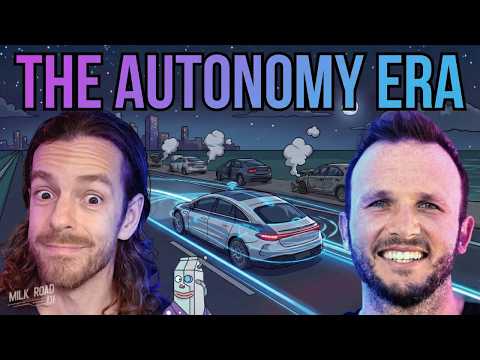
AI-driven automation and deflationary economics are converging with Tesla's proprietary neural networks and vast real-world data. This creates an unassailable moat in autonomous transportation and labor.
Monitor upcoming regulatory approvals for unsupervised FSD in key US states. This event will trigger the rollout of Tesla's robo-taxi network, fundamentally altering vehicle economics.
Tesla is not just a car company; it is a foundational AI and robotics platform. Its FSD and robo-taxi network, combined with the broader Musk ecosystem, position it to capture a multi-trillion dollar market in autonomous services and labor, driving massive deflation and investor upside over the next decade.
Tesla is an AI company, not a car manufacturer. This means its core product is autonomous intelligence, with cars serving as its initial deployment device.
Tesla's 8 million cars on the road constantly collect real-world driving data. This massive, proprietary dataset is an insurmountable moat, enabling its neural network AI to learn at a scale no competitor can match.
The convergence of Tesla, SpaceX, and XAI aims to create an abundance of cheap transportation and labor. This will drive massive deflation, making goods and services significantly more affordable globally.
The global economy is shifting from human-centric labor to AI-driven autonomous systems. Tesla's vertically integrated AI stack, from data to hardware, positions it as the architect of a deflationary future.
Evaluate Tesla not as an automotive stock, but as an AI and robotics platform with an unassailable data advantage. Consider FSD's Q2 rollout implications for direct investment and market disruption.
Tesla's unsupervised FSD and robo taxi network will unlock a new, massive revenue stream, potentially 10x current revenue by 2030, excluding humanoid robots. This re-rates Tesla as a multi-trillion dollar AI and robotics titan.
AI-driven automation, spearheaded by Tesla's vertical integration, will create unprecedented deflationary pressures across transportation and labor, redefining economic models and consumer behavior.
Monitor Q2 regulatory approvals for unsupervised FSD in key US states. This event will trigger the activation of Tesla's existing 8 million vehicle fleet into a revenue-generating network, repricing the company.
Tesla is not just a car company; it's a foundational AI platform. Its FSD lead, coupled with the impending robo taxi network and humanoid robots, positions it to capture a significant share of global transportation and labor markets, making it a critical long-term bet for investors and a bellwether for the AI economy.
Tesla is not a car company at all. It's an AI company. It's an autonomous company, autonomous robots company. And cars just happen to be one of the devices it's using to put the AI brain that it has into.
Tesla possesses an unparalleled dataset from 8 million cars, with 1 million actively using FSD. This massive, real-world driving data is impossible for competitors to replicate, creating an insurmountable lead in AI training.
Tesla owners will soon be able to deploy their cars as robo taxis, generating significant income. This transforms a depreciating asset into a revenue-generating one, incentivizing mass adoption and creating a new class of passive income.
AI-driven automation is converging with vertically integrated hardware and data ecosystems, creating winner-take-all dynamics in foundational industries.
Evaluate companies not by their current product category, but by their underlying AI and data moats. Tesla's FSD is a platform, not a feature.
Tesla's transition from carmaker to AI and robotics platform is not speculative; it is happening now.
The global economy is transitioning from human-centric labor and transportation to AI-driven autonomous systems. Tesla's vertical integration of hardware, software, data, and manufacturing positions it to capture this multi-trillion dollar change, driving unprecedented deflation.
Investors should recognize Tesla as an AI and robotics platform, not just an EV manufacturer. Consider the long-term implications of its FSD rollout and humanoid robot production, as these represent entirely new, high-margin revenue streams.
Tesla is on the cusp of activating unsupervised FSD and scaling robo-taxis, potentially within the next few quarters. This will reprice the company, not just on current earnings, but on the future value of global transportation, labor, and intelligence infrastructure.
AI-driven automation, spearheaded by Tesla's FSD and robotics, will create a deflationary economic environment by drastically reducing transportation and labor costs.
Evaluate Tesla not as an auto manufacturer, but as a vertically integrated AI and robotics platform. Its current valuation may not account for exponential revenue from FSD subscriptions and the robo-taxi network.
Tesla's strategic pivot to autonomous AI and robotics, with its data moat and impending unsupervised FSD, positions it to dominate multiple industries.
Escape Velocity Reached: Like the early internet and Bitcoin, BitTensor has survived its infancy. Its ecosystem of 128+ subnets has created a network-effect moat that makes it incredibly difficult to disrupt.
The "Front Door" Is the Next Billion-Dollar Opportunity: The most significant hurdle for BitTensor is its developer-focused user experience. The companies that successfully build simple, consumer-friendly interfaces on top of the subnets will unlock immense value.
Powerful Tokenomics Signal a Supply Shock: TAO's upcoming halving, combined with its built-in utility and high staking rate, is creating a classic supply squeeze. With demand structurally increasing as the network grows, the economics point toward a significant price appreciation for the root token.
The Game Is Rigged, Play Accordingly. Traditional analysis is failing. The winning strategy is "grift arbitrage"—investing in assets that benefit from government spending and political connections.
Bonds are Dead, Long Live Yield. With governments committed to fiscal dominance, bonds offer negative real returns. The hunt for yield is driving capital from fiat junk bonds into Bitcoin and Ethereum.
Hedge for the Inevitable Shakeup. The system is fragile. Key risks like aggressive tariffs or a hawkish Bank of Japan could trigger a sharp sell-off. With volatility low, now is the time to buy cheap protection.
Treasury Vehicles are a Trap. They're the new high-risk, high-reward play, but the danger isn't debt—it's massive shareholder dilution and a rapid, reflexive unwind that will be far quicker and more brutal than Grayscale's.
The Cycle Isn't Dead, It's Rhyming. The market is replaying the classic playbook: BTC runs, ETH surges, and capital spills into retail-favorite alts. Calling a top is a fool's errand, but the exuberance is palpable.
Regulation is a Double-Edged Sword. New laws provide a path for tokens to become commodities but may incentivize projects to launch chains purely for regulatory arbitrage, adding another layer of complexity to the market.
**Ethereum's revival is structural, not speculative.** Unprecedented ETF and corporate treasury inflows are creating sustained buying pressure that could push ETH to $10K and beyond, rendering past cynicism obsolete.
**Regulation is the unlock for institutional crypto.** The Clarity and Genius Acts are not just rules; they are the green light for institutional capital that has been waiting on the sidelines for legal certainty.
**The future of consumer crypto is weird and profitable.** Platforms like Pump.fun prove that the most powerful business models may not fit traditional molds but will win by tapping into raw, unfiltered user demand.
The ETH Treasury Is The New Institutional Bid. The narrative that powered Bitcoin's run is now being replicated for ETH, but with a twist: former Bitcoin miners are leading the charge, creating a powerful, reflexive buy-cycle.
ETH's Supply Squeeze Is Real. The combination of record ETF demand, minimal proof-of-stake issuance, and a re-staking culture means the buy pressure is overwhelming the available sell-side liquidity.
Regulation Is Becoming A Tailwind. The expected passage of the stablecoin bill provides a legitimate foundation for institutional adoption, turning a long-time headwind into a powerful catalyst for growth.
Solana’s Watershed Moment: The smooth on-chain execution for a high-demand event proved that decentralized infrastructure is not just viable but, in this case, superior to its centralized counterparts.
Value Accrual is Non-Negotiable: The era of valueless governance tokens is over. Protocols must now provide clear, tangible mechanisms like revenue sharing or buybacks to build trust and justify their valuation.
The Real Game is the Front-End: While back-end infrastructure plays are viable, the ultimate prize is owning the user relationship. PUMP’s battle with Axiom for the title of the premier consumer-facing crypto app is the key narrative to watch.