AI's real-world impact will accelerate in 2026, particularly in "conservative" professional services and fundamental sciences, despite market volatility.
Builders should focus on truly novel consumer agent experiences and niche robotics applications, while investors should eye AI IPOs with caution and consider energy efficiency plays.
The next 6-12 months will clarify the geopolitical AI race and expose the true infrastructure bottlenecks, shaping the industry's long-term trajectory.
Strategic Shift: The fintech market is moving from "digitizing everything" to "optimizing everything with AI." This means a focus on efficiency, personalization, and solving deep-seated financial problems.
Builder/Investor Note: Opportunities abound in B2B AI software for financial institutions and in consumer fintechs that prioritize "excellence" over mere access. However, the escalating AI fraud threat demands significant investment in defensive technologies.
The "So What?": Over the next 6-12 months, expect a surge in AI-powered financial products and services, but also a corresponding increase in the sophistication and volume of financial fraud. The battle for trust and security will define the winners.
Strategic Shift: The market will increasingly demand AI models evaluated on human-centric metrics, not just technical benchmarks. Companies prioritizing user experience and safety will gain a competitive edge.
Builder/Investor Note: Investigate companies developing or utilizing advanced, demographically representative human evaluation frameworks. These are crucial for building defensible, user-aligned AI products.
The "So What?": Over the next 6-12 months, expect a growing focus on AI safety, ethical alignment, and nuanced human preference data. The "Wild West" of AI evaluation is ending, paving the way for more robust, trustworthy systems.
Strategic Implication: The next frontier in AI is agentic, and progress hinges on fundamental pre-training innovation, not just post-training optimizations.
Builder/Investor Note: Focus on teams with deep experience in scaling and debugging large models, as this is a high-capital, high-risk endeavor. Builders should prioritize developing new benchmarks for agentic capabilities.
The "So What?": The industry needs to move beyond next-token prediction and static benchmarks to unlock truly capable, self-correcting AI agents in the next 6-12 months.
Shift in AI Development: The focus moves from syntax-aware code generation to execution-aware reasoning, enabling more robust and intelligent code agents.
Builder/Investor Note: Prioritize tools and platforms that support explicit execution modeling and highly asynchronous, high-throughput RL training for agentic systems.
The "So What?": AI that can simulate complex systems internally will drastically reduce development and testing costs, accelerating innovation in software and distributed systems over the next 6-12 months.
Strategic Shift: AI-driven kernel generation is not replacing human genius but augmenting it, allowing experts to focus on novel breakthroughs while AI automates the application of known optimizations across a complex hardware landscape.
Builder/Investor Note: Focus on robust validation and hardware-in-the-loop systems. Claims of "AI inventing new algorithms" in this domain are premature. The real value is in automating the "bag of tricks" for heterogeneous compute.
The "So What?": This technology is critical for scaling agentic AI workloads. Expect significant investment in tools that abstract hardware complexity and enable efficient, automated optimization, driving down the cost of AI inference in the next 6-12 months.
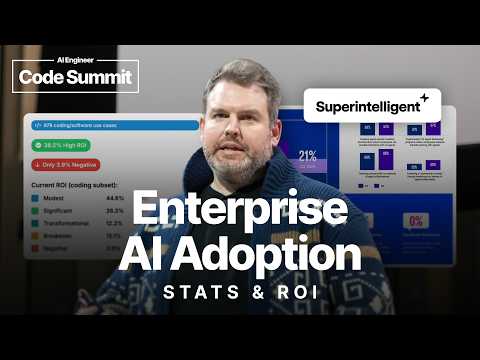
The Agent Economy is Here: Enterprises are moving past pilots with AI agents. Builders should focus on orchestration layers and human-agent interaction design.
ROI Measurement is the Next Frontier: Investors should look for solutions that help organizations accurately track and attribute AI value beyond traditional metrics.
Strategic AI, Not Spot Solutions: The biggest wins come from systematic, cross-organizational AI strategies that target new capabilities and revenue growth, not just incremental time savings.
The 100% AI adoption threshold is a step-function change, not incremental. Companies that commit fully will outpace those with partial integration.
Builders should prioritize "compounding engineering" by codifying knowledge into reusable prompts. This builds an organizational memory that accelerates future development exponentially.
Re-evaluate team structures and roles. Single engineers can own complex products, and even technical managers can contribute code, shifting how organizations operate.
Effective crime reduction requires a shift from reactive punishment to proactive, intelligence-driven deterrence, making it highly probable for criminals to be caught.
The market for AI-powered public safety technology, particularly solutions that integrate data for precision and accountability, presents a significant opportunity. Public-private partnerships are a key funding mechanism.
Over the next 6-12 months, expect to see more cities adopt advanced surveillance and AI tools, driven by private funding, as they seek to improve safety and address staffing shortages without resorting to ineffective, broad-stroke policies.
**Valuation is Evolving.** The most durable crypto projects will be judged not on tokenomics alone, but on a triad of community strength (Ecosystem), marketing reach (Attention), and real-world cash flow (Revenue).
**Centralization Wins the Consumer.** The next billion users will not navigate a dozen dApps. They will be onboarded through simplified, centralized super-apps that provide a seamless and curated on-chain experience.
**Reward Loyalty, Not Speculation.** Sustainable value is built by aligning with true believers. Founders should design mechanisms that reward long-term holders and actively discourage "farm-and-dump" behavior.
Re-evaluate Risk/Reward. With majors like Ethereum potentially offering symmetrical 50% upside vs. 50% downside, the rationale for holding heavy, levered positions weakens. It's time to take some chips off the table.
Explore Prediction Markets. This sector offers a fresh frontier for alpha. Get active on Polymarket, farm the Limitless airdrop on Base (min. $200 bet), and join Outcome’s risk-free testnet competition to get exposure.
Build a Defensive Core. Adopt assets like JLP on Solana as a portfolio cornerstone. It provides market exposure while protecting capital through its diversified pool and fees generated from retail traders, outperforming most crypto assets in a downturn.
**This Time Might Be Different.** Macro indicators like loosening bank lending standards, mid-range equity valuations, and a dovish Fed signal the business cycle is earlier than many believe, favoring a cycle extension into 2026 over a 2025 peak.
**On-Chain Metrics Show No Signs of a Top.** Key on-chain data is far from euphoric. The Bitcoin Fear & Greed index is neutral, and while long-term holders are selling, it’s being absorbed without triggering the "extreme greed" that defines market tops.
**Build a Concentrated, High-Conviction Portfolio.** Don't "diworsify." Anchor 70%+ of your portfolio in core assets (BTC, ETH), benchmark all other bets against them, and use small "hot sauce" allocations (5-10%) for high-risk plays while always maintaining cash to buy the dips.
**Macro is your north star.** The crypto market's direction is dictated by Fed policy. Rate cuts are the narrative, and trillions are waiting on the sidelines to flood into risk assets.
**Take profits aggressively.** We are in the "stupid" phase of the cycle. Systematically sell portions of your holdings at 20%, 50%, and 100% gains to de-risk before the music stops.
**Scrutinize DAOs.** Many are exit liquidity schemes. Only consider those with strong guardrails, like mandatory fresh capital matching, that bring new money into the ecosystem.
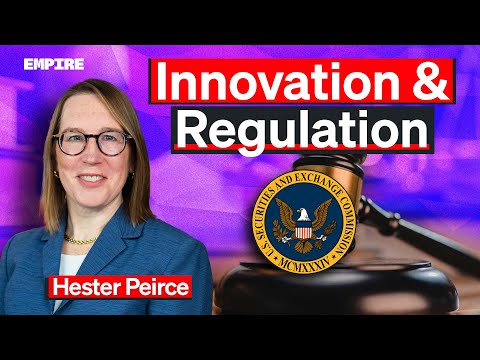
Frameworks, Not Fights: The SEC is shifting from broad prohibitions to creating specific, workable rules for token launches. The goal is to bring this crucial capital formation activity back to the U.S. under a clear and compliant regime.
Decentralization Changes the Game: True decentralization isn't just a buzzword; it fundamentally challenges the existing regulatory model. For truly peer-to-peer protocols, the old playbook of licensing intermediaries may no longer apply.
The Best Defense is Utility: The crypto industry's greatest protection against future regulatory hostility is to build things with real, lasting value. Use this period of clearer skies to create products and services that prove the technology's worth beyond speculation.
Bet on the Ecosystem, Not the Silo: Chainlink’s value is tied to the growth of the entire blockchain space, making it a diversified bet on institutional adoption. XRP’s success is a narrow wager on its own ledger and asset gaining dominance.
Follow the Proof, Not the Promises: Chainlink’s public partnerships with firms like Swift and JP Morgan provide concrete evidence of traction. This stands in sharp contrast to XRP's long-unfulfilled, NDA-shrouded narrative.
Infrastructure is the Ultimate Power Play: By providing a comprehensive suite of essential services (data, cross-chain, compliance), Chainlink is building a defensible moat as the go-to infrastructure platform for Web3, with no direct all-in-one competitor in sight.