The digital experience economy is moving from static content to dynamic, AI-driven co-experience platforms, where user interaction data becomes the core asset for training next-generation virtual intelligence.
Invest in platforms that offer robust, cloud-connected infrastructure and proprietary, vectorized user data for AI training, as these will be the engines for future immersive content and agentic AI development.
Roblox's long-term vision, powered by its unique data moat and AI investments, positions it to define the future of virtual co-experience, making it a critical player to watch for investors and builders in the AI and gaming space over the next 6-12 months.
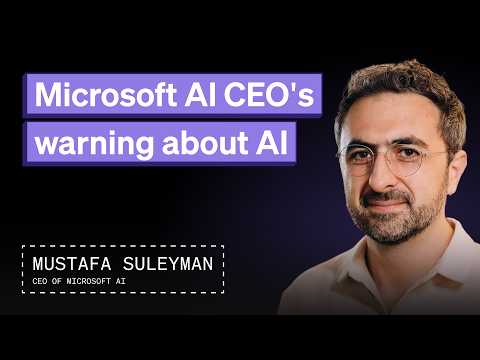
The exponential reduction in the cost of intelligence, coupled with open-source proliferation, is pushing AI into every corner of society, creating a collective action problem where market incentives for "engaging" AI clash with the need for societal safety and control.
Get hands-on with AI now. "Vibe coding" and actively experimenting with AI tools builds "AI muscle," inoculating users against psychosis risks and building a deeper understanding of AI's capabilities and limitations.
AI is here to stay and will redefine work and interaction. Understanding its "hyperobject" nature, advocating for clear regulatory boundaries, and actively engaging with the technology are critical for navigating the near future without falling for its simulated charms.
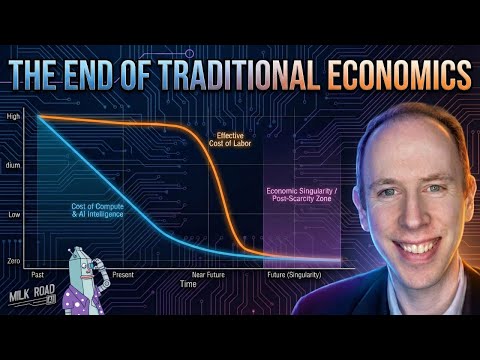
AI-driven hyperdeflation will fundamentally alter economic structures, leading to a post-scarcity future where the primary challenge shifts from production to distribution and the integration of human and machine economies.
Invest in infrastructure that bridges human and AI economies, or prepare for a future where AI agents become a significant, crypto-native economic force.
The next 6-12 months will see continued acceleration of AI capabilities, pushing us closer to a future where traditional labor and intelligence are nearly free. Understanding this change is crucial for navigating the emerging economic landscape and identifying new value creation opportunities.
The era of opaque, black-box AI is ending; the future demands intentionally designed models with human understanding and control. This shift is driven by reliability in high-stakes applications and extracting novel insights.
Investigate interpretability tools (like Goodfire's platform) to gain granular control over model behavior, moving beyond basic fine-tuning for critical applications.
Interpretability is not a niche; it's the missing piece for scaling AI safely into mission-critical domains. Mastering model understanding and intentional design will yield unprecedented capabilities and competitive advantage.
Robotics is moving from bespoke, data-hungry behavior cloning to generalized, human-informed learning via world models. This shift, mirroring the success of LLMs, means robots can use the vast, unstructured data of human experience to acquire new skills.
Invest in platforms and data pipelines that facilitate multi-modal, multi-stage training for humanoid robots. Prioritize systems that can generate synthetic data and use world models for high-throughput, targeted policy evaluation.
World models are the engine for scalable robot intelligence. They promise a future where robots learn faster, generalize wider, and self-improve through iterative simulation, making widespread humanoid deployment a near-term reality.
The Macro Shift: AI is collapsing the time horizon for technological deployment and market dominance, shifting the competitive advantage from pure innovation to a combination of innovation, capital, and rapid infrastructure deployment.
The Tactical Edge: Invest in companies that are not just building AI, but are fundamentally rethinking existing industries with AI-first principles, recognizing that traditional software moats are eroding.
The Bottom Line: The next 12-24 months will see AI's broad impact kick in, creating unprecedented opportunities for those who understand its new "laws of physics" and the critical role of policy in shaping its trajectory.
The healthcare system is moving from reactive, acute care to proactive, preventative interventions, driven by the unsustainable costs of chronic disease and a growing understanding of environmental health.
Build infrastructure that financially incentivizes lifestyle interventions, such as TrueMed's HSA/FSA payment rails for health-promoting products and services.
The next decade will see hundreds of billions of dollars redirected towards preventative health. Companies that bridge the gap between lifestyle choices and healthcare financing will capture significant market share.
The Macro Shift: Global energy demand, driven by AI, forces a strategic re-evaluation of nuclear power. This creates a window for nations to re-shore critical energy infrastructure, moving from reliance on adversaries to domestic, cost-competitive solutions.
The Tactical Edge: Investigate companies addressing foundational supply chain gaps in critical industries like energy. Look for teams with a "first principles" engineering approach and a track record of commercializing hard tech.
The Bottom Line: America's energy independence and its ability to power future technological growth, like AI, hinge on rebuilding domestic nuclear fuel enrichment. This is not just an industrial opportunity; it is a national security imperative.
From Voting to Value: Futarchy transforms governance from a popularity contest into a pure value-maximization engine, where the only thing that matters is whether a decision increases the token's price.
Investor Protection on-Chain: By locking funds in a market-governed treasury, Futarchy offers automated, code-enforced investor protections that mimic—and may even surpass—traditional shareholder rights.
The End of the Rug Pull Era: Platforms like MetaDAO create a new asset class of "ownership coins" where the incentive to rug is eliminated, signaling a potential turning point for the quality and reliability of crypto investments.
**Invisible Blockchain is the Endgame.** The biggest barrier to mass adoption is user experience. The ultimate winners will make crypto so seamless that users don't even realize they're using it.
**Revenue Beats Hype.** The industry is maturing from extractive schemes to sustainable businesses. Valuations must follow suit, focusing on ecosystem health, attention, and earned revenue—not just mints.
**Coordination Creates Wealth.** Crypto's core innovation is "human coordination on steroids," a force powerful enough to potentially trigger the largest single wealth creation event in the internet's history.
**The Four-Year Cycle Is Dead.** The absence of a parabolic, post-halving rally confirms a new paradigm. Investors should expect more sustained, multi-year growth fueled by institutional adoption and macro trends, pointing to a strong 2026.
**Stablecoins Are Capital Formation Engines.** The primary use case isn't peer-to-peer payments; it's a new financial primitive for funding real-world assets. This is crypto’s killer app for institutions.
**DeFi's Transparency Wins.** The recent liquidations proved that while CeFi remains a house of cards with opaque risks and preferential treatment for insiders, DeFi’s transparent, on-chain systems offer superior resilience.
**The Great Bifurcation Is Here.** Institutional capital is flowing into Bitcoin and Ethereum, but the flash crash proved the altcoin market is a liquidity desert. Do not mistake ETF inflows for broad market support.
**DeFi Won the Battle, CeFi Won the War (For Now).** Protocols like Aave performed perfectly, but the system's reliance on centralized exchange oracles was the critical point of failure. The future is hybrid, but the current integration is dangerously fragile.
**Cash Flow Is King.** The era of vaporware is ending. From DATs to new tokens, the market will no longer tolerate projects without a clear path to revenue. The music has stopped for assets without a viable business model.
Leverage is the market's double-edged sword. The $19B flash crash was a cascade failure driven by leverage, not fundamentals. It exposed the fragility of perpetual exchanges and the critical risk of Auto-Deleveraging (ADL) even for sophisticated traders.
Wall Street is tokenizing everything. Larry Fink and BlackRock are building the operating system to move trillions in traditional assets on-chain. This isn't a speculative bet; it's a core strategy to capture a massive, untapped global market.
Infrastructure is maturing, but risks are shifting. While core DeFi protocols proved bulletproof under stress, centralized exchanges and their oracle dependencies remain a systemic weak point, as shown by Binance's API failures and the resulting market chaos.
Altcoins Are Cooked. A decimated retail buyer base combined with relentless selling pressure from insider token unlocks creates a structurally bearish environment for the entire altcoin complex.
Farm, Don't Buy. Stop being exit liquidity. The winning strategy is to farm airdrops to acquire tokens for free and become the one who sells at launch.
Capital Preservation is King. The "one more 2x" mentality is a trap. Protect your gains by holding significant stablecoin reserves and acting quickly to de-risk. Take care of the downside, and the upside will take care of itself.