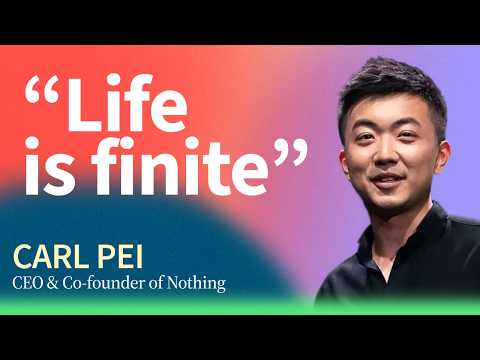
The Macro Shift: Infrastructure Invisibility. As core technologies become background noise, value moves from the pipes to the unique experiences built on top of them.
The Tactical Edge: Reject Mediocrity. Audit your product for average features and replace them with high-conviction improvements that competitors are too lazy to attempt.
The Bottom Line: Building is the only way to ensure the future happens. If you do not create the next version of reality, you are stuck living in an outdated vision.
The transition from hardware specs to emotional hardware where brand identity and OS-native AI become the primary moats.
Prioritize arbitrage opportunities in marketing by finding underpriced attention on platforms like TikTok before they become crowded.
Success in mature markets requires a Genghis Khan method: be a talent scout, stay open-minded to global supply chains, and use design to win the emotional battle for the consumer's pocket.
The transition from centralized cloud training to distributed local inference creates a massive demand for high-bandwidth storage and custom CPUs.
Audit your technical roadmap to prioritize local agentic workflows that reduce latency and data privacy risks.
The next 12 months will favor hardware that enables physical AI and local autonomy. Owning the compute stack is becoming a competitive necessity for builders who want to move faster than the cloud allows.
Intelligence is decoupling from scale. As reasoning becomes a commodity, the value moves from the size of the model to the proprietary nature of the training data.
Use TRL or Unsloth for single-GPU fine-tuning. Prioritize cleaning your instruction sets over increasing your training iterations.
The future belongs to those who own their data pipelines. If you can distill elite reasoning into a 350M parameter model, you win on latency, cost, and privacy.
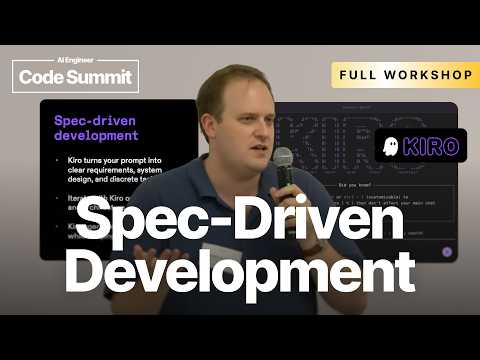
Software maintenance is moving from a manual craft to an industrial process. As agents handle the toil of migrations and security, human engineers will focus entirely on high-level system design.
Batch by Dependency. Use the OpenHands SDK to visualize your codebase as a graph and deploy agents to solve the leaf nodes first.
Companies that master agent orchestration will clear their tech debt backlogs in weeks instead of years, creating a massive competitive advantage in product velocity.
The Macro Shift: Institutional players are not just buying crypto; they are actively building and acquiring talent to integrate blockchain rails into existing financial infrastructure. This means the battle for crypto's future will increasingly be fought on the grounds of productization and distribution, not just raw technical innovation.
The Tactical Edge: Investigate projects that are actively bridging the gap between open-source crypto and traditional finance, but with clear, transparent tokenomics and governance structures. Prioritize teams willing to disclose financials, as this signals long-term viability and investor alignment in a market often opaque.
The Bottom Line: The next cycle will see a fierce competition between truly decentralized protocols and corporate-backed, crypto-native products. Understanding who owns the rails and how value accrues will be paramount for investors and builders seeking to capitalize on this evolving landscape.
The global financial system is undergoing a fundamental shift towards tokenized money, driven by efficiency gains and demand for dollar access in emerging markets. This transition will upgrade core payment rails, not just add layers.
Builders should focus on infrastructure that collapses existing financial stacks, leveraging stablecoins for global reach and capital efficiency. Investors should seek companies enabling this "under the surface" upgrade, particularly those with direct network memberships.
The future of finance is programmable and global. Companies like Rain, by building core stablecoin infrastructure and securing direct network access, are positioned to capture immense value as more of the world's money moves onchain over the next 6-12 months.
The crypto industry is experiencing a gravitational pull towards institutionalization, where traditional finance and tech giants are increasingly building on or acquiring web3 infrastructure and talent.
Monitor projects like MegaETH that are launching with clear, measurable KPIs for their token generation events.
The next 6-12 months will see increased competition from well-capitalized, traditional players building on crypto rails, potentially limiting direct token exposure to fundamental infrastructure plays.
The Ethereum scaling narrative is evolving from L2s as mere L1 extensions to specialized, high-performance execution layers. This creates a barbell structure where Ethereum provides core security, and L2s deliver extreme throughput and novel features.
Builders should explore high-performance L2s like MegaETH for applications requiring ultra-low latency and high transaction volumes, especially in gaming, DeFi, and AI agent interactions, where traditional fee models are prohibitive.
MegaETH's mainnet launch, with its technical innovations and unconventional economic and app strategies, signals a new generation of L2s.
The theoretical certainty of quantum computing, coupled with accelerating engineering breakthroughs, means the digital asset space must proactively build "crypto agility" into its core protocols. This ensures systems can adapt to new cryptographic standards as current ones become obsolete.
Secure your Bitcoin by ensuring it resides in unspent SegWit or P2SH addresses, as these keep your public key hidden until spent. This provides a temporary shield against quantum attacks.
Quantum computing is not a distant threat but a near-term risk with a 20% chance of moving Satoshi's coins by 2030. Ignoring this could lead to a systemic collapse of the "store of value" narrative for Bitcoin and other digital assets, forcing a costly and painful reset.
The crypto industry must shift from viewing quantum as a distant threat to an imminent engineering challenge requiring proactive, coordinated defense.
Ensure any long-term Bitcoin holdings are in SegWit addresses never spent from, as these public keys remain hashed and are currently more resistant to quantum attacks.
A 20% chance of Satoshi's coins moving by 2030, and near certainty by 2035, means delaying upgrades is a multi-billion dollar bet against Bitcoin's core security narrative.