The Macro Shift: The Great Re-Shoring. National security now depends on domestic production of critical minerals and semiconductors.
The Tactical Edge: Build for Scale. Prioritize manufacturing competence over pure software features to win government contracts.
The Bottom Line: The defense industrial base is being rebuilt from the ground up. The next decade belongs to the builders who can merge Silicon Valley speed with the Pentagon's scale.
The Macro Trend: Biological Sovereignty. As global systems destabilize, the Amazon remains the most critical piece of biological infrastructure on the planet.
The Tactical Edge: Support Jungle Keepers. Direct capital to organizations that convert loggers into rangers to secure land concessions.
The Amazon is a finite asset under active siege. Protecting it requires a blend of primitive survival skills and high-tech surveillance over the next 18 months.
The Macro Pivot: As generative AI masters simulation, the physical world becomes a high-fidelity playground for software.
The Tactical Edge: Invest in the "brain" layer rather than the "limb" layer. Software that can generalize across different hardware forms will capture the most value.
The next decade belongs to embodied AI that reasons in real time. If you are waiting for the hardware to look perfect before paying attention, you will miss the moment the software takes over the physical world.
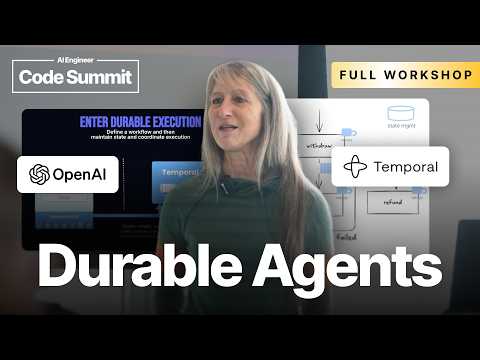
The industry is moving from "Agent as a Script" to "Agent as a Durable Service" where state management is handled by the infrastructure.
Wrap your existing API tools in the `activity_as_tool` function to gain automatic retries and execution history.
Reliability is the only moat in the agentic economy. If your agent cannot survive a server restart during a three-day task, it is not ready for the enterprise.
The Macro Trend: The move from fragmented content libraries to integrated health systems where AI synthesizes biomarkers and movement.
The Tactical Edge: Construct internal LLM tools to categorize qualitative feedback. This turns thousands of raw reviews into a precise roadmap.
The Bottom Line: Building a $100M ARR consumer app requires mastery of both growth loops and product retention. Solve for the daily habit to win the long game.
The transition from general-purpose AI to specialized application layers. As foundation models commoditize, value migrates to the "fat tail" of human-centric complexity.
Prioritize building or investing in "DNA of the future" companies that incumbents must eventually acquire to survive. Focus on winning the "point of attack" by staying deep in the technical details.
We are in a unique market where demand growth justifies high valuations. Success over the next year depends on identifying founders who are the absolute best in the world at one specific thing.
The demand for specialized "human alpha" in AI is intensifying, particularly for high-stakes problems where LLMs hit a performance ceiling. Platforms like Crunch are essential infrastructure for channeling this scarce human intelligence into decentralized networks.
Builders should integrate abstraction layers that simplify Web3 interaction for non-crypto native experts. This expands the talent pool and accelerates innovation by removing technical barriers to entry.
The future of decentralized AI hinges on effectively combining machine compute with unique human insight. Investing in platforms that bridge this gap will capture significant value as the "price of intelligence above benchmark" becomes increasingly transparent and monetizable.
The US is actively competing for crypto leadership, moving from a reactive, enforcement-first approach to proactive legislation and regulatory guidance. This strategic pivot aims to keep innovation and capital within American borders, positioning the US as a hub for future financial technology.
Monitor the progress of the Clarity Act and other market structure legislation in Congress. Focus on projects and protocols that align with the emerging regulatory framework, particularly those in DeFi and tokenization, as these areas stand to benefit most from increased certainty and institutional participation.
The next few years are critical for establishing durable crypto policy. A stable regulatory environment, coupled with strong political influence, will prevent future policy reversals. This period offers a unique opportunity for builders and investors to capitalize on a clearer path for onchain finance and technology.
The era of individual "superpowers" is here, where AI agents amplify personal expertise, allowing non-technical individuals to build and operate complex systems previously reserved for large teams. This democratizes high-skill output, shifting value from raw coding to strategic system design and prompt engineering.
Implement an agent-first workflow by setting up a personal Discord server with specialized AI sub-agents (e.g., "Saul Goodman" for legal, "Milhouse" for research). Train them with your data and integrate APIs for automated tasks like content generation or data analysis, reducing reliance on manual processes and external hires.
Over the next 6-12 months, the ability to effectively deploy and manage personal AI agents will be a critical differentiator. Those who master this will not only multiply their personal output but also gain a significant competitive advantage in content, trading, and online business, effectively becoming a one-person enterprise.
The convergence of legacy finance and DeFi is accelerating, driven by institutional demand for efficiency and new product capabilities, leading to a "Neo Finance" era where tokenization is the default for asset management.
Focus on infrastructure and protocols that facilitate institutional-grade tokenization and vault strategies, as these will capture significant value as traditional assets migrate on-chain.
The next 6-12 months will see institutions solidify their DeFi presence, making tokenized assets and vaults central to their strategies. Builders and investors must understand this shift to position themselves for the inevitable re-rating of financial infrastructure.
The Macro Shift: As crypto moves from niche tech to mainstream finance, it inherits the complex regulatory and criminal challenges of traditional systems, forcing a re-evaluation of its core principles like self-custody and transaction finality.
The Tactical Edge: Advocate for nuanced regulatory discussions that differentiate between legitimate innovation and outright fraud, while actively exploring privacy-preserving technologies like zero-knowledge proofs to mitigate real-world physical risks for users.
The Bottom Line: The industry must proactively address its vulnerabilities and engage constructively with regulators and the public. Ignoring these issues or retreating into insular arguments will only hinder crypto's long-term legitimacy and widespread adoption over the next 6-12 months.
The global economy is undergoing a dual transformation: a shift from lagging, survey-based economic data to real-time, granular insights (like Truflation's), and a speculative AI infrastructure build-out by tech giants.
Monitor Truflation's real-time inflation data and the balance sheets of MAG7 companies to identify early signs of market dislocation or mispriced assets.
The convergence of AI and blockchain will redefine economic measurement and payment rails, while massive AI infrastructure spending could create a new financial bubble.