Demand for provably correct systems in hardware, software, and critical infrastructure creates a massive market for formal verification. AI scales these human-bottlenecked processes.
Investigate formal verification tools for high-stakes codebases or chip designs. Prioritize solutions combining probabilistic generation with deterministic proof for speed and reliability.
"Good enough" code is ending for critical applications. AI-driven formal verification is a commercial imperative, redefining development cycles and trust.
The macro shift: Geopolitical competition in AI is not just about raw model power; it is about who controls the foundational research and development platforms. Open models are the battleground for long-term national AI sovereignty.
The tactical edge: Invest in open model research and infrastructure, particularly in post-training environments and high-quality data generation. This builds a resilient, transparent AI ecosystem that can adapt and innovate independently.
The bottom line: The US must prioritize open model development now to secure its position as a global AI leader, foster domestic innovation, and provide accessible AI options for a diverse global user base over the next 6-12 months.
The convergence of AI and immersive computing is pushing towards a "HoloDeck" future. Roblox's vector-based data storage of 13 billion monthly hours provides unprecedented training data for agentic NPCs and real-time world generation, fundamentally changing how virtual worlds are built and experienced.
Invest in platforms that offer cloud-native, AI-accelerated creation tools and robust multiplayer synchronization. Prioritize those building on rich, proprietary 3D interaction data for superior AI agent training.
The future of digital interaction is 4D, photorealistic, and AI-driven. Companies with a clear, long-term vision paired with rapid, cloud-connected iteration will capture the next wave of virtual co-experience, making them prime targets for investment and partnership over the next 6-12 months.
The exponential reduction in the cost of intelligence is transforming AI from a mere tool into a "hyperobject" with quasi-human capabilities, forcing society to adapt from a scarcity-based operating system to one of intelligence abundance.
Cultivate "AI muscle" by actively experimenting with AI tools, understanding their capabilities and limitations, and pushing their boundaries. This hands-on engagement is the best inoculation against "AI psychosis" and prepares you for a world where AI is ubiquitous.
AI's rapid proliferation and increasing autonomy demand immediate, collective action from governments, companies, and individuals to establish clear boundaries and ensure human control. Ignoring this "fourth class" of being risks societal instability and the erosion of human agency over the next 6-12 months.
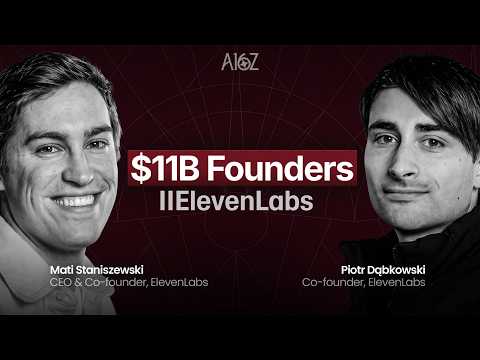
The computing paradigm is shifting from visual-centric to auditory-first, driven by AI's ability to process raw audio data for emotional depth and contextual understanding. This opens new frontiers for immersive experiences and global communication.
Invest in or build solutions that prioritize raw audio data processing and multimodal AI integration. Focus on applications where emotional nuance and natural interaction create a distinct user experience.
Voice AI, particularly with ElevenLabs' approach to emotional intelligence, is not just an incremental improvement; it is a foundational shift that will redefine human-computer interaction and unlock massive markets in education, entertainment, and global connectivity over the next 6-12 months.
AI's memory demands invert data center design, moving from storage-first to memory-first. High-speed networks and NVMe flash are now core memory tiers.
Fund software-defined memory solutions like WEKA's Axon and Augmented Memory Grid. These convert existing NVMe drives into high-performance context memory.
Persistent, rapid KV cache access through "Token Warehouses" will determine AI application and agent deployment profitability over the next 6-12 months.
AI is moving from opaque, data-driven systems to transparent, intentionally designed agents. This shift is driven by the need for reliability, safety, and the ability to extract novel insights from increasingly powerful models.
Invest in tools and research that provide granular control over AI internals, like Goodfire's platform. This enables precise customization, reduces unintended behaviors, and accelerates scientific discovery in critical domains.
The future of AI isn't just about bigger models; it's about smarter, more controllable ones. Understanding and directly influencing AI's "mind" will be a competitive differentiator and a prerequisite for deploying AI in high-stakes, real-world applications over the next 6-12 months.
The era of "good enough" probabilistic AI for critical systems is ending; the market demands provable correctness. Axiom Math's approach signals a return to formal methods, supercharged by AI, addressing the verification bottleneck in software and hardware.
Investigate formal verification tools for safety-critical code generation, hardware design, and legacy code migration. Prioritize solutions combining AI generation with deterministic proof for speed and certainty.
Formally verifying complex systems with AI will redefine trust in software and hardware. Companies integrating these capabilities gain a competitive advantage, reducing bugs, accelerating development, and meeting regulatory demands over the next 6-12 months.
The scaling laws seen in large language and video models are now extending to physical robotics. Internet-scale human video data, combined with humanoid morphology, is creating a new paradigm for robot generalization.
Invest in or build systems that prioritize multi-stage data pipelines, especially those incorporating diverse egocentric data. This approach is proving key to unlocking zero-shot capabilities in physical AI.
World models are not just a research curiosity; they are a practical tool for accelerating robot deployment. Their ability to generalize and act as learned simulators will redefine how robots are trained, tested, and ultimately integrated into our daily lives over the next 6-12 months.
Bitcoin's Rally Has Legs: Bitcoin's ascent beyond $100k is backed by robust institutional interest and a significant decoupling from equities, making $120k a tangible near-term target; however, high leverage in futures markets signals a need for short-term caution.
Alt Season is Brewing: The market is shifting focus to "real businesses" within crypto, igniting a potential altcoin season. Investors should seek revenue-generating protocols with solid fundamentals and transparent operations.
Product Innovation Signals Deep Demand: The explosion of diverse crypto financial products tailored for institutional investors indicates a profound, underlying demand that's only beginning to be tapped, marking a maturation of the crypto market.
REV is a starting point, not the finish line: It's a useful, objective measure of immediate user willingness to pay for blockspace but doesn't encompass all value drivers of an L1.
App-layer eats L1 lunch (eventually): Expect applications to get better at internalizing value (like MEV), potentially reducing direct REV flow to L1s, making app success crucial for the L1 ecosystem.
Narrative & adoption still trump pure metrics: For now, perceived momentum, user growth, and developer activity (like on Solana) can heavily influence L1 valuations, often overshadowing strict adherence to metrics like REV multiples.
Investing in specialized crypto treasury vehicles offers exposure not just to the underlying asset but also to a strategy of active accumulation and yield enhancement. These companies argue their NAV premiums are justified by their operational capabilities and future growth prospects.
NAV Premiums Signal Future Growth: Market premiums on crypto-holding companies often reflect expectations of continued asset accumulation, not just current asset values.
Expertise Drives Alpha: Specialized operational capabilities, like in-house validator management, can generate significantly higher yields (20-40% more) than readily available retail options.
Sophisticated Strategies Outperform Simple Holding: For investors seeking optimized exposure, vehicles offering complex, managed strategies for asset accumulation and yield can provide an edge over direct, passive investment.
Beyond ETFs: These treasury vehicles offer a more dynamic, potentially higher-return (and higher-risk) path to crypto exposure than standard ETFs, focusing on active accumulation and yield enhancement.
Volatility as a Tool: For certain crypto-native companies, extreme stock volatility is actively cultivated to unlock unique capital market opportunities and attract specific investor demographics.
The Solana "MicroStrategy" Model is Live: Companies like DeFi DevCorp are demonstrating that the playbook of leveraging public markets for aggressive, single-asset crypto accumulation can be replicated beyond Bitcoin, with Solana as a prime new candidate.
Tariffs Trump Tranquility: A 10% tariff floor could trigger summer stagflation, disrupting current Goldilocks market pricing.
Stablecoin Bill is Bellwether: The fate of the "Genius Act" will significantly impact the trajectory of broader US crypto regulation and investor confidence.
Institutional Crypto Evolves: Coinbase's S&P 500 nod and the push for diverse crypto ETFs (like Solana) underscore the sector's maturation, even as regulatory hurdles for features like staking persist.
LP Scrutiny Intensifies: Expect smaller fundraises for many VCs, especially in crypto, as LPs demand real returns (DPI) and, for crypto, regulatory certainty.
Endowment Exodus Looms: Yale's $6B private equity sale signals a potential LP supply shock as other endowments may follow suit due to tax changes and liquidity needs.
Elite VCs Consolidate Power: Capital will increasingly flow to the top 5-10 VC firms, particularly those with AI expertise, hastening the decline of underperformers.