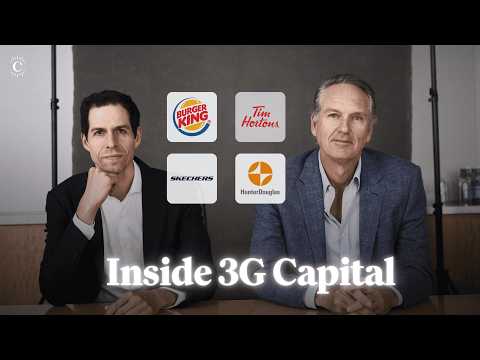
3G commits to one investment per fund, deploying significant house capital alongside partners. This singular focus drives an unparalleled rigor in due diligence and operational execution, because failure isn't an option—it's the only dish.
3G attracts top-tier talent by offering founder-like economics and accelerated responsibility. This creates a meritocracy where young leaders are given significant control and ownership earlier than traditional paths.
3G favors businesses with strong, direct customer relationships and physical assets, like Burger King or Hunter Douglas. These "atoms" businesses are inherently harder for new tech to disintermediate.
As capital markets become more efficient and valuations stretch, the edge shifts from financial engineering to deep operational expertise and a relentless focus on business quality.
Cultivate an owner-operator mindset throughout your organization, aligning incentives from the top down.
In the next 6-12 months, re-evaluate your investment criteria. Focus on businesses with clear customer relationships and robust, non-disruptable core offerings.
As market valuations stretch and technological disruption accelerates, the enduring value of well-moated, customer-centric businesses with strong physical components becomes clearer. 3G's focus on "harder to disrupt atoms" businesses, enhanced by technology, offers a resilient investment thesis.
Cultivate an owner-operator mindset, pushing decision-making closer to problems and aligning incentives with long-term success. Prioritize hiring ambitious young talent and empower them with responsibility, backed by strong mentorship.
In a world obsessed with speed and breadth, 3G Capital reminds us that deep, patient, operator-driven concentration in quality businesses, coupled with a fierce ownership culture, remains a powerful formula for outsized returns. This model builds enduring value, not just short-term gains.
In a market where digital disruption dominates headlines, 3G's success with physical, "atoms" businesses highlights that enduring value often lies in strong brands with direct customer relationships, where operational excellence and long-term thinking create defensible moats against technological fads.
Cultivate an "owner-operator" mindset in your investments and teams. Prioritize businesses with clear, simple value propositions and strong customer ties, then give young, ambitious talent significant ownership and autonomy to drive execution.
The next 6-12 months will reward investors and builders who resist the urge to chase every shiny new object. Instead, focus on fundamental business quality, deep operational involvement, and patient capital deployment in businesses that own their customer relationships. This disciplined approach, though counter-cultural, consistently compounds wealth.
As markets become more volatile and technology accelerates disruption, the traditional diversified portfolio approach faces increasing headwinds. 3G Capital's model signals a shift towards concentrated, operator-led bets on resilient, customer-owning brands with strong unit economics.
Identify businesses with deep moats, direct customer relationships, and long-term growth potential, then instill an owner-operator mindset throughout the organization, empowering young talent with significant equity and autonomy.
In a world of fleeting trends, focusing on fundamental business quality, operational excellence, and a long-term horizon offers a robust strategy for compounding capital, proving that sometimes, less truly is more.
3G commits to one investment per fund. This extreme concentration forces rigorous downside analysis and patience, ensuring capital is deployed only into truly exceptional opportunities.
Leaders are treated as shareholders, not just management. This alignment, often through outsized equity grants, drives decisions that prioritize the business's long-term health and value creation.
3G seeks businesses that own the relationship with their end customers. This direct connection provides a moat against disruption and disintermediation, as seen with brands like Burger King and Hunter Douglas.
The Macro Shift: As digital disruption accelerates, the value of businesses with inherent physical moats and direct customer relationships grows. 3G's focus on these "atoms" businesses, rather than "bits," positions them to capitalize on enduring consumer needs.
The Tactical Edge: Cultivate an owner-operator mindset in your ventures by aligning incentives deeply, empowering young talent, and relentlessly focusing on core business quality. This means prioritizing long-term value creation over short-term financial engineering.
The Bottom Line: In a world obsessed with speed and diversification, 3G Capital's patient, concentrated, and operator-driven model offers a powerful counter-narrative. For investors and builders, this means recognizing that deep, hands-on involvement in a few great businesses can still yield outsized returns, especially when others are chasing the next shiny object.
As technology accelerates disruption, businesses that own the direct customer relationship and operate in "atoms" industries become increasingly resilient.
Cultivate deep, long-term relationships with founders and owners of enduring businesses, positioning yourself as a patient, operator-led partner rather than a short-term financial buyer.
In an environment of stretched valuations and abundant capital, a disciplined, concentrated, and operator-driven approach to acquiring and growing high-quality, customer-owning businesses remains a powerful, albeit rare, path to outsized returns.
The AI infrastructure boom is transitioning from speculative buildouts to financially engineered, risk-managed investments, driven by the commodification of compute and memory.
Evaluate your compute procurement and data center buildout strategies through a financial lens, exploring futures contracts and residual value products to lock in costs and de-risk hardware investments.
The ability to quantify future compute demand and hardware value will be the differentiator for AI infrastructure players over the next 6-12 months, enabling smarter capital deployment and competitive advantage.
Bitcoin's Rally Has Legs: Bitcoin's ascent beyond $100k is backed by robust institutional interest and a significant decoupling from equities, making $120k a tangible near-term target; however, high leverage in futures markets signals a need for short-term caution.
Alt Season is Brewing: The market is shifting focus to "real businesses" within crypto, igniting a potential altcoin season. Investors should seek revenue-generating protocols with solid fundamentals and transparent operations.
Product Innovation Signals Deep Demand: The explosion of diverse crypto financial products tailored for institutional investors indicates a profound, underlying demand that's only beginning to be tapped, marking a maturation of the crypto market.
REV is a starting point, not the finish line: It's a useful, objective measure of immediate user willingness to pay for blockspace but doesn't encompass all value drivers of an L1.
App-layer eats L1 lunch (eventually): Expect applications to get better at internalizing value (like MEV), potentially reducing direct REV flow to L1s, making app success crucial for the L1 ecosystem.
Narrative & adoption still trump pure metrics: For now, perceived momentum, user growth, and developer activity (like on Solana) can heavily influence L1 valuations, often overshadowing strict adherence to metrics like REV multiples.
Investing in specialized crypto treasury vehicles offers exposure not just to the underlying asset but also to a strategy of active accumulation and yield enhancement. These companies argue their NAV premiums are justified by their operational capabilities and future growth prospects.
NAV Premiums Signal Future Growth: Market premiums on crypto-holding companies often reflect expectations of continued asset accumulation, not just current asset values.
Expertise Drives Alpha: Specialized operational capabilities, like in-house validator management, can generate significantly higher yields (20-40% more) than readily available retail options.
Sophisticated Strategies Outperform Simple Holding: For investors seeking optimized exposure, vehicles offering complex, managed strategies for asset accumulation and yield can provide an edge over direct, passive investment.
Beyond ETFs: These treasury vehicles offer a more dynamic, potentially higher-return (and higher-risk) path to crypto exposure than standard ETFs, focusing on active accumulation and yield enhancement.
Volatility as a Tool: For certain crypto-native companies, extreme stock volatility is actively cultivated to unlock unique capital market opportunities and attract specific investor demographics.
The Solana "MicroStrategy" Model is Live: Companies like DeFi DevCorp are demonstrating that the playbook of leveraging public markets for aggressive, single-asset crypto accumulation can be replicated beyond Bitcoin, with Solana as a prime new candidate.
Tariffs Trump Tranquility: A 10% tariff floor could trigger summer stagflation, disrupting current Goldilocks market pricing.
Stablecoin Bill is Bellwether: The fate of the "Genius Act" will significantly impact the trajectory of broader US crypto regulation and investor confidence.
Institutional Crypto Evolves: Coinbase's S&P 500 nod and the push for diverse crypto ETFs (like Solana) underscore the sector's maturation, even as regulatory hurdles for features like staking persist.
LP Scrutiny Intensifies: Expect smaller fundraises for many VCs, especially in crypto, as LPs demand real returns (DPI) and, for crypto, regulatory certainty.
Endowment Exodus Looms: Yale's $6B private equity sale signals a potential LP supply shock as other endowments may follow suit due to tax changes and liquidity needs.
Elite VCs Consolidate Power: Capital will increasingly flow to the top 5-10 VC firms, particularly those with AI expertise, hastening the decline of underperformers.