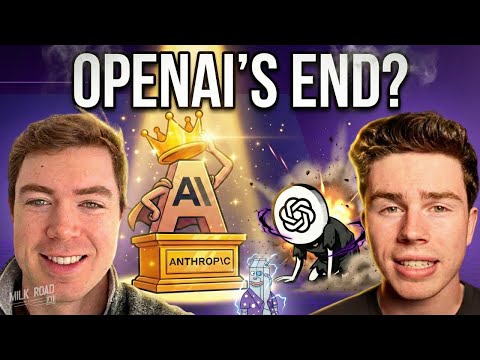
Trillion-dollar AI compute investments create market divergence: immediate monetization (Meta) is rewarded, while slower conversion (Microsoft) faces skepticism, as geopolitical tensions rise over open-source model parity.
Prioritize AI models balancing raw intelligence with superior user experience and collaborative features, as developer loyalty and enterprise adoption increasingly hinge on usability.
The AI landscape is rapidly reordering. Investors and builders must assess monetization pathways, geopolitical implications, and AI's social contract over the next 6-12 months.
The Macro Trend: The transition from opaque scaling to verifiable reasoning.
The Tactical Edge: Audit your models for brittleness by testing them on edge cases that require first principles logic rather than historical data.
The Bottom Line: The next winners in AI will not have the biggest models but the most verifiable ones. If you cannot prove how a model reached a conclusion, you cannot trust it in production.
The transition from more data to better thinking via inference-time compute. Reasoning is becoming a post-training capability rather than a pre-training byproduct.
Use AI for anti-gravity coding to automate bug fixes and data visualization. Treat the model as a passive aura that buffs the productivity of every senior engineer.
AGI will not be a collection of narrow tools but a single model that reasons its way through any domain. The gap between closed labs and open source is widening as these reasoning tricks compound.
The transition from static LLMs to interactive world models marks the move from AI as a tool to AI as a persistent environment.
Monitor the Hugging Face release of the 2B model to build custom image-to-experience wrappers for niche training or spatial entertainment.
Local world models will become the primary interface for spatial computing within the next year, making high-end local compute more valuable than cloud-based streaming.
The Strategic Pivot: The transition from "Understanding-First" science to "Prediction-First" engineering. We are building artifacts that work perfectly but remain theoretically opaque.
The Tactical Edge: Audit your AI stack for "Leaky Abstractions." Don't assume a model's reasoning capabilities in one domain will hold when the underlying causal structure changes.
AGI isn't just an engineering milestone; it's a philosophical wager. If the brain isn't a computer, we are building a very powerful helicopter, not a synthetic human.
The pivot from "Understanding-First" science to "Prediction-First" engineering creates massive technical liability in our models.
Audit your AI implementations for "Leaky Abstractions" where the model fails to account for physical edge cases.
High-performance automation is not the same as sentient reasoning. Builders who recognize this distinction will avoid the cultural illusion of inevitable AGI.
The transition from deterministic software to agentic networks. Companies are moving from rigid workflows to fluid systems that plan and execute autonomously.
Build an internal LLM gateway early. Centralizing model routing and cost monitoring allows you to swap providers as the model horse race changes without refactoring your product.
AI is not just a feature but a fundamental restructuring of the corporate cost center. Efficiency gains allow a static headcount of 300 engineers to support a business growing 5x.
Bitcoin's market behavior is increasingly dictated by sophisticated derivatives trading and institutional financial engineering, moving beyond historical halving cycles. Understanding TradFi options mechanics is crucial for predicting Bitcoin.
Monitor IBIT options market activity and implied volatility metrics closely, as these drive Bitcoin's short-term price action. Understand and capitalize on volatility mispricings or dealer hedging.
Simple Bitcoin narratives are over. Investors and builders must understand the complex interplay of traditional finance derivatives and market structure to navigate Bitcoin's future price movements over the next 6-12 months.
The speculative idea of AI agents driving quadrillions of transactions on crypto rails is rapidly becoming a foundational economic reality. This demand for high-throughput, low-cost, decentralized settlement is forcing a re-evaluation of blockchain architecture and token utility.
Identify and invest in protocols and chains that are demonstrably attracting institutional capital and building infrastructure for AI agent economies, particularly those solving for extreme scalability and near-zero transaction costs.
The next 6-12 months will see a clear bifurcation in the crypto market: assets with genuine utility and institutional adoption will separate from pure meme plays. Simultaneously, the accelerating capabilities of AI will demand increasingly robust and efficient onchain infrastructure, making the intersection of AI and crypto the most critical frontier.
The AI revolution is driving a massive capital concentration into infrastructure and asset ownership, creating a stark wealth divide that will likely precede political calls for redistribution.
Invest in hard assets and companies directly supporting AI infrastructure, while actively integrating AI tools into your skillset to become indispensable in your current role.
Position your capital and career now to benefit from the AI-driven wealth transfer, as money is cheap relative to the future value consolidated by AI builders, making this a critical window for strategic allocation.
Permissionless L2: Robinhood Chain is an open, permissionless Ethereum L2. This means anyone can build on it, contrasting sharply with the closed, proprietary blockchain initiatives from NASDAQ and NYSE.
Financial System Upgrade: Robinhood sees blockchain as a core technology to replace outdated financial systems, enabling 24/7 trading and instant settlement for traditional assets. This vision could fundamentally change how equities and other real-world assets are traded globally.
First User Advantage: Robinhood itself will be the primary user of its chain, customizing it for its needs while allowing other institutions to leverage its infrastructure. This positions Robinhood as both a platform provider and a leading innovator in tokenized finance.
The Macro Shift: As global monetary systems face increasing instability, institutional capital is seeking transparent, programmable, and yield-bearing alternatives in digital assets. This is driving a "revenue meta" where fundamental value accrual and robust risk management are paramount.
The Tactical Edge: Identify protocols and companies building infrastructure that bridges TradFi and DeFi with verifiable, RWA-backed yields and clear risk parameters. Prioritize those with strong institutional partnerships and a focus on sustainable, exogenous yield sources.
The Bottom Line: The next 6-12 months will see a continued influx of institutional capital into crypto, favoring platforms that offer predictable, risk-managed exposure to digital assets and real-world yields. Builders should focus on robust, transparent infrastructure, while investors should seek out projects with clear value accrual and institutional adoption.
The rise of autonomous AI agents is creating a new economic layer that demands blockchain's trustless execution and privacy guarantees. This shift will reprice traditional SaaS and middleman businesses, favoring direct agent-to-agent commerce.
Invest in infrastructure that provides secure credential management, sandboxed execution, and chain-agnostic payment rails for AI agents. Prioritize protocols actively building post-quantum secure primitives and native account abstraction.
The next 6-12 months will see a rapid acceleration in agentic capabilities and on-chain economic activity. Builders and investors must focus on privacy, security, and interoperability to capture value in this emerging, agent-driven internet.