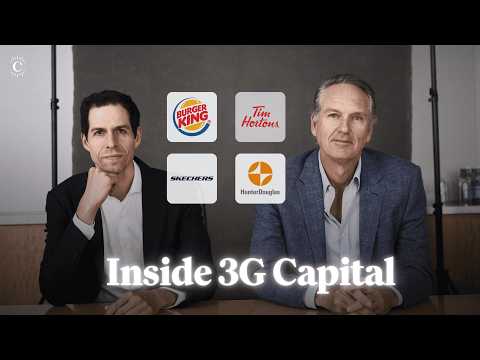
3G commits to one investment per fund, deploying significant internal capital alongside partners. This focus allows for rigorous downside analysis and patience, ensuring only truly exceptional businesses are acquired.
3G partners are seasoned operators who step into businesses, aligning incentives with ownership. This hands-on approach ensures decisions serve the business's long-term health, not just short-term management goals.
3G prioritizes businesses that directly own their customer relationships, like Burger King or Hunter Douglas. This direct connection reduces disintermediation risk from retailers or new technologies.
As capital markets become increasingly efficient and competitive, the edge moves from financial engineering to deep operational expertise and long-term, owner-aligned management.
Prioritize identifying and enabling high-potential individuals early in their careers, granting them significant responsibility and ownership.
Disciplined focus, patient relationship building, and an unwavering commitment to operational excellence in established, defensible businesses can still yield generational wealth.
The Macro Trend: In a world obsessed with digital disruption, 3G Capital's success with "atoms over bits" businesses highlights a strategic pivot: enduring value often resides in established brands with proprietary customer relationships, where operational excellence and long-term thinking create moats against fleeting tech trends.
The Tactical Edge: Identify businesses with strong, direct customer relationships and a clear path for operational improvement, even if they appear "boring." Prioritize deep, hands-on involvement to drive value, rather than relying solely on financial engineering.
The Bottom Line: The future of outsized returns may not be in chasing the next big tech wave, but in patiently acquiring and meticulously operating businesses that own their customer relationships, leveraging technology to enhance, not redefine, their core value. This strategy offers a more predictable, less volatile path to compounding capital.
The Macro Shift: In a world obsessed with digital disruption, 3G Capital's success highlights the enduring power of "hard" businesses with strong customer relationships. Their focus on foundational consumer brands, managed by operator-investors who prioritize long-term ownership and disciplined execution, offers a robust counter-narrative to the "bits over atoms" trend.
The Tactical Edge: Cultivate an extreme ownership culture by aligning incentives deeply, empowering young talent with real responsibility, and fostering a relentless bias for action.
The Bottom Line: For investors and builders, the lesson is clear: patience, deep operational involvement, and a fanatical focus on talent in defensible, "boring" businesses can yield extraordinary, long-term value, even in expensive markets.
Extreme Focus: 3G Capital commits to one investment per fund, deploying significant internal capital alongside partners. This singular focus forces rigorous downside analysis and patience, ensuring they only pursue truly exceptional opportunities.
Owner Operators: 3G partners are seasoned operators who step into businesses, aligning incentives with ownership. This means leaders act like shareholders, making decisions for the business's long-term health, not just short-term management goals.
Disruption Defense: 3G prioritizes businesses with strong customer relationships and physical components, making them less susceptible to digital disintermediation. They seek enduring brands like Hunter Douglas, where the sun will always rise and set, ensuring a consistent need for their product.
In an era of rapid technological change, businesses with strong, direct customer relationships and physical moats are increasingly valuable. 3G's focus on these "atoms" businesses, enhanced by strategic tech adoption, provides a blueprint for durable value creation.
Cultivate an ownership culture by aligning incentives deeply, empowering young talent with real responsibility, and prioritizing long-term value over short-term gains.
The future belongs to patient, operator-led investors who can identify and transform enduring businesses by focusing on fundamental quality, people, and strategic technological integration, rather than chasing fleeting trends.
3G Capital's model counters this by doubling down on "atoms" businesses with strong customer relationships and defensible positions, then applying rigorous operational excellence.
Cultivate an owner-operator mindset within your organization, even if you are not a private equity firm. Identify and back high-potential young talent with significant responsibility and aligned incentives, providing mentorship to maximize their success.
In a world obsessed with speed and diversification, 3G Capital proves that deep, patient, operator-led concentration on high-quality, defensible businesses, combined with a culture of ownership and meritocracy, remains a powerful engine for outsized value creation.
The era of celebrity endorsements is evolving into one of celebrity ownership, driven by a growing understanding of equity's compounding power and enabled by new technologies that lower the barrier to business creation.
Prioritize building a diverse, expert team and actively seek out "boring" businesses or underserved markets with clear, unmet demand.
The next 6-12 months will see an acceleration of talent leveraging their brand for equity stakes, particularly in tech-enabled ventures. Position yourself to either participate in these deals or build the tools that empower this new class of owner-operators.
Bitcoin's market behavior is increasingly dictated by sophisticated derivatives trading and institutional financial engineering, moving beyond historical halving cycles. Understanding TradFi options mechanics is crucial for predicting Bitcoin.
Monitor IBIT options market activity and implied volatility metrics closely, as these drive Bitcoin's short-term price action. Understand and capitalize on volatility mispricings or dealer hedging.
Simple Bitcoin narratives are over. Investors and builders must understand the complex interplay of traditional finance derivatives and market structure to navigate Bitcoin's future price movements over the next 6-12 months.
The speculative idea of AI agents driving quadrillions of transactions on crypto rails is rapidly becoming a foundational economic reality. This demand for high-throughput, low-cost, decentralized settlement is forcing a re-evaluation of blockchain architecture and token utility.
Identify and invest in protocols and chains that are demonstrably attracting institutional capital and building infrastructure for AI agent economies, particularly those solving for extreme scalability and near-zero transaction costs.
The next 6-12 months will see a clear bifurcation in the crypto market: assets with genuine utility and institutional adoption will separate from pure meme plays. Simultaneously, the accelerating capabilities of AI will demand increasingly robust and efficient onchain infrastructure, making the intersection of AI and crypto the most critical frontier.
The AI revolution is driving a massive capital concentration into infrastructure and asset ownership, creating a stark wealth divide that will likely precede political calls for redistribution.
Invest in hard assets and companies directly supporting AI infrastructure, while actively integrating AI tools into your skillset to become indispensable in your current role.
Position your capital and career now to benefit from the AI-driven wealth transfer, as money is cheap relative to the future value consolidated by AI builders, making this a critical window for strategic allocation.
Permissionless L2: Robinhood Chain is an open, permissionless Ethereum L2. This means anyone can build on it, contrasting sharply with the closed, proprietary blockchain initiatives from NASDAQ and NYSE.
Financial System Upgrade: Robinhood sees blockchain as a core technology to replace outdated financial systems, enabling 24/7 trading and instant settlement for traditional assets. This vision could fundamentally change how equities and other real-world assets are traded globally.
First User Advantage: Robinhood itself will be the primary user of its chain, customizing it for its needs while allowing other institutions to leverage its infrastructure. This positions Robinhood as both a platform provider and a leading innovator in tokenized finance.
The Macro Shift: As global monetary systems face increasing instability, institutional capital is seeking transparent, programmable, and yield-bearing alternatives in digital assets. This is driving a "revenue meta" where fundamental value accrual and robust risk management are paramount.
The Tactical Edge: Identify protocols and companies building infrastructure that bridges TradFi and DeFi with verifiable, RWA-backed yields and clear risk parameters. Prioritize those with strong institutional partnerships and a focus on sustainable, exogenous yield sources.
The Bottom Line: The next 6-12 months will see a continued influx of institutional capital into crypto, favoring platforms that offer predictable, risk-managed exposure to digital assets and real-world yields. Builders should focus on robust, transparent infrastructure, while investors should seek out projects with clear value accrual and institutional adoption.
The rise of autonomous AI agents is creating a new economic layer that demands blockchain's trustless execution and privacy guarantees. This shift will reprice traditional SaaS and middleman businesses, favoring direct agent-to-agent commerce.
Invest in infrastructure that provides secure credential management, sandboxed execution, and chain-agnostic payment rails for AI agents. Prioritize protocols actively building post-quantum secure primitives and native account abstraction.
The next 6-12 months will see a rapid acceleration in agentic capabilities and on-chain economic activity. Builders and investors must focus on privacy, security, and interoperability to capture value in this emerging, agent-driven internet.