The rise of autonomous AI agents will fundamentally reshape the app economy, rendering many single-purpose applications obsolete as agents integrate and automate tasks across systems. This forces companies to either become agent-facing APIs or risk irrelevance.
Cultivate "agent empathy" by understanding how models perceive codebases and problems. This skill, combined with a willingness to experiment and "play," is crucial for effectively guiding agents to build and refactor software.
The agentic AI era demands a shift from traditional programming to a builder mindset, where human creativity and strategic guidance become paramount. Investors should seek platforms enabling this shift, and builders must adapt to a world where natural language is the new code.
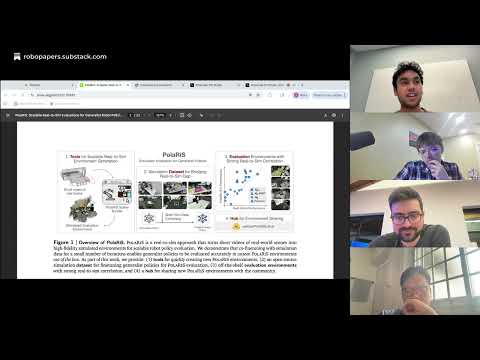
Robotics is moving towards generalist policies, demanding scalable, high-fidelity evaluation tools that mirror the real world, away from task-specific benchmarks.
Adopt PolaRiS for rapid policy iteration and generalization testing, especially for pick-and-place tasks, leveraging easy environment creation and proven real-to-sim correlation.
PolaRiS provides critical infrastructure for accelerating robot learning, enabling builders to quickly validate policies against real-world performance without prohibitive cost.
AI agents are transforming software development from a manual coding craft into an "agentic engineering" discipline, where human builders orchestrate and guide autonomous AI systems. This shift means the value moves from writing boilerplate code to designing agent-friendly architectures and providing high-level strategic direction.
Embrace agentic engineering by learning to "empathize" with AI models, understanding their context limitations, and guiding them with concise, clear prompts. Experiment with open-source agents like OpenClaw to build new tools or automate existing workflows, focusing on the what and why rather than the how.
Personal AI agents will commoditize many existing apps and services, forcing companies to either become agent-facing APIs or risk obsolescence. Investors should identify platforms and infrastructure that enable agent interoperability, while builders should focus on creating agent-native experiences and tools that augment human creativity, rather than replicating existing app functionality.
Robotics is moving beyond isolated tasks to generalist policies, demanding scalable, correlated evaluation methods. This mirrors the LLM world's need for diverse, generalization-focused benchmarks.
Utilize PolaRiS's open-source tools and Hugging Face hub to quickly create and share new evaluation environments. This crowdsourcing approach accelerates community-wide progress in robot policy development.
Investing in tools like PolaRiS that bridge the real-sim gap with high-fidelity visuals and minimal sim co-training is crucial. This enables faster policy iteration and more reliable real-world deployment for the next generation of generalist robots.
The macro shift: Generalist robot policies need generalist evaluation. The shift is from hand-crafted, task-specific sim environments to easily generated, real-world-correlated simulations that test zero-shot generalization, mirroring the rapid benchmark development in LLMs. This allows for a holistic understanding of policy capabilities across diverse, unseen scenarios.
The tactical edge: Adopt PolaRiS for rapid policy iteration. Builders should use its browser-based scene builder and Gaussian Splatting to quickly create new, diverse evaluation environments from real-world scans, then fine-tune policies with small, unrelated sim data to achieve high real-to-sim correlation. This accelerates development cycles and reduces costly real-world testing.
The future of robotics hinges on scalable, trustworthy evaluation. PolaRiS provides a critical tool today to bridge the sim-to-real gap, enabling faster, more reliable development of generalist robot policies. Expect a community-driven explosion of benchmarks, pushing robot capabilities faster than ever over the next 6-12 months.
The robotics community needs to move beyond task-specific benchmarks with provided training data towards a diverse suite of generalization-focused evaluations, mirroring the LLM ecosystem. PolaRiS provides the tools to crowdsource and rapidly deploy these new benchmarks, fostering a more holistic understanding of robot policy capabilities.
For robot policy developers, prioritize tools like PolaRiS that offer high real-to-sim correlation with minimal setup. Leverage its browser-based scene builder and the "visual vaccination" co-training method to quickly iterate on policies for pick-and-place and articulated object tasks, then validate on real hardware.
Scalable, correlated simulation is the missing piece for accelerating generalist robot AI. Over the next 6-12 months, the adoption of tools like PolaRiS will enable faster policy iteration, more robust benchmarking, and ultimately, a quicker path to deploying capable robots in diverse, unstructured environments.
The robotics community is moving from hand-crafted, task-specific simulations to generalist policies that demand scalable, real-world correlated evaluation. PolaRiS enables this by making it cheap and easy to create diverse, high-fidelity sim environments from real scans, allowing for generalization testing akin to LLM benchmarks.
Implement PolaRiS for rapid policy iteration. Use its real-to-sim environment generation and minimal, unrelated sim data co-training to quickly validate robot policies against real-world performance, reducing costly physical robot time.
PolaRiS offers a critical infrastructure upgrade for robot AI development. By providing a fast, reproducible, and highly correlated simulation environment, it allows builders to iterate on generalist robot policies at software speed, significantly de-risking and accelerating the path to real-world deployment and broader robot capabilities over the next 6-12 months.
The drive for generalist robot policies demands scalable, reliable evaluation. PolaRiS pushes robotics toward the community-driven, diverse benchmarking common in LLMs, accelerating the path to truly capable robots.
Adopt PolaRiS for rapid policy iteration and generalization testing. Leverage its easy environment creation and proven real-to-sim correlation to quickly validate new robot behaviors before costly real-world deployment.
PolaRiS is a critical tool for any team building robot policies. It cuts evaluation costs, speeds up development, and provides a trustworthy signal for real-world performance, making it a must-have for your robotics roadmap over the next 6-12 months.
Builders should prioritize hybrid real-to-sim evaluation tools like PolaRiS for rapid policy iteration.
Use minimal, out-of-domain sim data to align policies to the simulation environment, ensuring your sim results accurately predict real-world performance.
Investing in tools that democratize benchmark creation and ensure strong real-to-sim correlation will accelerate robot policy development.
Bitcoin's market behavior is increasingly dictated by sophisticated derivatives trading and institutional financial engineering, moving beyond historical halving cycles. Understanding TradFi options mechanics is crucial for predicting Bitcoin.
Monitor IBIT options market activity and implied volatility metrics closely, as these drive Bitcoin's short-term price action. Understand and capitalize on volatility mispricings or dealer hedging.
Simple Bitcoin narratives are over. Investors and builders must understand the complex interplay of traditional finance derivatives and market structure to navigate Bitcoin's future price movements over the next 6-12 months.
The speculative idea of AI agents driving quadrillions of transactions on crypto rails is rapidly becoming a foundational economic reality. This demand for high-throughput, low-cost, decentralized settlement is forcing a re-evaluation of blockchain architecture and token utility.
Identify and invest in protocols and chains that are demonstrably attracting institutional capital and building infrastructure for AI agent economies, particularly those solving for extreme scalability and near-zero transaction costs.
The next 6-12 months will see a clear bifurcation in the crypto market: assets with genuine utility and institutional adoption will separate from pure meme plays. Simultaneously, the accelerating capabilities of AI will demand increasingly robust and efficient onchain infrastructure, making the intersection of AI and crypto the most critical frontier.
The AI revolution is driving a massive capital concentration into infrastructure and asset ownership, creating a stark wealth divide that will likely precede political calls for redistribution.
Invest in hard assets and companies directly supporting AI infrastructure, while actively integrating AI tools into your skillset to become indispensable in your current role.
Position your capital and career now to benefit from the AI-driven wealth transfer, as money is cheap relative to the future value consolidated by AI builders, making this a critical window for strategic allocation.
Permissionless L2: Robinhood Chain is an open, permissionless Ethereum L2. This means anyone can build on it, contrasting sharply with the closed, proprietary blockchain initiatives from NASDAQ and NYSE.
Financial System Upgrade: Robinhood sees blockchain as a core technology to replace outdated financial systems, enabling 24/7 trading and instant settlement for traditional assets. This vision could fundamentally change how equities and other real-world assets are traded globally.
First User Advantage: Robinhood itself will be the primary user of its chain, customizing it for its needs while allowing other institutions to leverage its infrastructure. This positions Robinhood as both a platform provider and a leading innovator in tokenized finance.
The Macro Shift: As global monetary systems face increasing instability, institutional capital is seeking transparent, programmable, and yield-bearing alternatives in digital assets. This is driving a "revenue meta" where fundamental value accrual and robust risk management are paramount.
The Tactical Edge: Identify protocols and companies building infrastructure that bridges TradFi and DeFi with verifiable, RWA-backed yields and clear risk parameters. Prioritize those with strong institutional partnerships and a focus on sustainable, exogenous yield sources.
The Bottom Line: The next 6-12 months will see a continued influx of institutional capital into crypto, favoring platforms that offer predictable, risk-managed exposure to digital assets and real-world yields. Builders should focus on robust, transparent infrastructure, while investors should seek out projects with clear value accrual and institutional adoption.
The rise of autonomous AI agents is creating a new economic layer that demands blockchain's trustless execution and privacy guarantees. This shift will reprice traditional SaaS and middleman businesses, favoring direct agent-to-agent commerce.
Invest in infrastructure that provides secure credential management, sandboxed execution, and chain-agnostic payment rails for AI agents. Prioritize protocols actively building post-quantum secure primitives and native account abstraction.
The next 6-12 months will see a rapid acceleration in agentic capabilities and on-chain economic activity. Builders and investors must focus on privacy, security, and interoperability to capture value in this emerging, agent-driven internet.