The rise of autonomous AI agents will fundamentally reshape the app economy, rendering many single-purpose applications obsolete as agents integrate and automate tasks across systems. This forces companies to either become agent-facing APIs or risk irrelevance.
Cultivate "agent empathy" by understanding how models perceive codebases and problems. This skill, combined with a willingness to experiment and "play," is crucial for effectively guiding agents to build and refactor software.
The agentic AI era demands a shift from traditional programming to a builder mindset, where human creativity and strategic guidance become paramount. Investors should seek platforms enabling this shift, and builders must adapt to a world where natural language is the new code.
Robotics is moving towards generalist policies, demanding scalable, high-fidelity evaluation tools that mirror the real world, away from task-specific benchmarks.
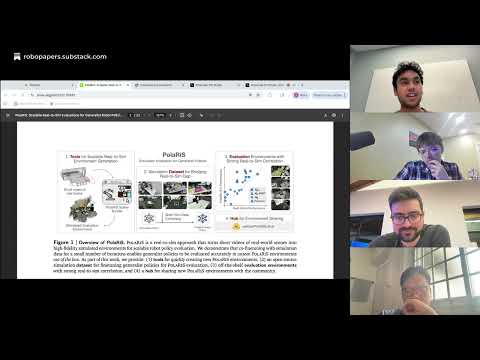
Adopt PolaRiS for rapid policy iteration and generalization testing, especially for pick-and-place tasks, leveraging easy environment creation and proven real-to-sim correlation.
PolaRiS provides critical infrastructure for accelerating robot learning, enabling builders to quickly validate policies against real-world performance without prohibitive cost.
AI agents are transforming software development from a manual coding craft into an "agentic engineering" discipline, where human builders orchestrate and guide autonomous AI systems. This shift means the value moves from writing boilerplate code to designing agent-friendly architectures and providing high-level strategic direction.
Embrace agentic engineering by learning to "empathize" with AI models, understanding their context limitations, and guiding them with concise, clear prompts. Experiment with open-source agents like OpenClaw to build new tools or automate existing workflows, focusing on the what and why rather than the how.
Personal AI agents will commoditize many existing apps and services, forcing companies to either become agent-facing APIs or risk obsolescence. Investors should identify platforms and infrastructure that enable agent interoperability, while builders should focus on creating agent-native experiences and tools that augment human creativity, rather than replicating existing app functionality.
Robotics is moving beyond isolated tasks to generalist policies, demanding scalable, correlated evaluation methods. This mirrors the LLM world's need for diverse, generalization-focused benchmarks.
Utilize PolaRiS's open-source tools and Hugging Face hub to quickly create and share new evaluation environments. This crowdsourcing approach accelerates community-wide progress in robot policy development.
Investing in tools like PolaRiS that bridge the real-sim gap with high-fidelity visuals and minimal sim co-training is crucial. This enables faster policy iteration and more reliable real-world deployment for the next generation of generalist robots.
The macro shift: Generalist robot policies need generalist evaluation. The shift is from hand-crafted, task-specific sim environments to easily generated, real-world-correlated simulations that test zero-shot generalization, mirroring the rapid benchmark development in LLMs. This allows for a holistic understanding of policy capabilities across diverse, unseen scenarios.
The tactical edge: Adopt PolaRiS for rapid policy iteration. Builders should use its browser-based scene builder and Gaussian Splatting to quickly create new, diverse evaluation environments from real-world scans, then fine-tune policies with small, unrelated sim data to achieve high real-to-sim correlation. This accelerates development cycles and reduces costly real-world testing.
The future of robotics hinges on scalable, trustworthy evaluation. PolaRiS provides a critical tool today to bridge the sim-to-real gap, enabling faster, more reliable development of generalist robot policies. Expect a community-driven explosion of benchmarks, pushing robot capabilities faster than ever over the next 6-12 months.
The robotics community needs to move beyond task-specific benchmarks with provided training data towards a diverse suite of generalization-focused evaluations, mirroring the LLM ecosystem. PolaRiS provides the tools to crowdsource and rapidly deploy these new benchmarks, fostering a more holistic understanding of robot policy capabilities.
For robot policy developers, prioritize tools like PolaRiS that offer high real-to-sim correlation with minimal setup. Leverage its browser-based scene builder and the "visual vaccination" co-training method to quickly iterate on policies for pick-and-place and articulated object tasks, then validate on real hardware.
Scalable, correlated simulation is the missing piece for accelerating generalist robot AI. Over the next 6-12 months, the adoption of tools like PolaRiS will enable faster policy iteration, more robust benchmarking, and ultimately, a quicker path to deploying capable robots in diverse, unstructured environments.
The robotics community is moving from hand-crafted, task-specific simulations to generalist policies that demand scalable, real-world correlated evaluation. PolaRiS enables this by making it cheap and easy to create diverse, high-fidelity sim environments from real scans, allowing for generalization testing akin to LLM benchmarks.
Implement PolaRiS for rapid policy iteration. Use its real-to-sim environment generation and minimal, unrelated sim data co-training to quickly validate robot policies against real-world performance, reducing costly physical robot time.
PolaRiS offers a critical infrastructure upgrade for robot AI development. By providing a fast, reproducible, and highly correlated simulation environment, it allows builders to iterate on generalist robot policies at software speed, significantly de-risking and accelerating the path to real-world deployment and broader robot capabilities over the next 6-12 months.
The drive for generalist robot policies demands scalable, reliable evaluation. PolaRiS pushes robotics toward the community-driven, diverse benchmarking common in LLMs, accelerating the path to truly capable robots.
Adopt PolaRiS for rapid policy iteration and generalization testing. Leverage its easy environment creation and proven real-to-sim correlation to quickly validate new robot behaviors before costly real-world deployment.
PolaRiS is a critical tool for any team building robot policies. It cuts evaluation costs, speeds up development, and provides a trustworthy signal for real-world performance, making it a must-have for your robotics roadmap over the next 6-12 months.
Builders should prioritize hybrid real-to-sim evaluation tools like PolaRiS for rapid policy iteration.
Use minimal, out-of-domain sim data to align policies to the simulation environment, ensuring your sim results accurately predict real-world performance.
Investing in tools that democratize benchmark creation and ensure strong real-to-sim correlation will accelerate robot policy development.
Authenticity Over Algorithms: Ditch the generic social media playbook; your genuine interest in a specific crypto niche is your most potent growth tool.
Niche Down to Blow Up: Become the go-to source for your specific passion (e.g., memecoins, DeFi protocols) by sharing your unique process and insights.
The Audience Knows: Users can "sniff out" disingenuous content. Real interest and transparent sharing build trust and attract a loyal following.
**Risk Re-Priced**: Post-2022, understanding and mitigating counterparty and correlated risk is paramount; high returns often masked these dangers.
**TradFi Rails Accelerate Crypto**: Publicly traded vehicles and ETFs are becoming key on-ramps, channeling traditional capital into crypto and reshaping market dynamics, notably compressing volatility.
**Fundamental & On-Chain Focus**: Durable value (on-chain credit, strong L1s like Solana, revenue-generating protocols) and innovative on-chain derivatives platforms (like Hyperliquid) are prime areas of growth and investor interest.
App Revenue as a Current Yardstick: For now, L1 "GDP" (market cap / app revenue) offers a more stable cross-chain valuation tool than direct fees, providing an "apples-to-apples" comparison.
The Inevitable Value Shift: Expect a future where applications, not L1s, capture the lion's share of value, as app take rates and business models mature. L1 valuations may compress as app valuations expand.
L1s Must Innovate to Retain Value: Blockchains like Solana are actively strategizing (e.g., application-specific sequencing) to keep successful apps within their ecosystems, highlighting the growing pressure on L1s to prove their enduring value proposition beyond basic infrastructure.
Treasury Strategies: High-Risk, Short-Term Plays: These vehicles are built for quick flips, not lasting value, with a high chance of premiums vanishing and values dropping below NAV.
Beware the "Mania": The proliferation of treasury vehicles with increasingly lax terms signals a speculative fever; MicroStrategy is an outlier, not the rule.
VCs Bet on Endurance: True crypto investing, from a venture perspective, demands patience and a focus on fundamental, long-term growth, distinct from chasing fleeting treasury premiums.
**Scale is King:** Sub-$3 billion valuation companies will struggle for analyst attention and institutional investment post-IPO.
**SaaS Sells:** Crypto firms with predictable, recurring revenue (like Fireblocks, Chainalysis) have a stronger IPO narrative than those riding crypto price waves.
**Trust is Currency:** For select businesses like Anchorage, an IPO isn't just about capital; it’s a strategic move to bolster their fundamental value proposition—trust.
Solana's ETF = Major Validation: If approved, a Solana ETF isn't just another fund; it's a significant nod to Solana's legitimacy and a big win for its community.
Beyond Single Assets - Think Indices: The success of individual crypto ETFs (like a potential Solana one) could fuel demand for broader market products, such as crypto index funds on traditional stock exchanges.
Staking in ETFs - Tax Clarity Coming?: Watch for regulatory updates on staking within ETFs. Positive guidance could unlock new product structures and resolve key tax concerns for investors.