The automotive industry is undergoing a significant architectural change, moving from fragmented, hardware-centric systems to vertically integrated, AI-powered software-defined vehicles. This demands re-platforming, making legacy automakers vulnerable.
Invest in or build companies controlling their full technology stack: custom silicon, sensor arrays, data collection, AI model training. Vertical integration is key to cost efficiency and rapid iteration for mass-market AI autonomy.
The next few years will see dramatic divergence. Companies mastering AI-driven autonomy and software-defined architectures, like Rivian with its R2, will capture significant market share by offering compelling, continuously improving vehicles at scale. Others face obsolescence.
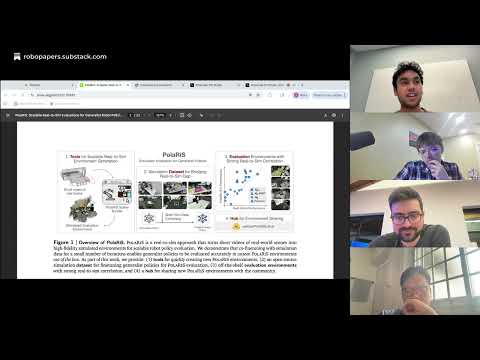
The robotics community is moving beyond task-specific benchmarks towards generalist policy evaluation, mirroring the LLM trend of testing off-the-shelf models on unseen tasks. This demands scalable, high-fidelity simulation tools that can quickly generate diverse test environments.
Builders and researchers should prioritize evaluation tools that offer strong real-to-sim correlation, even if it means a hybrid approach (like PolaRiS) over purely data-driven world models. Utilize real-to-sim environment generation (Gaussian splatting) and strategic sim data co-training to accelerate policy iteration.
PolaRiS offers a path to community-driven, crowdsourced robot benchmarks, making policy development faster and more robust. Expect a future where robot policies are evaluated across a broad suite of easily created, diverse simulated environments, pushing the boundaries of generalization and real-world applicability.
Generalist robot policies need robust, scalable evaluation. The shift is from bespoke, real-world-only testing to a hybrid real-to-sim approach that leverages modern 3D reconstruction and minimal sim data to create highly correlated, reproducible benchmarks.
Builders should adopt PolaRiS's real-to-sim environment generation and "sim co-training" methodology. This allows for rapid, cost-effective iteration on robot policies, ensuring that improvements in simulation translate directly to real-world gains.
Over the next 6-12 months, the ability to quickly and reliably evaluate robot policies in simulation will be a critical differentiator. PolaRiS provides the tools to build diverse, generalization-focused benchmarks, moving robotics closer to the rapid iteration cycles of other AI fields.
Tesla's core identity shifted from EV maker to autonomous AI and robotics. Its cars are devices for deploying its advanced AI brain; competitors miss this.
Tesla's 8 million cars collect real-world driving data. This massive dataset, combined with in-house AI processing, creates an unparalleled moat impossible for competitors to replicate.
This convergence creates an abundance of labor and transportation, driving down costs. Robo-taxis and humanoid robots automate tasks, making goods and services cheaper, even as Tesla's profitability soars.
Robotics is moving towards generalist policies that need broad, diverse evaluation. PolaRiS enables this by making it easy to create and share new, correlated benchmarks, cultivating a community-driven evaluation ecosystem similar to LLMs.
Adopt PolaRiS for rapid policy iteration on pick-and-place and articulated object tasks. Use its browser-based scene builder and existing assets to quickly create new evaluation environments, then fine-tune policies with a small amount of unrelated sim data to boost real-to-sim correlation.
Investing in tools like PolaRiS now means faster development cycles and more reliable policy improvements. This accelerates the path to robust, real-world robot deployment by providing a scalable, trustworthy intermediate testing ground.
PolaRiS enables a shift towards LLM-style generalization benchmarks, where models are tested on unseen environments and tasks, accelerating robot capabilities.
Use its browser-based scene builder and Gaussian splatting to quickly create diverse, real-world correlated evaluation environments, significantly reducing the cost and time of real robot testing.
Cheap, reliable robot policy evaluation in simulation, with strong real-world correlation, means faster development cycles, more robust generalist robots, and a path to crowdsourced, diverse benchmarks that will push the entire field forward.
AI is forcing a fundamental architectural change in automotive, moving from fragmented, rules-based systems to vertically integrated, neural network-powered platforms. This technical reality dictates market survival, favoring companies that control their entire software and hardware stack to build a continuous data flywheel.
Invest in or partner with companies demonstrating deep vertical integration in AI hardware and software for mobility. Prioritize those with a clear path to mass-market data collection and rapid iteration cycles.
Autonomy will be a must-have feature in cars within the next few years. Companies without a software-defined architecture and a vertically integrated AI stack will struggle to compete, creating a market share shift towards those few players who can deliver true self-driving at scale.
The automotive industry is undergoing a fundamental re-architecture, moving from hardware-centric, rules-based systems to software-defined, AI-powered platforms. This shift favors companies with deep vertical integration and proprietary data flywheels.
Invest in companies demonstrating full-stack control over their vehicle's software, hardware, and AI training data. This verticality is the moat against commoditization and the engine for rapid, continuous improvement.
Autonomy will be a non-negotiable feature by 2030, making software-defined vehicles the only viable path for mass-market automakers. Companies that fail to build or acquire this capability will face market irrelevance.
Tesla's core business is AI and autonomous robotics. This means its value comes from its software and data moat, not just vehicle sales.
Tesla is sunsetting Model S and X production to convert factories for humanoid robots. This signals a full commitment to autonomous devices beyond cars.
Unsupervised FSD is expected in select US states by Q2. This will enable cars to operate without human oversight, unlocking the robo-taxi network.
Business Models Over Memes: The new meta is clear: tokens must generate revenue. The most valuable assets will be those with defensible, on-chain business models, not just compelling narratives.
The 4-Year Cycle is Dead: Forget halving-driven bull runs. We are in the first inning of a multi-year institutional adoption cycle, creating a sustained "global buy order" for legitimate crypto assets and related equities.
Pick a Side (Token vs. Equity): The most critical question for any project is where value accrues. Investors must demand clarity on whether they are backing a decentralized network or a traditional company leveraging crypto rails.
Demand Cash Flow: The next crypto "Mag 7" will be defined by protocols with real, on-chain revenue and clear business models, not just speculative narratives.
Bet on Yield: The predicted $3.7 trillion influx into stablecoins will disproportionately benefit yield-generating protocols, offering a prime opportunity as they re-rate to reflect their cash-generating power.
The 4-Year Cycle is Dead: Forget the halving. Institutional capital entering via ETFs and public equities is transforming crypto into a multi-year bull market, fueled by a slow, steady global "T-WAP" of capital.
The IPO Pipeline is Live: Circle's 10x IPO created a clear playbook. Watch private crypto leaders like Kraken and Fireblocks. Their public listings will be a crucial bellwether for the industry's mainstream acceptance.
Watch Bitcoin Dominance, Not the Noise: A high and rising Bitcoin dominance is a coiled spring. When it finally breaks, it will likely break fast, signaling the true, explosive start of the next altcoin season.
Crypto is Now a Political Asset: A directive ordering Fannie Mae and Freddie Mac to prepare for crypto-backed mortgages shows that digital assets have officially entered the political arena. This top-down push for legitimacy is a powerful tailwind, even if bottom-up bank adoption lags.
Build for Joy, Not Just Gains. The most defensible moat is emotional utility. Create a product people love, then use crypto to enhance it—not the other way around. No amount of financial engineering can fix a crappy product.
Speak Human, Not Crypto. Ditch "Create Wallet" for "Create Account." The tech is 90% there, but the language and branding are the final, crucial 10%. The battle for the next billion users will be won with words, not just code.
Value Will Accrue at the App Layer. The next decade's unicorns will be consumer apps built on the rails, not the rails themselves. If the apps on a chain aren't eventually worth more than the chain, the entire model is broken.
Prediction Markets are Mainstream. Polymarket has become a go-to source for real-time sentiment, proving that markets can be more trusted indicators than media pundits. Its cultural embedding is a masterclass in product-market fit.
Memecoins are a Consumer Business. Pump.fun’s financial success is a direct result of treating memecoins as a fun, consumer-driven activity. The platform proves that the most powerful crypto use cases are often the ones that don’t take themselves too seriously.
Prioritize the Prosumer. Crypto developers should resist the urge to oversimplify for a hypothetical mass audience. The most profitable path is to build powerful, feature-rich tools for the dedicated users who generate the overwhelming majority of activity and revenue.
Crypto is undergoing a pragmatic, if painful, maturation. The speculative froth is evaporating, forcing a return to first principles: generating real revenue and creating sustainable economic models.
The Money Follows Access: Institutional capital is flooding into regulated, easy-to-buy assets like BTC ETFs and Circle equity. For alts to thrive, the on-ramp friction must be eliminated.
Bitcoin's Next Act is Yield: The most compelling emerging narrative is BTC DeFi. Forget Degen trading; the killer app will be providing simple, sustainable yield to BTC's massive holder base.
Economic Models are Being Rewritten: Experiments like Celestia's "Proof of Governance" signal a market-wide shift away from inflationary staking rewards toward revenue-burn models that create more direct and durable value for token holders.