The AI revolution in biology is moving from prediction to generation, enabling the de novo design of molecules with specific functions. This shift, driven by specialized architectures and open-source efforts, is fundamentally changing how new drugs and biological tools are discovered.
Invest in platforms that productize complex AI models with robust, real-world validation. For builders, focus on user experience and infrastructure that abstracts away computational complexity, making advanced tools accessible to domain experts.
The ability to reliably design novel proteins and small molecules will unlock unprecedented speed and efficiency in drug discovery over the next 6-12 months. Companies that can bridge the gap between cutting-edge AI models and practical, validated lab results will capture significant value.
AI in biology is rapidly transitioning from predictive analytics to generative design, demanding specialized models that integrate complex biophysical priors and robust, real-world experimental validation to move from theoretical predictions to tangible, novel molecules.
Builders and investors should prioritize platforms that not only offer state-of-the-art generative models but also provide scalable infrastructure, intuitive interfaces, and a commitment to open-source development and rigorous experimental validation, lowering the barrier for scientific innovation.
The ability to design new proteins and small molecules with AI is no longer science fiction; it's a rapidly maturing field. Companies that can effectively bridge the gap between cutting-edge AI research and practical, validated tools will capture significant value in the accelerating race for new therapeutics and biotechnologies.
The AI industry is moving from a focus on raw model size to a sophisticated interplay of frontier research, efficient distillation, and specialized hardware. This means the "best" model isn't just the biggest, but the one optimized for its specific deployment context, driven by energy efficiency and latency.
Prioritize investments in hardware and software architectures that enable extreme low-latency inference and multimodal processing. For builders, this means designing systems that can leverage both powerful frontier models for complex tasks and highly optimized "flash" models for ubiquitous, real-time applications.
The next 6-12 months will see a continued acceleration in AI capabilities, driven by a relentless focus on making models faster, cheaper, and more context-aware. Companies that excel at distilling cutting-edge AI into deployable, low-latency solutions will capture significant market share and redefine user expectations.
The AI industry is consolidating around unified, multimodal general models, moving past the era of highly specialized, single-task AI. This means foundational models will increasingly serve as the base for all applications, with specialized knowledge integrated via retrieval or modular training.
Invest in low-latency AI infrastructure and model architectures. The future of AI interaction hinges on near-instantaneous responses, enabling complex, multi-turn reasoning and agentic workflows that are currently bottlenecked by speed and cost.
The race for AI dominance is a full-stack game: superior hardware, efficient model architectures, and smart deployment strategies are inseparable. Companies that master this co-evolution will capture the next wave of AI-driven productivity and user experience.
The open-source AI movement is democratizing advanced scientific tools, particularly in generative biology, forcing a re-evaluation of proprietary models' long-term impact on innovation.
Builders and investors should prioritize platforms that combine cutting-edge open-source models with robust, scalable infrastructure and extensive experimental validation.
The future of drug discovery will be driven by accessible, validated generative AI platforms that empower a broad scientific community, rather than relying on a few closed, black-box solutions. This means faster iteration, lower costs, and a higher probability of discovering novel therapeutics in the next 6-12 months.
Prioritize low-latency AI interactions and invest in tools that enable precise, multimodal prompting.
The relentless pursuit of AI capability is increasingly tied to the energy efficiency of data movement, driving a co-evolution of model architectures and specialized hardware.
The next 6-12 months will see a significant acceleration in personalized AI experiences and a continued push for ultra-low latency models, making crisp communication with AI a competitive advantage.
The rise of autonomous AI agents is fundamentally reconfiguring the digital economy, transforming traditional software applications into agent-addressable services and democratizing building by lowering the technical bar for creation.
Invest in platforms and tools that prioritize agent-friendly APIs and open-source collaboration, as these will capture the next wave of digital value creation.
Personal AI agents are not just tools; they are a new operating system layer that will redefine how we interact with technology and each other. Understanding this shift is critical for navigating the next 6-12 months of rapid innovation and market disruption.
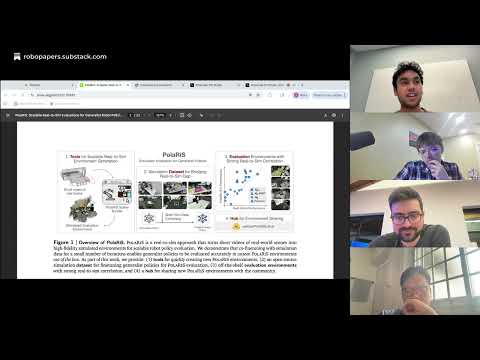
Adopt PolaRiS for policy iteration. Builders should use its browser-based scene builder and Gaussian splatting pipeline to quickly create new, diverse evaluation environments from real-world scans.
Integrate minimal, unrelated sim data into policy training to dramatically boost real-to-sim correlation, allowing for faster, cheaper development cycles before costly real-world deployment.
PolaRiS shifts the focus from hand-crafted, task-specific simulations to scalable, real-world-correlated benchmarks, enabling rapid iteration and generalization testing previously impossible in robotics.
Agentic AI is changing software from discrete applications to an integrated, conversational operating layer, making human intent the primary interface for complex tasks.
Invest in or build platforms that prioritize agent-friendly APIs and open-source collaboration, as these will capture the next wave of user interaction and value generation.
The future of computing is agent-centric; understanding and adapting to this paradigm change is crucial for staying relevant in the quickly evolving tech landscape over the next 6-12 months.
Business Models Over Memes: The new meta is clear: tokens must generate revenue. The most valuable assets will be those with defensible, on-chain business models, not just compelling narratives.
The 4-Year Cycle is Dead: Forget halving-driven bull runs. We are in the first inning of a multi-year institutional adoption cycle, creating a sustained "global buy order" for legitimate crypto assets and related equities.
Pick a Side (Token vs. Equity): The most critical question for any project is where value accrues. Investors must demand clarity on whether they are backing a decentralized network or a traditional company leveraging crypto rails.
Demand Cash Flow: The next crypto "Mag 7" will be defined by protocols with real, on-chain revenue and clear business models, not just speculative narratives.
Bet on Yield: The predicted $3.7 trillion influx into stablecoins will disproportionately benefit yield-generating protocols, offering a prime opportunity as they re-rate to reflect their cash-generating power.
The 4-Year Cycle is Dead: Forget the halving. Institutional capital entering via ETFs and public equities is transforming crypto into a multi-year bull market, fueled by a slow, steady global "T-WAP" of capital.
The IPO Pipeline is Live: Circle's 10x IPO created a clear playbook. Watch private crypto leaders like Kraken and Fireblocks. Their public listings will be a crucial bellwether for the industry's mainstream acceptance.
Watch Bitcoin Dominance, Not the Noise: A high and rising Bitcoin dominance is a coiled spring. When it finally breaks, it will likely break fast, signaling the true, explosive start of the next altcoin season.
Crypto is Now a Political Asset: A directive ordering Fannie Mae and Freddie Mac to prepare for crypto-backed mortgages shows that digital assets have officially entered the political arena. This top-down push for legitimacy is a powerful tailwind, even if bottom-up bank adoption lags.
Build for Joy, Not Just Gains. The most defensible moat is emotional utility. Create a product people love, then use crypto to enhance it—not the other way around. No amount of financial engineering can fix a crappy product.
Speak Human, Not Crypto. Ditch "Create Wallet" for "Create Account." The tech is 90% there, but the language and branding are the final, crucial 10%. The battle for the next billion users will be won with words, not just code.
Value Will Accrue at the App Layer. The next decade's unicorns will be consumer apps built on the rails, not the rails themselves. If the apps on a chain aren't eventually worth more than the chain, the entire model is broken.
Prediction Markets are Mainstream. Polymarket has become a go-to source for real-time sentiment, proving that markets can be more trusted indicators than media pundits. Its cultural embedding is a masterclass in product-market fit.
Memecoins are a Consumer Business. Pump.fun’s financial success is a direct result of treating memecoins as a fun, consumer-driven activity. The platform proves that the most powerful crypto use cases are often the ones that don’t take themselves too seriously.
Prioritize the Prosumer. Crypto developers should resist the urge to oversimplify for a hypothetical mass audience. The most profitable path is to build powerful, feature-rich tools for the dedicated users who generate the overwhelming majority of activity and revenue.
Crypto is undergoing a pragmatic, if painful, maturation. The speculative froth is evaporating, forcing a return to first principles: generating real revenue and creating sustainable economic models.
The Money Follows Access: Institutional capital is flooding into regulated, easy-to-buy assets like BTC ETFs and Circle equity. For alts to thrive, the on-ramp friction must be eliminated.
Bitcoin's Next Act is Yield: The most compelling emerging narrative is BTC DeFi. Forget Degen trading; the killer app will be providing simple, sustainable yield to BTC's massive holder base.
Economic Models are Being Rewritten: Experiments like Celestia's "Proof of Governance" signal a market-wide shift away from inflationary staking rewards toward revenue-burn models that create more direct and durable value for token holders.