The automotive industry is undergoing a significant architectural change, moving from fragmented, hardware-centric systems to vertically integrated, AI-powered software-defined vehicles. This demands re-platforming, making legacy automakers vulnerable.
Invest in or build companies controlling their full technology stack: custom silicon, sensor arrays, data collection, AI model training. Vertical integration is key to cost efficiency and rapid iteration for mass-market AI autonomy.
The next few years will see dramatic divergence. Companies mastering AI-driven autonomy and software-defined architectures, like Rivian with its R2, will capture significant market share by offering compelling, continuously improving vehicles at scale. Others face obsolescence.
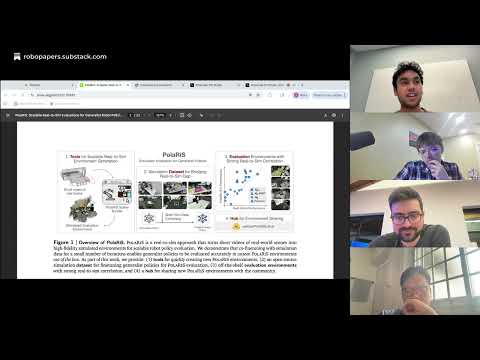
The robotics community is moving beyond task-specific benchmarks towards generalist policy evaluation, mirroring the LLM trend of testing off-the-shelf models on unseen tasks. This demands scalable, high-fidelity simulation tools that can quickly generate diverse test environments.
Builders and researchers should prioritize evaluation tools that offer strong real-to-sim correlation, even if it means a hybrid approach (like PolaRiS) over purely data-driven world models. Utilize real-to-sim environment generation (Gaussian splatting) and strategic sim data co-training to accelerate policy iteration.
PolaRiS offers a path to community-driven, crowdsourced robot benchmarks, making policy development faster and more robust. Expect a future where robot policies are evaluated across a broad suite of easily created, diverse simulated environments, pushing the boundaries of generalization and real-world applicability.
Generalist robot policies need robust, scalable evaluation. The shift is from bespoke, real-world-only testing to a hybrid real-to-sim approach that leverages modern 3D reconstruction and minimal sim data to create highly correlated, reproducible benchmarks.
Builders should adopt PolaRiS's real-to-sim environment generation and "sim co-training" methodology. This allows for rapid, cost-effective iteration on robot policies, ensuring that improvements in simulation translate directly to real-world gains.
Over the next 6-12 months, the ability to quickly and reliably evaluate robot policies in simulation will be a critical differentiator. PolaRiS provides the tools to build diverse, generalization-focused benchmarks, moving robotics closer to the rapid iteration cycles of other AI fields.
Tesla's core identity shifted from EV maker to autonomous AI and robotics. Its cars are devices for deploying its advanced AI brain; competitors miss this.
Tesla's 8 million cars collect real-world driving data. This massive dataset, combined with in-house AI processing, creates an unparalleled moat impossible for competitors to replicate.
This convergence creates an abundance of labor and transportation, driving down costs. Robo-taxis and humanoid robots automate tasks, making goods and services cheaper, even as Tesla's profitability soars.
Robotics is moving towards generalist policies that need broad, diverse evaluation. PolaRiS enables this by making it easy to create and share new, correlated benchmarks, cultivating a community-driven evaluation ecosystem similar to LLMs.
Adopt PolaRiS for rapid policy iteration on pick-and-place and articulated object tasks. Use its browser-based scene builder and existing assets to quickly create new evaluation environments, then fine-tune policies with a small amount of unrelated sim data to boost real-to-sim correlation.
Investing in tools like PolaRiS now means faster development cycles and more reliable policy improvements. This accelerates the path to robust, real-world robot deployment by providing a scalable, trustworthy intermediate testing ground.
PolaRiS enables a shift towards LLM-style generalization benchmarks, where models are tested on unseen environments and tasks, accelerating robot capabilities.
Use its browser-based scene builder and Gaussian splatting to quickly create diverse, real-world correlated evaluation environments, significantly reducing the cost and time of real robot testing.
Cheap, reliable robot policy evaluation in simulation, with strong real-world correlation, means faster development cycles, more robust generalist robots, and a path to crowdsourced, diverse benchmarks that will push the entire field forward.
AI is forcing a fundamental architectural change in automotive, moving from fragmented, rules-based systems to vertically integrated, neural network-powered platforms. This technical reality dictates market survival, favoring companies that control their entire software and hardware stack to build a continuous data flywheel.
Invest in or partner with companies demonstrating deep vertical integration in AI hardware and software for mobility. Prioritize those with a clear path to mass-market data collection and rapid iteration cycles.
Autonomy will be a must-have feature in cars within the next few years. Companies without a software-defined architecture and a vertically integrated AI stack will struggle to compete, creating a market share shift towards those few players who can deliver true self-driving at scale.
The automotive industry is undergoing a fundamental re-architecture, moving from hardware-centric, rules-based systems to software-defined, AI-powered platforms. This shift favors companies with deep vertical integration and proprietary data flywheels.
Invest in companies demonstrating full-stack control over their vehicle's software, hardware, and AI training data. This verticality is the moat against commoditization and the engine for rapid, continuous improvement.
Autonomy will be a non-negotiable feature by 2030, making software-defined vehicles the only viable path for mass-market automakers. Companies that fail to build or acquire this capability will face market irrelevance.
Tesla's core business is AI and autonomous robotics. This means its value comes from its software and data moat, not just vehicle sales.
Tesla is sunsetting Model S and X production to convert factories for humanoid robots. This signals a full commitment to autonomous devices beyond cars.
Unsupervised FSD is expected in select US states by Q2. This will enable cars to operate without human oversight, unlocking the robo-taxi network.
The Altcoin Graveyard Is Bitcoin's Tailwind. Capital is fleeing "useless" tokens and the defunct VC model, creating steady inflows for Bitcoin. The primary trade is now long BTC, short everything else.
From HODL to Tactical Alpha. The days of 100x returns on random tokens are gone. Generating alpha now requires sophisticated strategies like pairs trading, selling options volatility against spot holdings, and capitalizing on short-term macro events.
S&P is the New Dollar, Bitcoin is the New S&P. As the dollar loses its luster, the S&P 500 has become the default savings vehicle. Bitcoin has cemented its role as the premier risk-on asset within that new paradigm—a bet that “probably won’t” fail.
Wallets are Dead, Long Live Wallets: The future isn't a separate wallet app. It's an embedded, invisible experience inside the consumer apps themselves, just like friend.tech demonstrated.
From Gatekeepers to Curators: Centralized exchanges are becoming obsolete as gatekeepers. The new frontier is building sophisticated curation engines to help users discover signal in a sea of noise.
AI Agents are the Next Big User Base: The most forward-thinking founders aren't just building for humans; they're building for a future where AI agents drive the majority of on-chain trading volume.
**Stop Chasing Max Decentralization.** The market has voted with its volume. Users prioritize performance over ideological purity. "Verifiable Finance"—with centralized sequencers but guaranteed withdrawals—is the pragmatic path forward.
**Market Structure Is Destiny.** Inefficient L1s with toxic MEV force sophisticated teams to build workarounds (like the proprietary AMM Sulfi) or entirely new, controlled environments (like Atlas). The base layer's design dictates the quality of applications built on top.
**The Real Game Is Efficient Markets, Not Memecoins.** The long-term vision for crypto finance depends on building infrastructure that can attract institutional capital with fair, reliable, and highly efficient execution. The current system that incentivizes "bad fills" is a dead end.
Go-to-Market > Tech Specs: In the race between new chains, attracting a single breakout app is more critical than marginal performance gains. Value accrues to whoever owns the user relationship.
Bet on Improvable Niches: The biggest startup opportunities are in high-demand but clunky sectors like prediction markets and memecoin launchpads, where superior UX can create a dominant new player.
Look Forward, Not Sideways: Don't get trapped by the "revenue meta." Successful investing requires a forward-looking view of a project’s potential to capture future value, a lesson exemplified by the early thesis for Solana.
**The Real Bull Case is Boring.** The most significant trend isn't the next memecoin, but the "boring" migration of real-world finance onto blockchains via stablecoins. The winners will be those who solve for on-chain credit and build seamless user experiences, not just hype.
**Tokenization is a Double-Edged Sword.** While providing access to new assets, current tokenized stocks are riddled with counterparty risk, thin liquidity, and opaque structures. They are a step forward but risk backfiring if not communicated with radical transparency.
**The Altcoin Shakeout is Here.** Institutional interest is hyper-focused, leaving most altcoins without a bid. Protocols must now justify their existence with real revenue and utility, as the era of "liquidity-as-a-product" is over.
Tokenized Stocks Are Here, But Imperfect. Major players are live, but the current products are IOUs, not direct equity. The real test will be liquidity, price tracking, and regulatory endurance.
Tom Lee Is Creating the "MicroStrategy for ETH." He's pitching ETH to Wall Street not on decentralist ideals, but as the indispensable settlement layer for the coming stablecoin boom, front-running demand from major banks.
The US Is Pumping Crypto Bags. A massive deficit bill combined with an expected dovish Fed creates a perfect storm for liquidity, positioning assets like BTC and ETH as a necessary hedge against currency debasement.