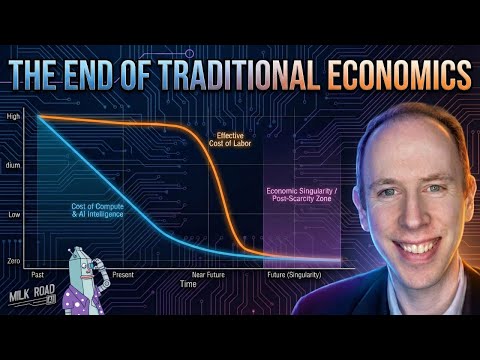
The Macro Shift: AI-driven hyperdeflation is colliding with the technical reality of autonomous AI agents creating their own crypto-backed economies, threatening a decoupling from human fiat systems.
The Tactical Edge: Investigate and build infrastructure that bridges human and AI economies, focusing on fiat-to-crypto rails that can accommodate agent-driven transactions to prevent a complete split.
The Bottom Line: The next 5-10 years will see an unprecedented economic transformation. Understanding AI's deflationary power and the emerging AI agent economy is critical for navigating a world where traditional economic models may no longer apply.
The time of practical AI agents is here, moving compute demand beyond pure GPU inference to a significant reliance on CPUs for coordination, data handling, and security.
Evaluate your agent deployment strategy now, prioritizing sandboxed environments (VPS, dedicated local servers) and exploring cost-optimized model routing to manage API expenses.
Prepare for a future where AI agents become integral to workflows, but recognize the hidden infrastructure costs and security implications, particularly the growing importance of CPU capacity and robust access controls.
The shift from "how" to "why" in AI agent capabilities creates a new, multi-trillion-dollar market for companies that can capture institutional decision logic.
Invest in or build agentic systems that are in the "right path" of business processes, actively capturing decision traces from unstructured data.
Hundreds of context graphs will be in production at scale within a year, defining a new "context graph stack." The winning companies will be those that master this flywheel, extracting value to accelerate automation and build deep, defensible moats.
The shift from linear, bottleneck-driven technological progress to a multi-layered, interconnected advancement model in AI has rendered traditional forecasting obsolete, forcing a re-evaluation of what "singularity" truly represents.
Prioritize adaptability: Invest in modular, composable AI infrastructure and tools that thrive in multi-layered, unpredictable environments, rather than betting on single-bottleneck solutions.
The inability to narrate AI's future means traditional roadmaps are obsolete; success hinges on navigating simultaneous, interconnected advancements and embracing the emergent.
The era of infrastructure-heavy tech deployment is over; AI's internet-native nature means immediate, widespread application. This shifts the competitive advantage from capital-intensive builds to rapid iteration and data leverage.
Invest in companies that are not just using AI, but are fundamentally rethinking their business models around AI's ability to collapse traditional cost structures and accelerate product development.
AI is a force multiplier for both individual opportunity and national power. Understanding its immediate deployability and the new rules of company building is crucial for investors and builders aiming to lead in the next wave of innovation over the next 12-24 months.
Unprecedented fiscal and monetary stimulus, coupled with a deregulatory environment, creates a powerful tailwind for financial assets and tech, driving a capital investment super cycle.
Investors should prioritize companies with proprietary data and GPU access, as these are the new moats in an AI-driven world where traditional software leads are eroding.
The convergence of a stimulative macro environment and AI's disruptive force means capital will flow to those who can scale, innovate, and navigate complex policy landscapes, making strategic positioning now critical for future relevance.
The macro trend of autonomous AI agents is shifting compute demand beyond GPUs, creating an unexpected CPU crunch and forcing a re-evaluation of on-premise inference and cost-optimized model routing for security and efficiency.
Investigate hybrid compute strategies, combining secure local environments (Mac Minis, home servers) with cloud-based LLMs, and explore multi-model API gateways like OpenRouter to optimize agent costs and performance.
AI agents are here, demanding a rethink of your compute stack and security protocols. Prepare for a future where CPU capacity, not just GPU, becomes a critical bottleneck, and strategic cost management for diverse AI models is non-negotiable for competitive advantage.
The move from general-purpose LLMs to specialized AI agents demands a new data architecture that captures the *why* of decisions, not just the *what*. This creates a new, defensible layer of institutional memory, moving value from raw model IP to proprietary decision intelligence.
Invest in or build agentic systems that are in the *orchestration path* of specific business processes. This allows for the organic capture of decision traces, forming a proprietary context graph that incumbents cannot easily replicate.
Over the next 12 months, the ability to build and extract value from context graphs will define the winners in the enterprise AI space, creating a new "context graph stack" that will be 10x more valuable than the modern data stack.
**App-Chains Are The New End Game.** Successful apps are now launching their own sovereign chains, posing an existential threat to host L1s like Solana. The most valuable real estate is direct user ownership, not just building on the fastest chain.
**Trading Is The New Gaming.** For Gen Z, speculation is a primary form of entertainment. Platforms that successfully blend content with financialization are tapping into a powerful cultural current that moves far beyond traditional "investing" narratives.
**Winners Buy, They Don't Build.** The crypto M&A market is hot. Well-capitalized players (e.g., Monad buying Portal) are acquiring talent and tech to build full-stack platforms, while many 2022-era startups are prime acquisition targets.
A perfect storm of narrative, structural demand, and historical precedent is building for Ether, but its price has yet to reflect this reality, and the underlying technical work remains critical.
The ETH Coiled Spring: A massive disconnect exists between euphoric pro-ETH sentiment—driven by treasury buys and mainstream narratives—and its lagging price. History suggests when ETH moves, it will be explosive, leaving sideline-sitters behind.
Corporate Treasuries are the New Demand Sink: A new class of publicly traded "ETH Treasury" companies is in an arms race to acquire ETH, creating a structural demand shock that could absorb all new issuance and initiate a powerful positive feedback loop.
Your Portfolio Is Bleeding. Unless concentrated in tech (NASDAQ) and crypto (Bitcoin, ETH), your purchasing power is eroding by 8% annually. Assets like the S&P 500 or gold are merely treading water against this relentless tide.
Diversification Is a Wealth Destroyer. In a world dominated by a single macro factor—currency debasement—spreading capital across underperforming assets guarantees a loss of real value. A concentrated portfolio is now the only logical strategy.
Tech Is Winning, But Crypto Is Lapping It. While the NASDAQ beats debasement, it's losing badly to crypto. The NASDAQ is down over 99% against Bitcoin since 2012, making crypto the apex asset for accumulating real wealth.
Stablecoins are the Trojan Horse. They are crypto's killer app, driving real-world utility and legitimizing the space for institutions and mainstream users by solving tangible financial inefficiencies.
Crypto is AI’s Essential Counterbalance. As AI centralizes power and blurs reality, crypto provides the critical infrastructure for decentralization, authentication, and new economic models for creators.
The Regulatory Winter is Over. A friendlier U.S. political climate has opened the door for a new wave of crypto innovation. For investors and builders, this is the signal that it's time to build.
Concentrate, Don't Diversify: In a world driven by a single macro factor (debasement), diversification is a losing strategy. The only assets generating real purchasing power are technology stocks and crypto.
The Business Cycle Is Broken, Not Dead: The old rules of cyclical recessions are on hold. Central banks will print money to prevent any systemic credit event, meaning any dip or crisis is met with more liquidity, further fueling the outperforming assets.
The "Banana Zone" Is Coming: The current market setup, with easing financial conditions and rising global M2, mirrors past explosive cycles like 2017. The stage is set for a significant rally in risk assets, particularly crypto and tech, extending into 2025.
**The SEC's Attack Backfired.** The agency’s attempt to decapitate Ethereum was thwarted by the very decentralization it failed to understand, forcing the ecosystem to legally fortify its position and prove its resilience under extreme pressure.
**Wall Street Wants Credible Neutrality.** Forget the narrative that institutions fear decentralization. They are actively seeking it as the ultimate hedge against counterparty risk, making Ethereum’s core values its most valuable asset in the next wave of adoption.
**The Accumulation Race Is On.** A new institutional playbook is emerging. Corporate treasuries, like Sharplink Gaming’s ETH vehicle, are not just buying and holding ETH. They are aggressively accumulating it and deploying it in staking and DeFi to grow their exposure, signaling a massive race to acquire "high-powered money" in an era of currency debasement.