The rise of autonomous AI agents will fundamentally reshape the app economy, rendering many single-purpose applications obsolete as agents integrate and automate tasks across systems. This forces companies to either become agent-facing APIs or risk irrelevance.
Cultivate "agent empathy" by understanding how models perceive codebases and problems. This skill, combined with a willingness to experiment and "play," is crucial for effectively guiding agents to build and refactor software.
The agentic AI era demands a shift from traditional programming to a builder mindset, where human creativity and strategic guidance become paramount. Investors should seek platforms enabling this shift, and builders must adapt to a world where natural language is the new code.
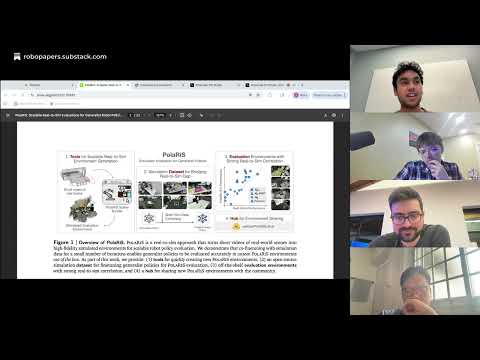
Robotics is moving towards generalist policies, demanding scalable, high-fidelity evaluation tools that mirror the real world, away from task-specific benchmarks.
Adopt PolaRiS for rapid policy iteration and generalization testing, especially for pick-and-place tasks, leveraging easy environment creation and proven real-to-sim correlation.
PolaRiS provides critical infrastructure for accelerating robot learning, enabling builders to quickly validate policies against real-world performance without prohibitive cost.
AI agents are transforming software development from a manual coding craft into an "agentic engineering" discipline, where human builders orchestrate and guide autonomous AI systems. This shift means the value moves from writing boilerplate code to designing agent-friendly architectures and providing high-level strategic direction.
Embrace agentic engineering by learning to "empathize" with AI models, understanding their context limitations, and guiding them with concise, clear prompts. Experiment with open-source agents like OpenClaw to build new tools or automate existing workflows, focusing on the what and why rather than the how.
Personal AI agents will commoditize many existing apps and services, forcing companies to either become agent-facing APIs or risk obsolescence. Investors should identify platforms and infrastructure that enable agent interoperability, while builders should focus on creating agent-native experiences and tools that augment human creativity, rather than replicating existing app functionality.
Robotics is moving beyond isolated tasks to generalist policies, demanding scalable, correlated evaluation methods. This mirrors the LLM world's need for diverse, generalization-focused benchmarks.
Utilize PolaRiS's open-source tools and Hugging Face hub to quickly create and share new evaluation environments. This crowdsourcing approach accelerates community-wide progress in robot policy development.
Investing in tools like PolaRiS that bridge the real-sim gap with high-fidelity visuals and minimal sim co-training is crucial. This enables faster policy iteration and more reliable real-world deployment for the next generation of generalist robots.
The macro shift: Generalist robot policies need generalist evaluation. The shift is from hand-crafted, task-specific sim environments to easily generated, real-world-correlated simulations that test zero-shot generalization, mirroring the rapid benchmark development in LLMs. This allows for a holistic understanding of policy capabilities across diverse, unseen scenarios.
The tactical edge: Adopt PolaRiS for rapid policy iteration. Builders should use its browser-based scene builder and Gaussian Splatting to quickly create new, diverse evaluation environments from real-world scans, then fine-tune policies with small, unrelated sim data to achieve high real-to-sim correlation. This accelerates development cycles and reduces costly real-world testing.
The future of robotics hinges on scalable, trustworthy evaluation. PolaRiS provides a critical tool today to bridge the sim-to-real gap, enabling faster, more reliable development of generalist robot policies. Expect a community-driven explosion of benchmarks, pushing robot capabilities faster than ever over the next 6-12 months.
The robotics community needs to move beyond task-specific benchmarks with provided training data towards a diverse suite of generalization-focused evaluations, mirroring the LLM ecosystem. PolaRiS provides the tools to crowdsource and rapidly deploy these new benchmarks, fostering a more holistic understanding of robot policy capabilities.
For robot policy developers, prioritize tools like PolaRiS that offer high real-to-sim correlation with minimal setup. Leverage its browser-based scene builder and the "visual vaccination" co-training method to quickly iterate on policies for pick-and-place and articulated object tasks, then validate on real hardware.
Scalable, correlated simulation is the missing piece for accelerating generalist robot AI. Over the next 6-12 months, the adoption of tools like PolaRiS will enable faster policy iteration, more robust benchmarking, and ultimately, a quicker path to deploying capable robots in diverse, unstructured environments.
The robotics community is moving from hand-crafted, task-specific simulations to generalist policies that demand scalable, real-world correlated evaluation. PolaRiS enables this by making it cheap and easy to create diverse, high-fidelity sim environments from real scans, allowing for generalization testing akin to LLM benchmarks.
Implement PolaRiS for rapid policy iteration. Use its real-to-sim environment generation and minimal, unrelated sim data co-training to quickly validate robot policies against real-world performance, reducing costly physical robot time.
PolaRiS offers a critical infrastructure upgrade for robot AI development. By providing a fast, reproducible, and highly correlated simulation environment, it allows builders to iterate on generalist robot policies at software speed, significantly de-risking and accelerating the path to real-world deployment and broader robot capabilities over the next 6-12 months.
The drive for generalist robot policies demands scalable, reliable evaluation. PolaRiS pushes robotics toward the community-driven, diverse benchmarking common in LLMs, accelerating the path to truly capable robots.
Adopt PolaRiS for rapid policy iteration and generalization testing. Leverage its easy environment creation and proven real-to-sim correlation to quickly validate new robot behaviors before costly real-world deployment.
PolaRiS is a critical tool for any team building robot policies. It cuts evaluation costs, speeds up development, and provides a trustworthy signal for real-world performance, making it a must-have for your robotics roadmap over the next 6-12 months.
Builders should prioritize hybrid real-to-sim evaluation tools like PolaRiS for rapid policy iteration.
Use minimal, out-of-domain sim data to align policies to the simulation environment, ensuring your sim results accurately predict real-world performance.
Investing in tools that democratize benchmark creation and ensure strong real-to-sim correlation will accelerate robot policy development.
**App-Chains Are The New End Game.** Successful apps are now launching their own sovereign chains, posing an existential threat to host L1s like Solana. The most valuable real estate is direct user ownership, not just building on the fastest chain.
**Trading Is The New Gaming.** For Gen Z, speculation is a primary form of entertainment. Platforms that successfully blend content with financialization are tapping into a powerful cultural current that moves far beyond traditional "investing" narratives.
**Winners Buy, They Don't Build.** The crypto M&A market is hot. Well-capitalized players (e.g., Monad buying Portal) are acquiring talent and tech to build full-stack platforms, while many 2022-era startups are prime acquisition targets.
A perfect storm of narrative, structural demand, and historical precedent is building for Ether, but its price has yet to reflect this reality, and the underlying technical work remains critical.
The ETH Coiled Spring: A massive disconnect exists between euphoric pro-ETH sentiment—driven by treasury buys and mainstream narratives—and its lagging price. History suggests when ETH moves, it will be explosive, leaving sideline-sitters behind.
Corporate Treasuries are the New Demand Sink: A new class of publicly traded "ETH Treasury" companies is in an arms race to acquire ETH, creating a structural demand shock that could absorb all new issuance and initiate a powerful positive feedback loop.
Your Portfolio Is Bleeding. Unless concentrated in tech (NASDAQ) and crypto (Bitcoin, ETH), your purchasing power is eroding by 8% annually. Assets like the S&P 500 or gold are merely treading water against this relentless tide.
Diversification Is a Wealth Destroyer. In a world dominated by a single macro factor—currency debasement—spreading capital across underperforming assets guarantees a loss of real value. A concentrated portfolio is now the only logical strategy.
Tech Is Winning, But Crypto Is Lapping It. While the NASDAQ beats debasement, it's losing badly to crypto. The NASDAQ is down over 99% against Bitcoin since 2012, making crypto the apex asset for accumulating real wealth.
Stablecoins are the Trojan Horse. They are crypto's killer app, driving real-world utility and legitimizing the space for institutions and mainstream users by solving tangible financial inefficiencies.
Crypto is AI’s Essential Counterbalance. As AI centralizes power and blurs reality, crypto provides the critical infrastructure for decentralization, authentication, and new economic models for creators.
The Regulatory Winter is Over. A friendlier U.S. political climate has opened the door for a new wave of crypto innovation. For investors and builders, this is the signal that it's time to build.
Concentrate, Don't Diversify: In a world driven by a single macro factor (debasement), diversification is a losing strategy. The only assets generating real purchasing power are technology stocks and crypto.
The Business Cycle Is Broken, Not Dead: The old rules of cyclical recessions are on hold. Central banks will print money to prevent any systemic credit event, meaning any dip or crisis is met with more liquidity, further fueling the outperforming assets.
The "Banana Zone" Is Coming: The current market setup, with easing financial conditions and rising global M2, mirrors past explosive cycles like 2017. The stage is set for a significant rally in risk assets, particularly crypto and tech, extending into 2025.
**The SEC's Attack Backfired.** The agency’s attempt to decapitate Ethereum was thwarted by the very decentralization it failed to understand, forcing the ecosystem to legally fortify its position and prove its resilience under extreme pressure.
**Wall Street Wants Credible Neutrality.** Forget the narrative that institutions fear decentralization. They are actively seeking it as the ultimate hedge against counterparty risk, making Ethereum’s core values its most valuable asset in the next wave of adoption.
**The Accumulation Race Is On.** A new institutional playbook is emerging. Corporate treasuries, like Sharplink Gaming’s ETH vehicle, are not just buying and holding ETH. They are aggressively accumulating it and deploying it in staking and DeFi to grow their exposure, signaling a massive race to acquire "high-powered money" in an era of currency debasement.