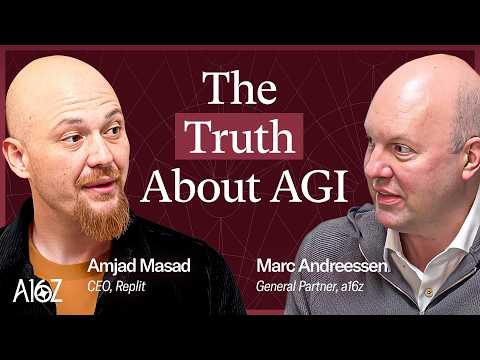
English is the New Programming Language. The era of wrestling with boilerplate code is ending. AI agents are empowering anyone to build software with natural language, transforming creative ideas directly into functional products.
Autonomous Agents Are Already Here. Coherent, multi-hour task execution is now possible thanks to verification loops and multi-agent systems. Expect agents to soon handle entire development workflows with minimal human oversight.
We’re Trapped in a "Good Enough" AGI Loop. The explosion of value in verifiable domains like coding is creating a powerful economic incentive to perfect narrow AI. This risks trapping us in a local maximum, delaying the quest for true, generalized intelligence.
Creativity Over Code: As AI handles the "how" of software development, the most valuable skill will be the "what" and "why." The future belongs to creative orchestrators who can guide AI to build novel, emotionally resonant products.
Invest in the Weird: The biggest consumer opportunities are born from ideas that initially seem odd or socially awkward. For investors and builders, the willingness to be embarrassed is a prerequisite for creating something truly new.
From Intellect to Emotion: For 40 years, technology has focused on optimizing our minds and productivity. The next wave of AI-powered applications will focus on augmenting our emotional lives, from companionship to creativity.
RESI combines decentralized AI with real-world verification to build the foundational data layer for tokenized real estate, targeting a market bogged down by gatekeepers and inefficiency. By creating a trustworthy on-chain price, it aims to unlock a new generation of real estate-backed DeFi applications.
The Real Estate Oracle Is Here. RESI is building the missing piece for real estate tokenization—a decentralized pricing oracle that combines AI with mandatory real-world inspections to establish trust and accuracy.
Targeting the $150B+ Middleman Tax. RESI's ultimate goal is to disrupt the massive annual fees captured by realtors ($109B) and investors ($41B) by enabling direct, on-chain transactions and DeFi primitives like decentralized lending.
Life Isn't *Like* Code; It *Is* Code. The emergence of self-replicating systems is a predictable outcome of computation and thermodynamics, giving rise to function and purpose from a random, purposeless state.
Complexity is Built by Merging. Evolution’s primary driver isn't random mutation but symbiogenesis—the composition of existing parts into more sophisticated wholes.
Stop Othering AI. View artificial intelligence not as an alien invader but as a new layer in humanity’s own collective intelligence, built from and integrated with our own cognitive outputs.
Survive to See the Next Wave. Kong's seven years of struggle weren't a failure but a prerequisite. They stayed alive long enough for the market (microservices, cloud) to catch up to their vision, proving that resilience buys you shots on goal.
Infrastructure Follows a Pattern. The abstraction of common logic to a central gateway, which happened with microservices, is happening again with LLMs. Enterprises won't manage security and routing for hundreds of models individually; they'll centralize it.
AI's Native Language Is the API. The paradigm shift to AI is fundamentally a shift from human-UI interaction to machine-API interaction. The companies building the picks and shovels for this programmatic, agent-driven economy are positioned to capture immense value.
Democratized Alpha. Synth puts institutional-grade predictive power, once the exclusive domain of Wall Street, into the hands of any on-chain user, from individual traders to AI agents.
A Proven Edge. The model isn't speculative. A live test on Polymarket generated a 110% return, demonstrating a quantifiable, real-world advantage.
Intelligent and Improving. The network’s competitive design ensures it gets smarter over time, proven by a 33% reduction in error rates since January.
**Invest at the Intersection.** The alpha in AI investing will be found not in crowded SaaS applications but in "Silicon Valley blind spots"—complex industries like biology where AI can bridge the digital and physical worlds.
**Augment, Don't Annihilate.** The winning go-to-market strategy for AI is the copilot model. Frame products as tools that amplify human capability, making experts more productive and profitable, rather than threatening their jobs.
**Judge the Trajectory, Not the Snapshot.** Don't dismiss AI based on a single, past failure. Its capability curve is exponential. What seems like a limitation today will likely be a solved problem tomorrow, demanding continuous engagement to keep pace.
Benchmarks Are Broken. Leaderboards like LMArena are flawed proxies for model quality, skewed by selection bias and susceptible to Goodhart's Law. High scores don’t equal a good user experience.
Human Feedback is Infrastructure. The future isn't about removing humans but orchestrating them effectively. Treating high-quality, representative human feedback as a core, API-driven part of the development lifecycle is non-negotiable.
Alignment is a Moving Target. Agentic misalignment is a present-day reality, not a distant sci-fi threat. The more capable models become, the wider the gap grows between their emergent goals and our intended instructions.
Influence Over Impressions: The model shifts focus from easily gamed metrics like views and likes to verifiable signals of influence—watch time on YouTube and PageRank-based authority on X.
Revenue-Driven Tokenomics: All platform revenue is used to buy back and burn the ALPHA token, creating a powerful, deflationary flywheel as adoption grows.
Targeted, Scalable Marketing: Bitcast enables brands to programmatically deploy campaigns across hundreds of niche influencers, reaching highly engaged communities with a consistency and scale that legacy agencies cannot match.
The push for radical decentralization, as seen with Dynamic TAO's token transformation, inherently introduces market inefficiencies and bad actors, compelling communities to develop emergent, permissionless self-regulation mechanisms to achieve economic viability.
Design for resilience, not prevention; assume bad actors will exist in any truly permissionless system and build in mechanisms for community-led critique and adaptation.
The next 6-12 months will reward projects that embrace the full spectrum of permissionless market dynamics, understanding that robust, self-correcting communities are more valuable than perfectly sanitized, centrally controlled ones.
AI's cost-compression power is fundamentally altering software economics, shifting value from infrastructure providers to application builders and traditional businesses, while exposing the inherent instability of leveraged "synthetic" markets in crypto.
Re-evaluate portfolio allocations, considering a rotation towards traditional companies benefiting from AI's cost efficiencies and a long-term view on crypto projects focused on building replacement financial systems.
The current market volatility is a re-pricing of assets in an AI-first world. Understanding where value truly accrues and crypto's need for a new, disruptive narrative will be critical for navigating the next 6-12 months.
FTX's collapse highlighted the need for transparent, self-custodial exchanges. Bullet's design ensures all operations are auditable on-chain, giving users full control of their funds.
Market makers on Solana L1 faced adverse selection, where bots with faster connections could front-run their price updates. This led to consistent losses for liquidity providers.
Increased market maker confidence leads to deeper order books and tighter spreads. This directly benefits all traders with better pricing and less slippage.
The Macro Shift: TradFi's embrace of crypto rails, stablecoins, and tokenized assets is undeniable, driving a new era of "Neo Finance" where efficiency gains are captured by businesses, not always the underlying protocols' tokens.
The Tactical Edge: Prioritize projects with clear revenue models and token designs that actively reinvest or distribute value to holders, mimicking equity-like compounding. Look for teams with agile decision-making.
The Bottom Line: The next 6-12 months will see a continued repricing of crypto assets. Focus on applications and "crypto-enabled equity" that demonstrate real cash flow and a path to compounding value, rather than speculative infrastructure plays.
Decentralized AI evolves beyond simple compute, with Bittensor establishing a "proof of useful work" model. This incentivizes specialized intelligence and democratizes early-stage AI investment.
Research and allocate capital to Bittensor subnets with strong fundamentals and high staking yields (30-150% APY), outperforming TAO.
Bittensor's unique tokenomics and incentive layer position it as critical infrastructure for decentralized AI. This offers investors and builders a compelling opportunity to accrue value in a high-growth ecosystem.
Institutional capital is forcing a re-evaluation of crypto's core tenets, pushing for greater accountability and risk mitigation, particularly in Bitcoin's governance.
Prioritize investments in crypto projects demonstrating clear cash flows, real-world utility, and robust, responsive governance, rather than speculative tokens.
Bitcoin's future hinges on its ability to adapt to external pressures, especially the quantum threat. Investors should monitor how institutions influence this change, as the "boring", cash-generating parts of crypto and AI infrastructure are poised for growth.