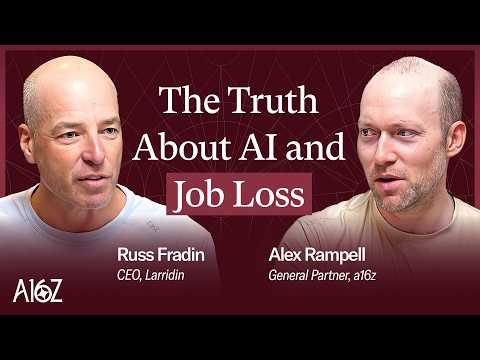
Measure Usage, Not Just Spend. The biggest failure in enterprise AI is tracking software purchases as a proxy for progress. The focus must shift to measuring actual tool usage correlated with output.
Solve for Fear, Not Features. Employee adoption hinges on psychological safety. The most powerful tools will fail if users are afraid of looking incompetent or getting fired for making a mistake.
Competition Drives Augmentation, Not Unemployment. The "AI will take our jobs" narrative is a red herring. Companies will reinvest AI-driven productivity gains to crush competitors, not just to cut headcount.
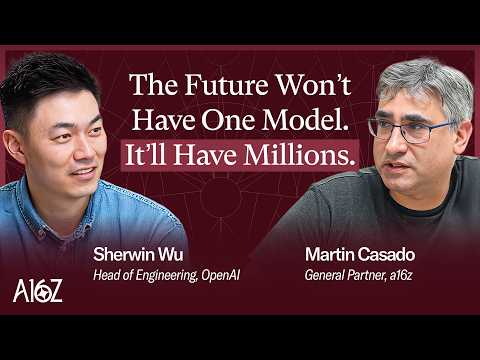
**The "One Model" Thesis Is Dead.** The future belongs to a portfolio of specialized models. This creates distinct opportunities for both foundational labs and companies that can leverage proprietary data to build best-in-class models for niche applications.
**Data Is the Ultimate Differentiator.** Reinforcement learning fine-tuning elevates proprietary data from a simple input for RAG systems to the core ingredient for building a defensible, state-of-the-art product.
**Agents Will Specialize.** The agent ecosystem is bifurcating into two primary types: open-ended, creative agents for knowledge work and deterministic, procedural agents designed for enterprise automation where reliability and adherence to standard operating procedures are critical.
Politics Will Trump Tech. Expect a policy pivot ahead of the 2024 election. The administration’s singular focus on AI stimulus is creating populist backlash, forcing a shift toward policies that support the broader labor market to secure votes.
The AI Trade Is Evolving. The "Mag 7" may soon become regulated utilities. The next wave of winners will be legacy companies that successfully integrate AI to boost margins and the overlooked players in the AI supply chain, such as power and commodity providers.
Prepare for a New Monetary Regime. The era of "QE Infinity" is ending. A post-Powell Fed is expected to move credit creation from its own balance sheet back to commercial banks, using deep rate cuts and deregulation to stimulate the economy.
AI Demand Is Not Cyclical; It's Infinite. Forget boom-and-bust. The mission to solve humanity's greatest problems—from disease to space travel—creates limitless demand for intelligence, underpinning a durable, multi-decade investment cycle.
Scrap GDP; Watch Profit Margins. The widening chasm between the astronomical profit margins of tech companies and the rest of the economy is the single most important macroeconomic signal today.
Bitcoin Is the Apex Predator of Moats. In a world where AI can replicate any business model, the only defensible moats are those built on time-tested belief and mathematical scarcity. Bitcoin is the emerging winner for the digital age.
AI's Physical Footprint is Astronomical: Individual AI data centers are now multi-billion dollar megaprojects, with construction timelines accelerating to as little as one year for a gigawatt-scale facility.
Power is a Solvable Problem, Not a Hard Cap: AI firms will pay whatever it takes to secure electricity, making power costs a secondary concern to the price of GPUs. The real constraint is getting chips, not watts.
Open-Source Intelligence Unveils All: By combining satellite imagery, public permits, and news reports, the physical expansion of the AI industry can be tracked in near real-time, providing unprecedented transparency.
AI Isn't a Bubble; It's a Buildout. The market is rational. Massive spending is backed by real revenue from inference. The true bottleneck is the speed at which capital can be deployed to build city-sized data centers.
Brace for Economic Whiplash. A sudden, AI-driven unemployment spike is the most likely trigger for massive government intervention. The political response will be swift, decisive, and potentially radical.
Superintelligence is a Hardware Problem. The path to 2045 runs through physical infrastructure. Progress is gated by the brute-force economics of building data centers, not a quest for a magical algorithm.
**Escape the Architecture Lottery.** The inertia behind Transformers is immense. A new model must be demonstrably superior across the board to justify a paradigm shift.
**Nature's Algorithms are the Next Frontier.** The CTM proves that biologically-inspired principles like neuron synchronization can unlock powerful capabilities like adaptive computation and better calibration naturally.
**Reasoning is Deeper Than Scaling.** The Sudoku Bench benchmark shows that current SOTA models cannot perform the creative, nuanced reasoning humans do. Brute-force scaling has hit a wall against truly complex problems.
Your Data is the New Oil, and You're Giving It Away. Every smart device, social media post, and email you create is a valuable asset used to build multi-billion dollar AI empires, yet you receive no compensation.
The Creator Economy is Facing an Existential Threat. The outcome of lawsuits like *NYT vs. OpenAI* will determine whether creative work remains intellectual property or becomes free raw material for AI, potentially decimating entire professions.
Reclaim Your Digital Sovereignty. Losing control of your data isn't just a privacy issue; it's a slide into "digital feudalism." The podcast champions decentralized technologies as a tool to break these data monopolies and reassert individual ownership.
AI's Debt Rally vs. Fed's Tight Grip. The AI boom is now fueled by credit markets, making it highly sensitive to the Fed's hawkish policy and rising real rates. An epic battle between tech momentum and macro gravity is brewing.
The Fed's Playbook Is Evolving. Forget immediate QE. The Fed is signaling a long-term plan to steepen the yield curve by offloading its long-duration assets. This strategy aims to ease pressure on "Main Street" while making financing more expensive for "Wall Street."
Crypto Is in a Historic Washout. On-chain and ETF flow data paint a picture of extreme capitulation. Both new and old hands are selling heavily, suggesting a major market reset is underway before the next cycle can truly begin.
Escape Velocity Reached: Like the early internet and Bitcoin, BitTensor has survived its infancy. Its ecosystem of 128+ subnets has created a network-effect moat that makes it incredibly difficult to disrupt.
The "Front Door" Is the Next Billion-Dollar Opportunity: The most significant hurdle for BitTensor is its developer-focused user experience. The companies that successfully build simple, consumer-friendly interfaces on top of the subnets will unlock immense value.
Powerful Tokenomics Signal a Supply Shock: TAO's upcoming halving, combined with its built-in utility and high staking rate, is creating a classic supply squeeze. With demand structurally increasing as the network grows, the economics point toward a significant price appreciation for the root token.
The Game Is Rigged, Play Accordingly. Traditional analysis is failing. The winning strategy is "grift arbitrage"—investing in assets that benefit from government spending and political connections.
Bonds are Dead, Long Live Yield. With governments committed to fiscal dominance, bonds offer negative real returns. The hunt for yield is driving capital from fiat junk bonds into Bitcoin and Ethereum.
Hedge for the Inevitable Shakeup. The system is fragile. Key risks like aggressive tariffs or a hawkish Bank of Japan could trigger a sharp sell-off. With volatility low, now is the time to buy cheap protection.
Treasury Vehicles are a Trap. They're the new high-risk, high-reward play, but the danger isn't debt—it's massive shareholder dilution and a rapid, reflexive unwind that will be far quicker and more brutal than Grayscale's.
The Cycle Isn't Dead, It's Rhyming. The market is replaying the classic playbook: BTC runs, ETH surges, and capital spills into retail-favorite alts. Calling a top is a fool's errand, but the exuberance is palpable.
Regulation is a Double-Edged Sword. New laws provide a path for tokens to become commodities but may incentivize projects to launch chains purely for regulatory arbitrage, adding another layer of complexity to the market.
**Ethereum's revival is structural, not speculative.** Unprecedented ETF and corporate treasury inflows are creating sustained buying pressure that could push ETH to $10K and beyond, rendering past cynicism obsolete.
**Regulation is the unlock for institutional crypto.** The Clarity and Genius Acts are not just rules; they are the green light for institutional capital that has been waiting on the sidelines for legal certainty.
**The future of consumer crypto is weird and profitable.** Platforms like Pump.fun prove that the most powerful business models may not fit traditional molds but will win by tapping into raw, unfiltered user demand.
The ETH Treasury Is The New Institutional Bid. The narrative that powered Bitcoin's run is now being replicated for ETH, but with a twist: former Bitcoin miners are leading the charge, creating a powerful, reflexive buy-cycle.
ETH's Supply Squeeze Is Real. The combination of record ETF demand, minimal proof-of-stake issuance, and a re-staking culture means the buy pressure is overwhelming the available sell-side liquidity.
Regulation Is Becoming A Tailwind. The expected passage of the stablecoin bill provides a legitimate foundation for institutional adoption, turning a long-time headwind into a powerful catalyst for growth.
Solana’s Watershed Moment: The smooth on-chain execution for a high-demand event proved that decentralized infrastructure is not just viable but, in this case, superior to its centralized counterparts.
Value Accrual is Non-Negotiable: The era of valueless governance tokens is over. Protocols must now provide clear, tangible mechanisms like revenue sharing or buybacks to build trust and justify their valuation.
The Real Game is the Front-End: While back-end infrastructure plays are viable, the ultimate prize is owning the user relationship. PUMP’s battle with Axiom for the title of the premier consumer-facing crypto app is the key narrative to watch.