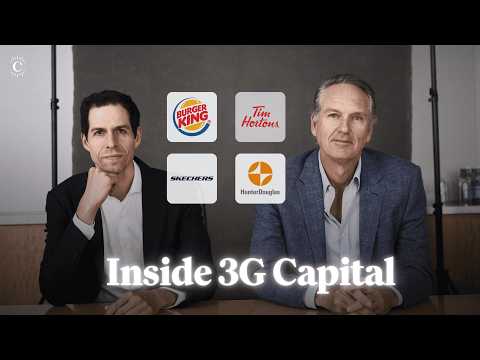
3G commits to one investment per fund, deploying significant house capital alongside partners. This singular focus drives an unparalleled rigor in due diligence and operational execution, because failure isn't an option—it's the only dish.
3G attracts top-tier talent by offering founder-like economics and accelerated responsibility. This creates a meritocracy where young leaders are given significant control and ownership earlier than traditional paths.
3G favors businesses with strong, direct customer relationships and physical assets, like Burger King or Hunter Douglas. These "atoms" businesses are inherently harder for new tech to disintermediate.
As capital markets become more efficient and valuations stretch, the edge shifts from financial engineering to deep operational expertise and a relentless focus on business quality.
Cultivate an owner-operator mindset throughout your organization, aligning incentives from the top down.
In the next 6-12 months, re-evaluate your investment criteria. Focus on businesses with clear customer relationships and robust, non-disruptable core offerings.
As market valuations stretch and technological disruption accelerates, the enduring value of well-moated, customer-centric businesses with strong physical components becomes clearer. 3G's focus on "harder to disrupt atoms" businesses, enhanced by technology, offers a resilient investment thesis.
Cultivate an owner-operator mindset, pushing decision-making closer to problems and aligning incentives with long-term success. Prioritize hiring ambitious young talent and empower them with responsibility, backed by strong mentorship.
In a world obsessed with speed and breadth, 3G Capital reminds us that deep, patient, operator-driven concentration in quality businesses, coupled with a fierce ownership culture, remains a powerful formula for outsized returns. This model builds enduring value, not just short-term gains.
In a market where digital disruption dominates headlines, 3G's success with physical, "atoms" businesses highlights that enduring value often lies in strong brands with direct customer relationships, where operational excellence and long-term thinking create defensible moats against technological fads.
Cultivate an "owner-operator" mindset in your investments and teams. Prioritize businesses with clear, simple value propositions and strong customer ties, then give young, ambitious talent significant ownership and autonomy to drive execution.
The next 6-12 months will reward investors and builders who resist the urge to chase every shiny new object. Instead, focus on fundamental business quality, deep operational involvement, and patient capital deployment in businesses that own their customer relationships. This disciplined approach, though counter-cultural, consistently compounds wealth.
As markets become more volatile and technology accelerates disruption, the traditional diversified portfolio approach faces increasing headwinds. 3G Capital's model signals a shift towards concentrated, operator-led bets on resilient, customer-owning brands with strong unit economics.
Identify businesses with deep moats, direct customer relationships, and long-term growth potential, then instill an owner-operator mindset throughout the organization, empowering young talent with significant equity and autonomy.
In a world of fleeting trends, focusing on fundamental business quality, operational excellence, and a long-term horizon offers a robust strategy for compounding capital, proving that sometimes, less truly is more.
3G commits to one investment per fund. This extreme concentration forces rigorous downside analysis and patience, ensuring capital is deployed only into truly exceptional opportunities.
Leaders are treated as shareholders, not just management. This alignment, often through outsized equity grants, drives decisions that prioritize the business's long-term health and value creation.
3G seeks businesses that own the relationship with their end customers. This direct connection provides a moat against disruption and disintermediation, as seen with brands like Burger King and Hunter Douglas.
The Macro Shift: As digital disruption accelerates, the value of businesses with inherent physical moats and direct customer relationships grows. 3G's focus on these "atoms" businesses, rather than "bits," positions them to capitalize on enduring consumer needs.
The Tactical Edge: Cultivate an owner-operator mindset in your ventures by aligning incentives deeply, empowering young talent, and relentlessly focusing on core business quality. This means prioritizing long-term value creation over short-term financial engineering.
The Bottom Line: In a world obsessed with speed and diversification, 3G Capital's patient, concentrated, and operator-driven model offers a powerful counter-narrative. For investors and builders, this means recognizing that deep, hands-on involvement in a few great businesses can still yield outsized returns, especially when others are chasing the next shiny object.
As technology accelerates disruption, businesses that own the direct customer relationship and operate in "atoms" industries become increasingly resilient.
Cultivate deep, long-term relationships with founders and owners of enduring businesses, positioning yourself as a patient, operator-led partner rather than a short-term financial buyer.
In an environment of stretched valuations and abundant capital, a disciplined, concentrated, and operator-driven approach to acquiring and growing high-quality, customer-owning businesses remains a powerful, albeit rare, path to outsized returns.
The AI infrastructure boom is transitioning from speculative buildouts to financially engineered, risk-managed investments, driven by the commodification of compute and memory.
Evaluate your compute procurement and data center buildout strategies through a financial lens, exploring futures contracts and residual value products to lock in costs and de-risk hardware investments.
The ability to quantify future compute demand and hardware value will be the differentiator for AI infrastructure players over the next 6-12 months, enabling smarter capital deployment and competitive advantage.
The Playbook is Proven. YUMA is running DCG's time-tested Bitcoin strategy on Bittensor—solving access, building infrastructure, and investing to catalyze the entire ecosystem.
The Arbitrage is Complexity. Subnets are wildly undervalued compared to Web2 counterparts. The friction to invest creates a massive opportunity for sophisticated players and platforms (like YUMA and Sturdy) that can simplify it.
The Moat is More Than Code. Bittensor's defense isn't just its protocol. It’s the flywheel of token incentives, a deeply committed community, and a decade-long head start on solving hard problems—a combination that capital alone can't easily replicate.
**The Bitcoin Mining Business is Broken.** The model of guaranteed profit-halving and a relentless hardware arms race is unsustainable, forcing miners to pivot to more viable ventures like AI infrastructure or ETH staking.
**Ethereum's Target is 10x Bigger Than Bitcoin's.** Ethereum isn't competing with Bitcoin; it's competing with the multi-trillion-dollar traditional finance industry. Its utility in powering stablecoins and DeFi makes its total addressable market exponentially larger.
**A New "Race to a Billion" in ETH Has Begun.** The new competitive arena for public crypto companies is the ETH treasury. Success hinges on aggressive acquisition, capturing investor mindshare, and—critically—generating superior, risk-adjusted yield through staking.
**The Playbook is a Trap.** So-called "active market making" is a destructive financing loop. Projects trade their future for a brief, artificial price pump fueled by selling locked tokens at catastrophic discounts.
**Perps Are the Canary in the Coal Mine.** A sudden, plummeting perpetual futures funding rate is a massive red flag. It often signals that insiders are rushing to hedge their positions before an imminent and devastating spot price collapse.
**Your Chart Is Your Reputation.** Once a token's chart is destroyed by one of these schemes, it becomes incredibly difficult to be taken seriously by the community, investors, or builders, leaving a permanent stain on the project's credibility.
Don't Get Sidelined. Most of the cycle's gains happen in a handful of days. Trying to trade in and out of a bull market is a high-risk strategy that can easily leave you behind.
Watch the Macro Clock. The Bitcoin cycle top will be dictated by the timing of the global business downturn. This, not internal metrics, is the primary indicator to watch.
Use Price Levels as Triggers, Not Targets. If the macro downturn hits this year, a cycle top in the $140k-$160k range is plausible. Use these levels to re-evaluate risk rather than trying to perfectly time an unknowable peak.
Product Is King. The market consistently rewards applications that prioritize a simple, effective user experience. Hyperliquid’s mobile integration and the rise of intents-based bridging show that abstract infrastructure plays are losing ground to products that just work.
Incentives Need a Narrative. Pump.fun’s gigantic treasury is a powerful tool, but without a clear strategy and strong communication from the team, it's not enough to prevent a massive loss of market share and investor confidence.
De-Risking Is the New Black. Mature protocols like Ethena are actively moving to reduce complexity and risk, even at the cost of marginal yield. This signals a broader shift towards sustainability and resilience over chasing every last basis point.
Stablecoins are Mainstream Infrastructure. The Genius Act solidifies stablecoins as a key pillar of the future financial system. For founders and investors, the largest immediate opportunities are in building white-label issuance platforms and other ancillary services for traditional companies.
ICOs Are Back, But With Guardrails. The Clarity Act paves the way for a resurgence in token pre-sales by creating a compliant fundraising path. Founders gain a new capital formation tool, while investors get a clearer framework, albeit with longer lockups for insiders.
The Next Battle is Taxes. With stablecoin and market structure frameworks advancing, the next major regulatory hurdle is tax. Expect a significant push to clarify the tax treatment of staking rewards and other on-chain activities, which will be critical for integration into products like ETFs.