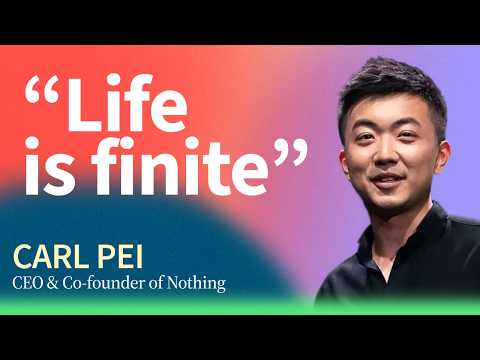
The Macro Shift: Infrastructure Invisibility. As core technologies become background noise, value moves from the pipes to the unique experiences built on top of them.
The Tactical Edge: Reject Mediocrity. Audit your product for average features and replace them with high-conviction improvements that competitors are too lazy to attempt.
The Bottom Line: Building is the only way to ensure the future happens. If you do not create the next version of reality, you are stuck living in an outdated vision.
The transition from hardware specs to emotional hardware where brand identity and OS-native AI become the primary moats.
Prioritize arbitrage opportunities in marketing by finding underpriced attention on platforms like TikTok before they become crowded.
Success in mature markets requires a Genghis Khan method: be a talent scout, stay open-minded to global supply chains, and use design to win the emotional battle for the consumer's pocket.
The transition from centralized cloud training to distributed local inference creates a massive demand for high-bandwidth storage and custom CPUs.
Audit your technical roadmap to prioritize local agentic workflows that reduce latency and data privacy risks.
The next 12 months will favor hardware that enables physical AI and local autonomy. Owning the compute stack is becoming a competitive necessity for builders who want to move faster than the cloud allows.
Intelligence is decoupling from scale. As reasoning becomes a commodity, the value moves from the size of the model to the proprietary nature of the training data.
Use TRL or Unsloth for single-GPU fine-tuning. Prioritize cleaning your instruction sets over increasing your training iterations.
The future belongs to those who own their data pipelines. If you can distill elite reasoning into a 350M parameter model, you win on latency, cost, and privacy.
Software maintenance is moving from a manual craft to an industrial process. As agents handle the toil of migrations and security, human engineers will focus entirely on high-level system design.
Batch by Dependency. Use the OpenHands SDK to visualize your codebase as a graph and deploy agents to solve the leaf nodes first.
Companies that master agent orchestration will clear their tech debt backlogs in weeks instead of years, creating a massive competitive advantage in product velocity.
**Treasury Companies Are A Double-Edged Sword.** They are creating massive buy-side pressure now but pose a systemic risk. Their weak debt covenants could turn a market dip into a liquidation cascade.
**Market Structure Over Fundamentals (For Now).** ETH’s surge exemplifies this trend. Despite weak fundamentals, its powerful technical breakout and role as the next asset for treasury buyers are driving its outperformance.
**Watch the NAV Premium.** The key health metric is the premium-to-NAV on these treasury companies. As long as investors pay $2 for $1 of crypto, the mania continues. A flip to a discount is the canary in the coal mine.
The Cycle is Dead, Long Live the Cycle: The old four-year, retail-driven crypto cycle is over. We're in an institutionally-led "gigachad bull run" that will last through 2026 and push the market cap above $10 trillion, pending regulatory clarity.
Narrative is the Ultimate Metric: Chains that focus on philosophical purity and solving real-world problems (Bitcoin, Cardano) build more resilient communities and long-term value than those chasing fleeting metrics like TPS and TVL.
Bitcoin's Next Chapter will be Written on Cardano: As Bitcoin matures into a yield-bearing asset, its massive capital base will seek returns elsewhere. Cardano’s UTXO model and upcoming interoperability features are designed to capture this flow, positioning it as Bitcoin’s de facto yield layer.
The Dollar's "Gold Moment" is Here. The dollar is decoupling from its traditional anchor (rate differentials) just as gold decoupled from real yields, signaling a permanent regime shift driven by geopolitics, not just economics.
The "Dollar Smile" Has Inverted. The dollar is no longer a reliable risk-off hedge. Its positive correlation with equities means it now falls during market stress—a fundamental rewiring for asset allocators.
The Devaluation Trade is a Trap (For Now). While the long-term bearish case for the dollar is clear, the trade is dangerously crowded. Expect markets to test this one-sided positioning with a painful bounce before the ultimate decline resumes.
**The Real Cycle Indicator:** Forget price targets. The bull market's health is directly tied to the premium-to-NAV on crypto treasury vehicles. When those premiums collapse, the party is over.
**L1s Are Dead Money:** The dominant thesis is a massive market re-rating where capital flees overvalued L1 infrastructure and concentrates into Bitcoin and a handful of cash-flow-positive applications.
**Stablecoins Aren't a Commodity:** The moats are deep. New issuers will struggle to compete with Tether's liquidity network effects and Ethena's structural yield advantage, making it a bear market for new stablecoin startups.
Content is the New Capital: The Base App transforms every post into a tradable asset. This makes content creation a direct form of capital formation, rewarding creators for attention in a way that’s native to the internet of value.
The Rise of the Native Creator: The biggest winners on Base won't be Web2 transplants, but new creators who master the platform's unique blend of content and commerce. The strategy is to find and elevate undiscovered talent from every vertical.
From Algorithm to Free Market: Base is trading the black box of social media algorithms for the transparent chaos of a free market. The central experiment is whether market-based incentives can build a healthier, more aligned social network.
**ETH is the New Institutional Primitive.** The "ETH Treasury" model is a new unlock, leveraging ETH's native yield to create a self-financing acquisition engine that is attracting billions in institutional capital.
**The Floodgates Are Open.** The Genius Bill and explosive ETF inflows are not just bullish signals; they are structural shifts that are unleashing a torrent of capital and legitimizing the asset class for mainstream finance.
**Risk is Ramping.** The excitement is palpable, but so is the risk. The treasury meta feels like a potential bubble, and legal threats against core DeFi and infrastructure remain a significant overhang. Buyer beware.