The digital experience economy is moving from static content to dynamic, AI-driven co-experience platforms, where user interaction data becomes the core asset for training next-generation virtual intelligence.
Invest in platforms that offer robust, cloud-connected infrastructure and proprietary, vectorized user data for AI training, as these will be the engines for future immersive content and agentic AI development.
Roblox's long-term vision, powered by its unique data moat and AI investments, positions it to define the future of virtual co-experience, making it a critical player to watch for investors and builders in the AI and gaming space over the next 6-12 months.
The exponential reduction in the cost of intelligence, coupled with open-source proliferation, is pushing AI into every corner of society, creating a collective action problem where market incentives for "engaging" AI clash with the need for societal safety and control.
Get hands-on with AI now. "Vibe coding" and actively experimenting with AI tools builds "AI muscle," inoculating users against psychosis risks and building a deeper understanding of AI's capabilities and limitations.
AI is here to stay and will redefine work and interaction. Understanding its "hyperobject" nature, advocating for clear regulatory boundaries, and actively engaging with the technology are critical for navigating the near future without falling for its simulated charms.
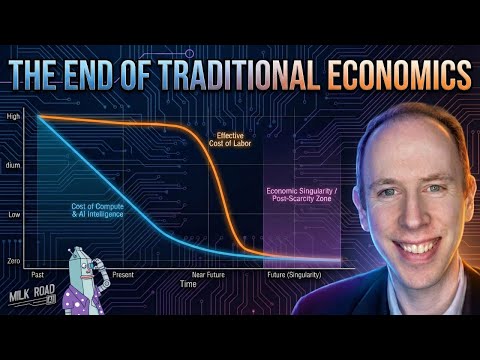
AI-driven hyperdeflation will fundamentally alter economic structures, leading to a post-scarcity future where the primary challenge shifts from production to distribution and the integration of human and machine economies.
Invest in infrastructure that bridges human and AI economies, or prepare for a future where AI agents become a significant, crypto-native economic force.
The next 6-12 months will see continued acceleration of AI capabilities, pushing us closer to a future where traditional labor and intelligence are nearly free. Understanding this change is crucial for navigating the emerging economic landscape and identifying new value creation opportunities.
The era of opaque, black-box AI is ending; the future demands intentionally designed models with human understanding and control. This shift is driven by reliability in high-stakes applications and extracting novel insights.
Investigate interpretability tools (like Goodfire's platform) to gain granular control over model behavior, moving beyond basic fine-tuning for critical applications.
Interpretability is not a niche; it's the missing piece for scaling AI safely into mission-critical domains. Mastering model understanding and intentional design will yield unprecedented capabilities and competitive advantage.
Robotics is moving from bespoke, data-hungry behavior cloning to generalized, human-informed learning via world models. This shift, mirroring the success of LLMs, means robots can use the vast, unstructured data of human experience to acquire new skills.
Invest in platforms and data pipelines that facilitate multi-modal, multi-stage training for humanoid robots. Prioritize systems that can generate synthetic data and use world models for high-throughput, targeted policy evaluation.
World models are the engine for scalable robot intelligence. They promise a future where robots learn faster, generalize wider, and self-improve through iterative simulation, making widespread humanoid deployment a near-term reality.
The Macro Shift: AI is collapsing the time horizon for technological deployment and market dominance, shifting the competitive advantage from pure innovation to a combination of innovation, capital, and rapid infrastructure deployment.
The Tactical Edge: Invest in companies that are not just building AI, but are fundamentally rethinking existing industries with AI-first principles, recognizing that traditional software moats are eroding.
The Bottom Line: The next 12-24 months will see AI's broad impact kick in, creating unprecedented opportunities for those who understand its new "laws of physics" and the critical role of policy in shaping its trajectory.
The healthcare system is moving from reactive, acute care to proactive, preventative interventions, driven by the unsustainable costs of chronic disease and a growing understanding of environmental health.
Build infrastructure that financially incentivizes lifestyle interventions, such as TrueMed's HSA/FSA payment rails for health-promoting products and services.
The next decade will see hundreds of billions of dollars redirected towards preventative health. Companies that bridge the gap between lifestyle choices and healthcare financing will capture significant market share.
The Macro Shift: Global energy demand, driven by AI, forces a strategic re-evaluation of nuclear power. This creates a window for nations to re-shore critical energy infrastructure, moving from reliance on adversaries to domestic, cost-competitive solutions.
The Tactical Edge: Investigate companies addressing foundational supply chain gaps in critical industries like energy. Look for teams with a "first principles" engineering approach and a track record of commercializing hard tech.
The Bottom Line: America's energy independence and its ability to power future technological growth, like AI, hinge on rebuilding domestic nuclear fuel enrichment. This is not just an industrial opportunity; it is a national security imperative.
Crypto Is America's Counter-Offensive. The U.S. is betting on privately-issued, regulated stablecoins—not a government-backed digital dollar—to maintain its edge in global payments. This strategy mirrors how it co-opted the offshore Eurodollar market in the 1970s to expand the dollar’s influence.
The Rise of Parallel Systems. The weaponization of the dollar is forcing countries like China to build their own financial infrastructure (e.g., the M-Bridge platform). This guarantees a future where nations have multiple payment networks to choose from, eroding the U.S.’s unique leverage.
Sanctions Are Not a Free Lunch. While a powerful alternative to military conflict, economic sanctions must be used judiciously. Overusing them risks dulling their impact and ultimately dismantling the very system that grants the U.S. its power.
ETH's Narrative Is Its Near-Term Weapon. ETH's strength lies in a story simple enough for a "dumb banker": massive market cap, 80%+ stablecoin dominance, and the perceived success of its L2s. This makes it an easier buy for TradFi, even if the value accrual thesis is murky.
Solana Is Playing The Long Game. Solana is betting that superior tech will ultimately win. Its focus isn't on the current TradFi narrative but on building the infrastructure for future "internet capital markets," a strategy that requires patience.
Stablecoin Liquidity Is a Vanity Metric. Billions in stablecoins on platforms like Aave don't automatically translate to productive economic activity. The primary use case remains on-chain speculation, challenging the idea that massive liquidity is an end in itself.
Ditch the Beta, Pick Your Alts: The days of everything moving in unison are fading. Idiosyncratic returns are back, rewarding investors who can identify projects with strong, sustainable tokenomics.
Beware the Treasury Treadmill: The crypto treasury model is not an "infinite money glitch." Expect premiums to compress and consolidation to begin as the market becomes saturated and the ability to raise capital at a premium wanes.
Tokenization is the Next Frontier: The real institutional play is the rise of "internet capital markets." The tokenization of money market funds by giants like BNY and Goldman will create new, regulated avenues for investment and yield generation on-chain.
Price Action Is the Best Marketing. ETH’s bullish chart has single-handedly revived interest, breaking a long-term downtrend against BTC and forcing even skeptics to reconsider. The technicals are now undeniably strong.
ETH Is Wall Street’s High-Beta Darling. New institutional money, looking for 5-10x returns and limited to what’s available in brokerage accounts, is flowing into ETH as the logical next step down the risk curve from Bitcoin.
Trade Your Conviction. Don't chase a rally you don't understand. Entering a trade based on technicals without a fundamental framework is a recipe for selling the lows when volatility hits. For some, leveraged Bitcoin remains a more coherent trade.
Crypto as a Political Countermeasure: For Hoskinson, blockchain is the practical tool to enforce the sound money and transparent governance that the US government has abandoned.
The Federal Reserve Is a Core Target: He identifies the Federal Reserve's unchecked power over the monetary supply as a central flaw in the current system, positioning decentralized currencies as a direct challenge to its authority.
A Mission, Not a Job: His daily engagement isn't for financial gain but is driven by the conviction that the fight for a more honest and accountable system is far from over.
Tech Over Hype: Solana’s long-term bet is on fundamental technology. Upgrades like Jito’s BAM are designed to create a superior on-chain environment for sophisticated finance, even if it means losing short-term narrative battles to ETH.
The Institutional Gap: Ethereum is currently winning the institutional game with simple, powerful stories around stablecoins and treasury assets. Solana needs a clearer, more accessible pitch beyond raw performance to compete for this capital.
Performance is Non-Negotiable: The Solana ecosystem is doubling down on its high-throughput thesis. Expect a continued push for more blockspace and faster finality, even if it makes running a validator more exclusive. The trade-off is deemed worth it to bring global-scale finance on-chain.