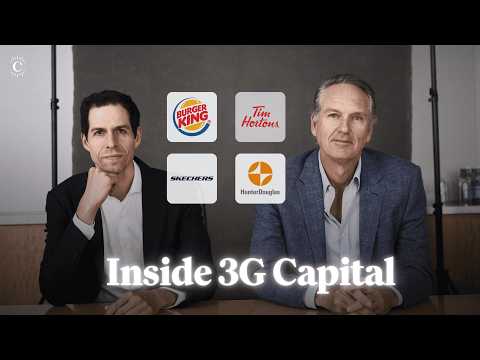
3G commits to one investment per fund, deploying significant internal capital alongside partners. This focus allows for rigorous downside analysis and patience, ensuring only truly exceptional businesses are acquired.
3G partners are seasoned operators who step into businesses, aligning incentives with ownership. This hands-on approach ensures decisions serve the business's long-term health, not just short-term management goals.
3G prioritizes businesses that directly own their customer relationships, like Burger King or Hunter Douglas. This direct connection reduces disintermediation risk from retailers or new technologies.
As capital markets become increasingly efficient and competitive, the edge moves from financial engineering to deep operational expertise and long-term, owner-aligned management.
Prioritize identifying and enabling high-potential individuals early in their careers, granting them significant responsibility and ownership.
Disciplined focus, patient relationship building, and an unwavering commitment to operational excellence in established, defensible businesses can still yield generational wealth.
The Macro Trend: In a world obsessed with digital disruption, 3G Capital's success with "atoms over bits" businesses highlights a strategic pivot: enduring value often resides in established brands with proprietary customer relationships, where operational excellence and long-term thinking create moats against fleeting tech trends.
The Tactical Edge: Identify businesses with strong, direct customer relationships and a clear path for operational improvement, even if they appear "boring." Prioritize deep, hands-on involvement to drive value, rather than relying solely on financial engineering.
The Bottom Line: The future of outsized returns may not be in chasing the next big tech wave, but in patiently acquiring and meticulously operating businesses that own their customer relationships, leveraging technology to enhance, not redefine, their core value. This strategy offers a more predictable, less volatile path to compounding capital.
The Macro Shift: In a world obsessed with digital disruption, 3G Capital's success highlights the enduring power of "hard" businesses with strong customer relationships. Their focus on foundational consumer brands, managed by operator-investors who prioritize long-term ownership and disciplined execution, offers a robust counter-narrative to the "bits over atoms" trend.
The Tactical Edge: Cultivate an extreme ownership culture by aligning incentives deeply, empowering young talent with real responsibility, and fostering a relentless bias for action.
The Bottom Line: For investors and builders, the lesson is clear: patience, deep operational involvement, and a fanatical focus on talent in defensible, "boring" businesses can yield extraordinary, long-term value, even in expensive markets.
Extreme Focus: 3G Capital commits to one investment per fund, deploying significant internal capital alongside partners. This singular focus forces rigorous downside analysis and patience, ensuring they only pursue truly exceptional opportunities.
Owner Operators: 3G partners are seasoned operators who step into businesses, aligning incentives with ownership. This means leaders act like shareholders, making decisions for the business's long-term health, not just short-term management goals.
Disruption Defense: 3G prioritizes businesses with strong customer relationships and physical components, making them less susceptible to digital disintermediation. They seek enduring brands like Hunter Douglas, where the sun will always rise and set, ensuring a consistent need for their product.
In an era of rapid technological change, businesses with strong, direct customer relationships and physical moats are increasingly valuable. 3G's focus on these "atoms" businesses, enhanced by strategic tech adoption, provides a blueprint for durable value creation.
Cultivate an ownership culture by aligning incentives deeply, empowering young talent with real responsibility, and prioritizing long-term value over short-term gains.
The future belongs to patient, operator-led investors who can identify and transform enduring businesses by focusing on fundamental quality, people, and strategic technological integration, rather than chasing fleeting trends.
3G Capital's model counters this by doubling down on "atoms" businesses with strong customer relationships and defensible positions, then applying rigorous operational excellence.
Cultivate an owner-operator mindset within your organization, even if you are not a private equity firm. Identify and back high-potential young talent with significant responsibility and aligned incentives, providing mentorship to maximize their success.
In a world obsessed with speed and diversification, 3G Capital proves that deep, patient, operator-led concentration on high-quality, defensible businesses, combined with a culture of ownership and meritocracy, remains a powerful engine for outsized value creation.
The era of celebrity endorsements is evolving into one of celebrity ownership, driven by a growing understanding of equity's compounding power and enabled by new technologies that lower the barrier to business creation.
Prioritize building a diverse, expert team and actively seek out "boring" businesses or underserved markets with clear, unmet demand.
The next 6-12 months will see an acceleration of talent leveraging their brand for equity stakes, particularly in tech-enabled ventures. Position yourself to either participate in these deals or build the tools that empower this new class of owner-operators.
It’s an Operating Company, Not Just a Vault: xTAO’s strategy is to actively build validators and infrastructure, using its public listing as a flywheel for accretive TAO acquisition, rather than passively holding the asset.
Structure is Strategy: The combination of a low-cost TSXV listing and a tax-free Cayman Islands headquarters gives xTAO a significant operational and financial edge designed for long-term sustainability.
The Next Frontier is User Adoption: For Bittensor to reach its potential, it must break out of the crypto bubble. The ecosystem's ultimate success hinges on subnets creating useful products that attract mainstream users.
Own What Institutions Buy. This is not a crypto-native cycle. The winning strategy is to hold the assets institutions are buying: Bitcoin, Ethereum, and potentially Ripple as a speculative trade on its IPO.
Trade Crypto Stocks Like Memes. Public companies like Galaxy are being driven by retail hype, not fundamentals. This creates high-volatility trading opportunities for those who can ride the narrative waves.
Hold Your Conviction. The macro backdrop is incredibly bullish. Don't let healthy, short-term corrections driven by "amateur hour" traders shake you out of your positions before the real move happens.
The Narrative Gap: Solana is shipping game-changing tech like Jito’s BAM, but it’s losing market momentum to Ethereum’s simpler, more digestible "digital treasury" narrative. This highlights a critical disconnect between engineering reality and market perception.
BAM is an Ecosystem Reset: Jito’s BAM isn’t a simple patch; it's a foundational redesign of Solana's value pipeline. By internalizing MEV and enabling custom sequencing, it directly challenges the business model of SVM appchains and unlocks a new design space for DeFi on the L1.
Decentralization is a Means, Not an End: The push for higher block limits signals a pragmatic shift. The ecosystem is increasingly willing to trade some degree of validator decentralization for the massive performance gains needed to onboard real-world finance, prioritizing the network's ultimate utility over ideological purity.
A Sum-of-the-Parts Discount: The market is failing to properly value Galaxy’s three distinct segments. The existing data center deal with CoreWeave alone is arguably worth more than the current stock price, meaning investors get the robust crypto business and a multi-billion dollar balance sheet for free.
Unmatched Credibility in AI Pivot: Galaxy’s multi-billion dollar balance sheet is its trump card. It provides the financial muscle and credibility to secure financing and execute massive data center projects, a feat cash-burning Bitcoin miners can only talk about.
An Execution-Driven Rocket Ship: The current valuation offers a significant margin of safety. If management successfully executes the full buildout of Helios and secures new tenants for its massive power pipeline, the upside is astronomical.
The US is Back in the Game: The regulatory climate has shifted from a headwind to a tailwind. The new clarity allows builders to focus on product, not legal acrobatics, and gives institutions the green light to engage.
Leverage is Transparent, Not Gone: The system is deleveraged, but more importantly, its risk profile has improved dramatically. Leverage now lives in safer, productized, and on-chain formats built on verifiable custody rather than handshake deals.
Bitcoin is Becoming Core Collateral: Look beyond Bitcoin as just "digital gold." Its true institutional power is emerging as a pristine collateral asset, set to anchor a multi-hundred-billion-dollar lending market packaged for TradFi consumption.
The On-Chain Mandate is Here. The SEC is no longer an obstacle but a proponent of moving U.S. capital markets onto blockchains. This signals a green light for builders and investors focused on tokenization and on-chain financial infrastructure.
The "Pretend" Game is Over. With the SEC lead declaring "most tokens are not securities," the industry can move past the convoluted narratives used to avoid regulatory scrutiny. Projects can now be more direct about value accrual and business models.
The Roman Storm Verdict is Crypto's Next Big Catalyst. The outcome of this trial will have profound implications. An acquittal would be a massive win for open-source developers and privacy, while a conviction could set a chilling precedent for years to come.