The Macro Shift: Celebrity capital is moving from transactional endorsements to strategic equity investments, driven by a desire for long-term wealth creation and the recognition that personal brand power can significantly accelerate startup growth.
The Tactical Edge: Cultivate a diverse network of mentors and partners, prioritizing those who bring complementary expertise and can challenge your assumptions.
The Bottom Line: The future of wealth creation for high-profile individuals and savvy investors lies in strategic, long-term equity plays, supported by strong teams and a willingness to partner.
AI agents with system-level access are shifting the core value proposition of software from discrete applications to fluid, context-aware personal assistants.
Cultivate "agent empathy" by learning to guide AI models effectively, understanding their limitations, and designing projects for agent-first navigation.
The rise of autonomous agents will redefine software's purpose and value.
Adopt PolaRiS for rapid policy iteration. Leverage its real-to-sim environment generation and minimal sim data co-training to quickly validate robot policies in diverse, unseen environments before committing to expensive real-world deployments.
The era of generalist robot policies demands a new paradigm for evaluation. The shift is from bespoke, real-world testing to scalable, high-fidelity sim-to-real correlation, enabling faster iteration and broader generalization testing.
Reliable sim-to-real evaluation is the missing link for accelerating robot AI. PolaRiS offers a pragmatic, community-driven path to unlock faster development cycles and more robust generalist robot policies over the next 6-12 months.
Generalist robot policies demand evaluation that tests true generalization across diverse, unseen environments. The shift is from hand-tuned, task-specific benchmarks to scalable, community-driven evaluation suites that can keep pace with rapidly improving model capabilities. This requires tools that make environment creation cheap and ensure real-world predictive power.
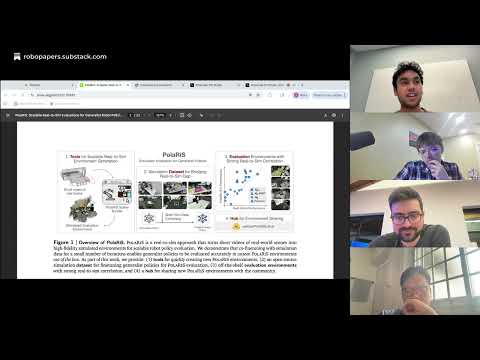
Adopt PolaRiS for rapid, correlated policy iteration. Builders should leverage its real-to-sim environment generation (Gaussian splatting for scenes, generative models for objects) and the "sim co-training" trick to quickly validate policy improvements against real-world performance, especially for pick-and-place tasks. Contribute new environments to the Polaris Hub to expand the collective benchmark.
The future of robotics hinges on fast, reliable evaluation. PolaRiS offers a pragmatic, immediate solution to accelerate policy development by providing high-fidelity, correlated sim environments. Over the next 6-12 months, expect this hybrid approach to become a standard for iterating on generalist robot policies, while fully learned world models continue to improve for more complex, deformable tasks.
The push for generalist robot policies demands scalable, trustworthy evaluation. PolaRiS democratizes high-fidelity sim evaluation, moving robotics closer to rapid iteration cycles seen in other AI fields.
Builders should explore PolaRiS's open-source tools and pre-trained checkpoints to quickly test policies in diverse, real-world-correlated environments. Prioritize visual fidelity and use small, unrelated sim data for alignment.
Rapid, reliable sim evaluation with strong real-world correlation is a significant advancement. This tool enables faster policy iteration, broader generalization, and community-driven benchmarking, setting the stage for the next generation of robot capabilities.
Generalist robot policies demand community-driven, scalable evaluation, mirroring LLM benchmarking. PolaRiS provides the technical foundation by making high-fidelity, correlated sim environments accessible.
Adopt PolaRiS for rapid policy iteration. Use its browser-based scene builder and Gaussian splatting for quick environment creation, incorporating minimal, unrelated sim co-training data for strong real-world correlation.
PolaRiS accelerates robot development with a reliable, scalable simulation tool. This means faster iteration, more robust policies, and a clearer path to real-world deployment for your robot applications over the next 6-12 months.
The era of generalist robot policies demands evaluation tools that can keep pace with rapid development and broad generalization. PolaRiS pushes robotics toward the LLM benchmark paradigm, where models are tested on unseen environments and tasks, rather than being trained on specific benchmarks.
For builders, leverage PolaRiS's browser-based scene builder and Gaussian splatting pipeline to quickly create diverse, high-fidelity evaluation environments from real-world scans. This enables faster policy iteration and more reliable real-world deployment.
PolaRiS offers a pragmatic, scalable path to more effective robot policy development. By providing a tool that makes sim performance a reliable predictor of real-world success, it accelerates the journey from lab to real-world application, especially for pick-and-place tasks, and sets the stage for community-driven benchmarking.
Celebrity capital is evolving from passive endorsements to active, strategic equity investment, transforming athletes and entertainers into powerful venture partners who bring more than just money to the table.
Prioritize building a diverse, expert team that can challenge your assumptions and vet opportunities, especially when entering new sectors like AI or overlooked geographic markets.
Long-term thinking, a willingness to invest in growth, and a focus on strategic partnerships are non-negotiable for building lasting wealth and influence in both traditional and emerging industries over the next 6-12 months.
Follow the Flows. Ethereum's rally is a direct result of capital firehoses from new treasury companies. This isn't a narrative trade; it's a structural buying pressure that creates its own momentum.
Yield is Widening. As TradFi rates fall, on-chain credit yields are set to expand. The widening spread between traditional and decentralized finance will be a powerful magnet for capital.
The Treasury Gold Rush Has Begun. The explosion of new treasury companies is a land grab for asset accumulation. The real game will be fought on operational efficiency, yield generation, and brand dominance, leading to inevitable consolidation.
ETH is the bellwether for risk. Its current rally is the starting gun for an "ETH alt season." Use ETH's strength as a barometer for when to be aggressive with altcoin allocations.
Buy breakouts, not bottoms. The most profitable strategy is to wait for assets to break their downtrend, then ride the reflexive narrative loop. Aave (AAVE) and Aerodrome (AERO) are prime examples of this setup.
Aerodrome is a conviction play. With superior tokenomics, a dominant position on Base, and a direct pipeline to Coinbase's retail army, Aerodrome has a clear path to becoming a breakout star of this cycle.
Privacy as a Feature, Not a Product. The next major user-facing push will be to embed privacy tools directly into mainstream wallets, shifting privacy from a niche cypherpunk concern to a default user experience.
Scale L1, Anchor L2s. The roadmap focuses on a strong L1 as the ultimate settlement and asset-issuance layer. This keeps the sprawling L2 ecosystem economically aligned and prevents fragmentation by making the L1 indispensable.
ETH is the Economic Glue. A strong ETH is essential for coordinating incentives across the ecosystem. It is the core economic asset that aligns the Foundation, L2s, DeFi apps, and users, preventing the community from fracturing.
**Platform, Not Phones.** Success for Solana Mobile isn't another phone sale; it's getting another manufacturer to adopt its platform. The end goal is to be the crypto equivalent of Android—a foundational layer for a world of hardware.
**Go Global or Go Home.** The US is a sideshow. The real action is in the wildly diverse international market, where hundreds of device makers are looking for a competitive edge. This is where Solana Mobile plans to win.
**Ecosystem as the Engine.** The strategy hinges on empowering the ecosystem to "go nuts." If the core team has to scale massively, it’s a sign of failure. True success is when hardware builders and dApp developers drive the platform’s growth organically.
Specialization Over Generalization. For demanding use cases like exchanges, purpose-built rollups have a massive edge over L1s. They can be hyper-optimized for a single function without being constrained by the needs of a diverse ecosystem.
Performance Is the Product. Sub-10-millisecond finality isn't a vanity metric; it's the fundamental requirement to bring serious financial markets and liquidity on-chain. Sovereign is making on-chain performance competitive with centralized finance.
Revenue Before Token. In a direct rejection of the "launch-and-pray" model, Sovereign is building a sustainable business via a revenue-share on its core technology. The team has no plans for a token until a clear, long-term value accrual mechanism exists.
The Scale is Real: At $28 trillion in annual volume, stablecoins have already surpassed Visa and Mastercard combined, proving the infrastructure is ready for primetime.
B2B is the Killer App: The most powerful immediate use case isn't speculation, but something far more practical: B2B payments. The efficiency gains are too large for corporate treasurers to ignore.
TradFi is Scrambling: Wall Street has moved from dismissal to active investigation. Sell-side analysts are now quantifying the threat stablecoins pose to legacy payment networks, signaling a major paradigm shift.