The rise of autonomous AI agents will fundamentally reshape the app economy, rendering many single-purpose applications obsolete as agents integrate and automate tasks across systems. This forces companies to either become agent-facing APIs or risk irrelevance.
Cultivate "agent empathy" by understanding how models perceive codebases and problems. This skill, combined with a willingness to experiment and "play," is crucial for effectively guiding agents to build and refactor software.
The agentic AI era demands a shift from traditional programming to a builder mindset, where human creativity and strategic guidance become paramount. Investors should seek platforms enabling this shift, and builders must adapt to a world where natural language is the new code.
Robotics is moving towards generalist policies, demanding scalable, high-fidelity evaluation tools that mirror the real world, away from task-specific benchmarks.
Adopt PolaRiS for rapid policy iteration and generalization testing, especially for pick-and-place tasks, leveraging easy environment creation and proven real-to-sim correlation.
PolaRiS provides critical infrastructure for accelerating robot learning, enabling builders to quickly validate policies against real-world performance without prohibitive cost.
AI agents are transforming software development from a manual coding craft into an "agentic engineering" discipline, where human builders orchestrate and guide autonomous AI systems. This shift means the value moves from writing boilerplate code to designing agent-friendly architectures and providing high-level strategic direction.
Embrace agentic engineering by learning to "empathize" with AI models, understanding their context limitations, and guiding them with concise, clear prompts. Experiment with open-source agents like OpenClaw to build new tools or automate existing workflows, focusing on the what and why rather than the how.
Personal AI agents will commoditize many existing apps and services, forcing companies to either become agent-facing APIs or risk obsolescence. Investors should identify platforms and infrastructure that enable agent interoperability, while builders should focus on creating agent-native experiences and tools that augment human creativity, rather than replicating existing app functionality.
Robotics is moving beyond isolated tasks to generalist policies, demanding scalable, correlated evaluation methods. This mirrors the LLM world's need for diverse, generalization-focused benchmarks.
Utilize PolaRiS's open-source tools and Hugging Face hub to quickly create and share new evaluation environments. This crowdsourcing approach accelerates community-wide progress in robot policy development.
Investing in tools like PolaRiS that bridge the real-sim gap with high-fidelity visuals and minimal sim co-training is crucial. This enables faster policy iteration and more reliable real-world deployment for the next generation of generalist robots.
The macro shift: Generalist robot policies need generalist evaluation. The shift is from hand-crafted, task-specific sim environments to easily generated, real-world-correlated simulations that test zero-shot generalization, mirroring the rapid benchmark development in LLMs. This allows for a holistic understanding of policy capabilities across diverse, unseen scenarios.
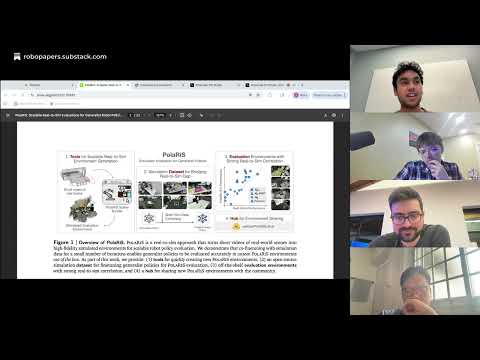
The tactical edge: Adopt PolaRiS for rapid policy iteration. Builders should use its browser-based scene builder and Gaussian Splatting to quickly create new, diverse evaluation environments from real-world scans, then fine-tune policies with small, unrelated sim data to achieve high real-to-sim correlation. This accelerates development cycles and reduces costly real-world testing.
The future of robotics hinges on scalable, trustworthy evaluation. PolaRiS provides a critical tool today to bridge the sim-to-real gap, enabling faster, more reliable development of generalist robot policies. Expect a community-driven explosion of benchmarks, pushing robot capabilities faster than ever over the next 6-12 months.
The robotics community needs to move beyond task-specific benchmarks with provided training data towards a diverse suite of generalization-focused evaluations, mirroring the LLM ecosystem. PolaRiS provides the tools to crowdsource and rapidly deploy these new benchmarks, fostering a more holistic understanding of robot policy capabilities.
For robot policy developers, prioritize tools like PolaRiS that offer high real-to-sim correlation with minimal setup. Leverage its browser-based scene builder and the "visual vaccination" co-training method to quickly iterate on policies for pick-and-place and articulated object tasks, then validate on real hardware.
Scalable, correlated simulation is the missing piece for accelerating generalist robot AI. Over the next 6-12 months, the adoption of tools like PolaRiS will enable faster policy iteration, more robust benchmarking, and ultimately, a quicker path to deploying capable robots in diverse, unstructured environments.
The robotics community is moving from hand-crafted, task-specific simulations to generalist policies that demand scalable, real-world correlated evaluation. PolaRiS enables this by making it cheap and easy to create diverse, high-fidelity sim environments from real scans, allowing for generalization testing akin to LLM benchmarks.
Implement PolaRiS for rapid policy iteration. Use its real-to-sim environment generation and minimal, unrelated sim data co-training to quickly validate robot policies against real-world performance, reducing costly physical robot time.
PolaRiS offers a critical infrastructure upgrade for robot AI development. By providing a fast, reproducible, and highly correlated simulation environment, it allows builders to iterate on generalist robot policies at software speed, significantly de-risking and accelerating the path to real-world deployment and broader robot capabilities over the next 6-12 months.
The drive for generalist robot policies demands scalable, reliable evaluation. PolaRiS pushes robotics toward the community-driven, diverse benchmarking common in LLMs, accelerating the path to truly capable robots.
Adopt PolaRiS for rapid policy iteration and generalization testing. Leverage its easy environment creation and proven real-to-sim correlation to quickly validate new robot behaviors before costly real-world deployment.
PolaRiS is a critical tool for any team building robot policies. It cuts evaluation costs, speeds up development, and provides a trustworthy signal for real-world performance, making it a must-have for your robotics roadmap over the next 6-12 months.
Builders should prioritize hybrid real-to-sim evaluation tools like PolaRiS for rapid policy iteration.
Use minimal, out-of-domain sim data to align policies to the simulation environment, ensuring your sim results accurately predict real-world performance.
Investing in tools that democratize benchmark creation and ensure strong real-to-sim correlation will accelerate robot policy development.
A New Economic Primitive: Bittensor is pioneering "Incentivism," a model that replaces traditional companies with a decentralized network of goals and globally competing workers, creating a system that is described as "capitalism squared.
TAO is an Index on Innovation: The network is designed so all value accrues back to the base TAO token through staking mechanisms. Investing in TAO is effectively an index bet on the entire ecosystem’s innovation.
An Unbeatable Cost Structure: The "Law of Subnet Stacking" enables exponential cost reductions, giving the Bittensor ecosystem a potentially insurmountable competitive advantage over centralized incumbents.
**The Market Is Cooked.** With momentum buyers exhausted and value buyers absent, the risk/reward on majors like BTC and ETH is heavily skewed to the downside. The party may not be over, but it's time to find the exit.
**DEXs Are Not CEXs.** Decentralized perpetual exchanges like Hyperliquid offer unparalleled access but lack the circuit breakers and centralized oversight of a Binance. In these venues, you are the risk manager, and there is no sheriff coming to save you.
**Beware OG Whales.** The market is still heavily influenced by a small number of early crypto holders operating with immense capital and unsophisticated "ape first, research later" strategies. Their unpredictable actions can and will create violent dislocations.
**The Fed's dovish turn is the primary market catalyst.** Powell's signals of impending rate cuts have injected massive optimism, driving ETH to a new all-time high and confirming that macro now dictates crypto's direction.
**Capital is aggressively rotating from Bitcoin to Ether.** This classic cycle rotation, amplified by whale activity and trader expectations, is a self-fulfilling prophecy, positioning ETH as the next dominant asset to watch.
**The Solana treasury narrative is the next frontier.** With the window closing for new Bitcoin and ETH treasury vehicles, a fierce competition is underway to establish the dominant, "Saylor-like" figurehead for Solana, creating a new focal point for institutional capital.
**Track NFT Blue-Chips as a Signal.** The price action of collections like CryptoPunks acts as a potent gauge for the "wealth effect" and overall risk appetite within the crypto ecosystem. Their peaks often correlate with broader market tops.
**Separate Collecting from Investing.** Frame high-end NFT acquisitions as an "expense" for art you genuinely love, not a financial investment. This strategy decouples your emotional well-being from market volatility.
**Embrace Your Top-Signal Buys.** An expensive purchase at a market peak isn't just a loss; it's a powerful lesson in humility. Use it as a constant reminder that no one is immune to market psychology.
Ditch the Rotator Playbook. This isn't 2021. Stop chasing every pump. Success this cycle requires picking a few narratives, believing in them, and holding with conviction.
Make On-Chain Money Real. Stablecoins encourage bad habits. Cash out profits to a real bank account to create a psychological barrier against recklessly aping your gains back into the market.
Plan for Post-Win Depression. The dopamine crash after a massive score is inevitable. Resist the urge to chase that high; prioritize building sustainable, real-world income instead of buying status symbols.
A Politicized Fed is the Baseline. Assume the Federal Reserve will be pressured to cut rates to neutral (~3%) by 2026, creating an unusually loose policy backdrop relative to strong nominal growth.
Mind the Fiscal Cliff, Then the Rocket Ship. Brace for a temporary growth slowdown as tariffs bite over the next few months, but prepare for a sharp re-acceleration in 2026 if and when new stimulus kicks in.
Ditch Old Hedges, Buy Protest Assets. Your portfolio's traditional diversifiers (long bonds, USD) are broken. Shift allocation toward assets that benefit from inflation risk and high nominal growth: commodities, crypto, and undervalued international equities.