The Macro Shift: In an era of rapid technological disruption and diversified portfolios, 3G Capital's success with "old economy" brands highlights the enduring power of deep operational expertise, long-term alignment, and a relentless focus on fundamental business quality, even in non-tech sectors.
The Tactical Edge: Cultivate Ownership: Implement incentive structures that align management with long-term shareholder value, treating company capital as personal capital. This means disproportionately rewarding top performers and fostering a culture of accountability.
The Bottom Line: In a market obsessed with rapid tech cycles, 3G's long-term, deep-operator model suggests that enduring value lies in fundamental business quality, direct customer relationships, and a culture that empowers talent, offering a counter-narrative for builders and investors seeking sustainable alpha.
The robotics community is moving from bespoke, task-specific benchmarks to generalist policy evaluation platforms that prioritize real-world correlation and scalability. This mirrors LLM benchmark evolution, demanding tools that enable rapid, diverse testing.
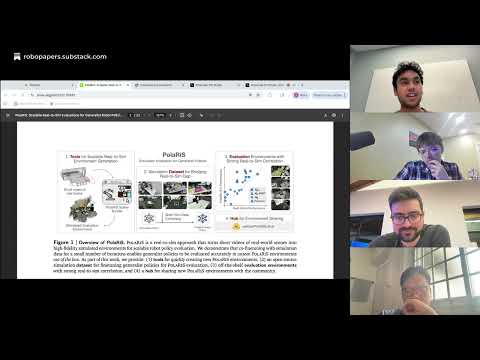
Builders and researchers should prioritize evaluation frameworks that offer easy, real-to-sim environment generation (like PolaRiS's Gaussian splatting) and incorporate small, diverse sim data for distribution alignment. This accelerates policy iteration and ensures applicability.
Scalable, real-world-correlated simulation is the missing link for accelerating generalist robot policy development. Investing in or building on tools like PolaRiS, which democratize environment creation and robust evaluation, will be key to unlocking the next generation of capable robots over the next 6-12 months.
The rise of generalist robot policies demands a new generation of evaluation tools that are both scalable and highly correlated with real-world performance.
Adopt hybrid real-to-sim evaluation frameworks like PolaRiS to accelerate robot policy iteration and ensure real-world applicability.
Reliable, scalable simulation is no longer a pipe dream; it's a present reality for rigid body tasks. This means faster development cycles and more robust robot policies in the next 6-12 months.
The rise of generalist robot policies, trained on large real-world datasets, demands a new evaluation framework. PolaRiS provides a scalable, real-world correlated simulation, moving robotics towards an LLM-like benchmark ecosystem where models are tested for zero-shot generalization across diverse, easily created environments.
Adopt PolaRiS to rapidly iterate on robot policies. Leverage its real-to-sim environment generation and minimal sim-code training to achieve high correlation with real-world performance, significantly cutting development time and cost compared to physical testing.
For builders and investors, PolaRiS means faster, cheaper, and more reliable robot policy development. This tool accelerates the path to deployable, generalist robots, making advanced robotics more accessible and competitive in the next 6-12 months.
The push for generalist robot policies, akin to foundation models in other AI fields, necessitates a shift from bespoke, real-world-only evaluations to scalable, correlated simulation benchmarks.
Adopt PolaRiS for faster policy iteration. Integrate small, diverse sets of *unrelated* sim data into your co-training mix to significantly boost real-to-sim correlation.
Robotics is moving towards LLM-style benchmarking.
While the market obsesses over "bits" and rapid tech disruption, 3G Capital demonstrates that enduring value often resides in "atoms"—physical businesses with strong brands and direct customer relationships. This highlights a counter-cyclical opportunity in overlooked, tangible assets.
Cultivate an owner-operator mentality in your ventures. Focus on attracting and empowering top talent with significant equity, then decentralize execution while maintaining clear strategic alignment.
In the next 6-12 months, prioritize investments in businesses with defensible customer relationships and clear, long-term growth runways, even if they appear "boring." Your ability to instill a true ownership culture will be a differentiator, driving outsized returns where others chase fleeting trends.
In a world where capital is abundant but truly great businesses are rare and often overpriced, 3G's model highlights a strategic pivot: deep, operator-led concentration on defensible, customer-centric assets with long-term growth potential, rather than broad, passive diversification.
Cultivate an "owner operator" mindset within your organization, pushing decision-making closer to the problems and aligning incentives with long-term shareholder value, not just short-term metrics.
Over the next 6-12 months, focus on identifying businesses with strong, direct customer relationships and inherent resistance to technological disruption. These "forever businesses," often family-controlled, offer a more reliable path to compounding returns than pursuing fleeting trends or commoditized assets.
The Macro Shift: In an era of rapid technological change, businesses with strong, direct customer relationships and physical moats are increasingly resilient. Technology should improve, not replace, core offerings.
The Tactical Edge: Cultivate a "brand bigger than the business" mindset. Seek out established brands with global recognition but underperforming operations, then apply rigorous, owner-operator principles to create latent value and growth.
The Bottom Line: Long-term thinking and a relentless focus on people and business quality, even in a concentrated portfolio, remain the most powerful engines for compounding capital. This means patience, deep operational involvement, and a willingness to bet big on exceptional talent.
Question Sacred Cows: The path to breakthrough performance lies in challenging foundational assumptions. For Layer 2s, this means recognizing that sequencer decentralization may be a solution in search of a problem.
Focus and Outsource: MegaETH’s strategy is simple: be the best at performance by outsourcing the hardest part—consensus—to Ethereum. This allows them to build a hyper-optimized execution environment without compromising on security.
Hire Outside the Echo Chamber: The next major blockchain innovation may not come from a crypto veteran. Expertise from adjacent fields like low-latency computing can provide the first-principles thinking needed to solve the industry’s most entrenched problems.
**Allocations Are Multiplying:** The standard institutional crypto allocation is moving from a timid 1% to a more confident 3-5%, driven by crypto's declining volatility and the fading fear of a "go-to-zero" event.
**The ETF Universe is Exploding:** New SEC guidelines will unleash a wave of crypto ETFs, from single assets to index funds. This will reshape market structure and provide traditional investors with simple on-ramps to the entire ecosystem.
**Stablecoins are the Real Trojan Horse:** Beyond Bitcoin, institutional demand for stablecoins is immense. They aren't just an asset; they are recognized as the critical settlement layer for a tokenized, 24/7 global market.
Becoming the Capital Stack: Coinbase's endgame is not just being a crypto exchange but providing the full, end-to-end infrastructure for any company—crypto or traditional—to issue, manage, and raise capital on-chain.
Acquire Missionaries, Not Mercenaries: Their M&A success hinges on a proactive, culture-first approach. They identify strategic needs, hunt for the best teams, and integrate them deeply, ensuring founders stay long after their earnouts expire.
Prediction Markets are the Next Trojan Horse: Coinbase is betting big on prediction markets to onboard the next wave of mainstream users, using familiar activities like sports betting as an accessible entry point into the crypto ecosystem.
Leverage Overload, Fundamental Weakness. Record leverage created a "house of cards" structure. Without strong underlying spot volume and new buyers, the market became highly susceptible to cascading liquidations.
The Profits Are In. Long-term Bitcoin holders have already cashed out nearly twice the profit they did last cycle ($900B vs. $500B), indicating the "wealth distribution" phase is well underway.
The Line in the Sand. The key level to watch is Bitcoin's 50-week moving average (around $102k). As long as Bitcoin holds above it, the bull market structure remains intact; two weekly closes below it would be a strong confirmation that the cycle is over.
**Volume is the Best Validation**: Meme coins proved Solana isn't just fast in theory; it can handle transactional loads that surpass major centralized exchanges, making it a credible platform for serious financial assets.
**Simplicity Wins**: Solana’s killer feature is its seamless user experience. By eliminating the bridging and multi-chain complexities of rivals, it has created a low-friction environment that attracts both developers and mainstream users.
**The Next Frontier is Tokenization**: The meme coin craze was the chaotic opening act. The main event is the tokenization of real-world assets, and Solana’s proven performance has positioned it as the frontrunner to become the settlement layer for this new market.
Stop Reacting, Start Anticipating: The market’s direction is a better economic predictor than official data. Focus on forward guidance, not rearview-mirror analysis.
Bitcoin Is a Macro Asset: The primary thesis for assets like Bitcoin stems from the structural debasement of fiat currencies. Analyze it through the lens of global liquidity and monetary policy.
Trust the Market, Not the Fed: The bond market can and will reject central bank policy. When market signals contradict official narratives, pay attention—the market is often right.