The rise of autonomous AI agents will fundamentally reshape the app economy, rendering many single-purpose applications obsolete as agents integrate and automate tasks across systems. This forces companies to either become agent-facing APIs or risk irrelevance.
Cultivate "agent empathy" by understanding how models perceive codebases and problems. This skill, combined with a willingness to experiment and "play," is crucial for effectively guiding agents to build and refactor software.
The agentic AI era demands a shift from traditional programming to a builder mindset, where human creativity and strategic guidance become paramount. Investors should seek platforms enabling this shift, and builders must adapt to a world where natural language is the new code.
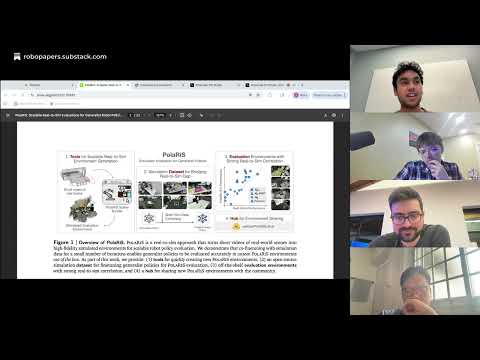
Robotics is moving towards generalist policies, demanding scalable, high-fidelity evaluation tools that mirror the real world, away from task-specific benchmarks.
Adopt PolaRiS for rapid policy iteration and generalization testing, especially for pick-and-place tasks, leveraging easy environment creation and proven real-to-sim correlation.
PolaRiS provides critical infrastructure for accelerating robot learning, enabling builders to quickly validate policies against real-world performance without prohibitive cost.
AI agents are transforming software development from a manual coding craft into an "agentic engineering" discipline, where human builders orchestrate and guide autonomous AI systems. This shift means the value moves from writing boilerplate code to designing agent-friendly architectures and providing high-level strategic direction.
Embrace agentic engineering by learning to "empathize" with AI models, understanding their context limitations, and guiding them with concise, clear prompts. Experiment with open-source agents like OpenClaw to build new tools or automate existing workflows, focusing on the what and why rather than the how.
Personal AI agents will commoditize many existing apps and services, forcing companies to either become agent-facing APIs or risk obsolescence. Investors should identify platforms and infrastructure that enable agent interoperability, while builders should focus on creating agent-native experiences and tools that augment human creativity, rather than replicating existing app functionality.
Robotics is moving beyond isolated tasks to generalist policies, demanding scalable, correlated evaluation methods. This mirrors the LLM world's need for diverse, generalization-focused benchmarks.
Utilize PolaRiS's open-source tools and Hugging Face hub to quickly create and share new evaluation environments. This crowdsourcing approach accelerates community-wide progress in robot policy development.
Investing in tools like PolaRiS that bridge the real-sim gap with high-fidelity visuals and minimal sim co-training is crucial. This enables faster policy iteration and more reliable real-world deployment for the next generation of generalist robots.
The macro shift: Generalist robot policies need generalist evaluation. The shift is from hand-crafted, task-specific sim environments to easily generated, real-world-correlated simulations that test zero-shot generalization, mirroring the rapid benchmark development in LLMs. This allows for a holistic understanding of policy capabilities across diverse, unseen scenarios.
The tactical edge: Adopt PolaRiS for rapid policy iteration. Builders should use its browser-based scene builder and Gaussian Splatting to quickly create new, diverse evaluation environments from real-world scans, then fine-tune policies with small, unrelated sim data to achieve high real-to-sim correlation. This accelerates development cycles and reduces costly real-world testing.
The future of robotics hinges on scalable, trustworthy evaluation. PolaRiS provides a critical tool today to bridge the sim-to-real gap, enabling faster, more reliable development of generalist robot policies. Expect a community-driven explosion of benchmarks, pushing robot capabilities faster than ever over the next 6-12 months.
The robotics community needs to move beyond task-specific benchmarks with provided training data towards a diverse suite of generalization-focused evaluations, mirroring the LLM ecosystem. PolaRiS provides the tools to crowdsource and rapidly deploy these new benchmarks, fostering a more holistic understanding of robot policy capabilities.
For robot policy developers, prioritize tools like PolaRiS that offer high real-to-sim correlation with minimal setup. Leverage its browser-based scene builder and the "visual vaccination" co-training method to quickly iterate on policies for pick-and-place and articulated object tasks, then validate on real hardware.
Scalable, correlated simulation is the missing piece for accelerating generalist robot AI. Over the next 6-12 months, the adoption of tools like PolaRiS will enable faster policy iteration, more robust benchmarking, and ultimately, a quicker path to deploying capable robots in diverse, unstructured environments.
The robotics community is moving from hand-crafted, task-specific simulations to generalist policies that demand scalable, real-world correlated evaluation. PolaRiS enables this by making it cheap and easy to create diverse, high-fidelity sim environments from real scans, allowing for generalization testing akin to LLM benchmarks.
Implement PolaRiS for rapid policy iteration. Use its real-to-sim environment generation and minimal, unrelated sim data co-training to quickly validate robot policies against real-world performance, reducing costly physical robot time.
PolaRiS offers a critical infrastructure upgrade for robot AI development. By providing a fast, reproducible, and highly correlated simulation environment, it allows builders to iterate on generalist robot policies at software speed, significantly de-risking and accelerating the path to real-world deployment and broader robot capabilities over the next 6-12 months.
The drive for generalist robot policies demands scalable, reliable evaluation. PolaRiS pushes robotics toward the community-driven, diverse benchmarking common in LLMs, accelerating the path to truly capable robots.
Adopt PolaRiS for rapid policy iteration and generalization testing. Leverage its easy environment creation and proven real-to-sim correlation to quickly validate new robot behaviors before costly real-world deployment.
PolaRiS is a critical tool for any team building robot policies. It cuts evaluation costs, speeds up development, and provides a trustworthy signal for real-world performance, making it a must-have for your robotics roadmap over the next 6-12 months.
Builders should prioritize hybrid real-to-sim evaluation tools like PolaRiS for rapid policy iteration.
Use minimal, out-of-domain sim data to align policies to the simulation environment, ensuring your sim results accurately predict real-world performance.
Investing in tools that democratize benchmark creation and ensure strong real-to-sim correlation will accelerate robot policy development.
Question Sacred Cows: The path to breakthrough performance lies in challenging foundational assumptions. For Layer 2s, this means recognizing that sequencer decentralization may be a solution in search of a problem.
Focus and Outsource: MegaETH’s strategy is simple: be the best at performance by outsourcing the hardest part—consensus—to Ethereum. This allows them to build a hyper-optimized execution environment without compromising on security.
Hire Outside the Echo Chamber: The next major blockchain innovation may not come from a crypto veteran. Expertise from adjacent fields like low-latency computing can provide the first-principles thinking needed to solve the industry’s most entrenched problems.
**Allocations Are Multiplying:** The standard institutional crypto allocation is moving from a timid 1% to a more confident 3-5%, driven by crypto's declining volatility and the fading fear of a "go-to-zero" event.
**The ETF Universe is Exploding:** New SEC guidelines will unleash a wave of crypto ETFs, from single assets to index funds. This will reshape market structure and provide traditional investors with simple on-ramps to the entire ecosystem.
**Stablecoins are the Real Trojan Horse:** Beyond Bitcoin, institutional demand for stablecoins is immense. They aren't just an asset; they are recognized as the critical settlement layer for a tokenized, 24/7 global market.
Becoming the Capital Stack: Coinbase's endgame is not just being a crypto exchange but providing the full, end-to-end infrastructure for any company—crypto or traditional—to issue, manage, and raise capital on-chain.
Acquire Missionaries, Not Mercenaries: Their M&A success hinges on a proactive, culture-first approach. They identify strategic needs, hunt for the best teams, and integrate them deeply, ensuring founders stay long after their earnouts expire.
Prediction Markets are the Next Trojan Horse: Coinbase is betting big on prediction markets to onboard the next wave of mainstream users, using familiar activities like sports betting as an accessible entry point into the crypto ecosystem.
Leverage Overload, Fundamental Weakness. Record leverage created a "house of cards" structure. Without strong underlying spot volume and new buyers, the market became highly susceptible to cascading liquidations.
The Profits Are In. Long-term Bitcoin holders have already cashed out nearly twice the profit they did last cycle ($900B vs. $500B), indicating the "wealth distribution" phase is well underway.
The Line in the Sand. The key level to watch is Bitcoin's 50-week moving average (around $102k). As long as Bitcoin holds above it, the bull market structure remains intact; two weekly closes below it would be a strong confirmation that the cycle is over.
**Volume is the Best Validation**: Meme coins proved Solana isn't just fast in theory; it can handle transactional loads that surpass major centralized exchanges, making it a credible platform for serious financial assets.
**Simplicity Wins**: Solana’s killer feature is its seamless user experience. By eliminating the bridging and multi-chain complexities of rivals, it has created a low-friction environment that attracts both developers and mainstream users.
**The Next Frontier is Tokenization**: The meme coin craze was the chaotic opening act. The main event is the tokenization of real-world assets, and Solana’s proven performance has positioned it as the frontrunner to become the settlement layer for this new market.
Stop Reacting, Start Anticipating: The market’s direction is a better economic predictor than official data. Focus on forward guidance, not rearview-mirror analysis.
Bitcoin Is a Macro Asset: The primary thesis for assets like Bitcoin stems from the structural debasement of fiat currencies. Analyze it through the lens of global liquidity and monetary policy.
Trust the Market, Not the Fed: The bond market can and will reject central bank policy. When market signals contradict official narratives, pay attention—the market is often right.