The Macro Shift: Celebrity capital is moving from transactional endorsements to strategic equity investments, driven by a desire for long-term wealth creation and the recognition that personal brand power can significantly accelerate startup growth.
The Tactical Edge: Cultivate a diverse network of mentors and partners, prioritizing those who bring complementary expertise and can challenge your assumptions.
The Bottom Line: The future of wealth creation for high-profile individuals and savvy investors lies in strategic, long-term equity plays, supported by strong teams and a willingness to partner.
AI agents with system-level access are shifting the core value proposition of software from discrete applications to fluid, context-aware personal assistants.
Cultivate "agent empathy" by learning to guide AI models effectively, understanding their limitations, and designing projects for agent-first navigation.
The rise of autonomous agents will redefine software's purpose and value.
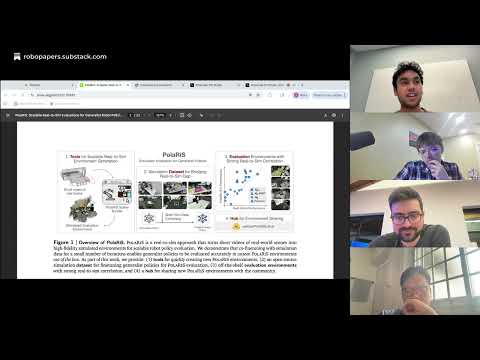
Adopt PolaRiS for rapid policy iteration. Leverage its real-to-sim environment generation and minimal sim data co-training to quickly validate robot policies in diverse, unseen environments before committing to expensive real-world deployments.
The era of generalist robot policies demands a new paradigm for evaluation. The shift is from bespoke, real-world testing to scalable, high-fidelity sim-to-real correlation, enabling faster iteration and broader generalization testing.
Reliable sim-to-real evaluation is the missing link for accelerating robot AI. PolaRiS offers a pragmatic, community-driven path to unlock faster development cycles and more robust generalist robot policies over the next 6-12 months.
Generalist robot policies demand evaluation that tests true generalization across diverse, unseen environments. The shift is from hand-tuned, task-specific benchmarks to scalable, community-driven evaluation suites that can keep pace with rapidly improving model capabilities. This requires tools that make environment creation cheap and ensure real-world predictive power.
Adopt PolaRiS for rapid, correlated policy iteration. Builders should leverage its real-to-sim environment generation (Gaussian splatting for scenes, generative models for objects) and the "sim co-training" trick to quickly validate policy improvements against real-world performance, especially for pick-and-place tasks. Contribute new environments to the Polaris Hub to expand the collective benchmark.
The future of robotics hinges on fast, reliable evaluation. PolaRiS offers a pragmatic, immediate solution to accelerate policy development by providing high-fidelity, correlated sim environments. Over the next 6-12 months, expect this hybrid approach to become a standard for iterating on generalist robot policies, while fully learned world models continue to improve for more complex, deformable tasks.
The push for generalist robot policies demands scalable, trustworthy evaluation. PolaRiS democratizes high-fidelity sim evaluation, moving robotics closer to rapid iteration cycles seen in other AI fields.
Builders should explore PolaRiS's open-source tools and pre-trained checkpoints to quickly test policies in diverse, real-world-correlated environments. Prioritize visual fidelity and use small, unrelated sim data for alignment.
Rapid, reliable sim evaluation with strong real-world correlation is a significant advancement. This tool enables faster policy iteration, broader generalization, and community-driven benchmarking, setting the stage for the next generation of robot capabilities.
Generalist robot policies demand community-driven, scalable evaluation, mirroring LLM benchmarking. PolaRiS provides the technical foundation by making high-fidelity, correlated sim environments accessible.
Adopt PolaRiS for rapid policy iteration. Use its browser-based scene builder and Gaussian splatting for quick environment creation, incorporating minimal, unrelated sim co-training data for strong real-world correlation.
PolaRiS accelerates robot development with a reliable, scalable simulation tool. This means faster iteration, more robust policies, and a clearer path to real-world deployment for your robot applications over the next 6-12 months.
The era of generalist robot policies demands evaluation tools that can keep pace with rapid development and broad generalization. PolaRiS pushes robotics toward the LLM benchmark paradigm, where models are tested on unseen environments and tasks, rather than being trained on specific benchmarks.
For builders, leverage PolaRiS's browser-based scene builder and Gaussian splatting pipeline to quickly create diverse, high-fidelity evaluation environments from real-world scans. This enables faster policy iteration and more reliable real-world deployment.
PolaRiS offers a pragmatic, scalable path to more effective robot policy development. By providing a tool that makes sim performance a reliable predictor of real-world success, it accelerates the journey from lab to real-world application, especially for pick-and-place tasks, and sets the stage for community-driven benchmarking.
Celebrity capital is evolving from passive endorsements to active, strategic equity investment, transforming athletes and entertainers into powerful venture partners who bring more than just money to the table.
Prioritize building a diverse, expert team that can challenge your assumptions and vet opportunities, especially when entering new sectors like AI or overlooked geographic markets.
Long-term thinking, a willingness to invest in growth, and a focus on strategic partnerships are non-negotiable for building lasting wealth and influence in both traditional and emerging industries over the next 6-12 months.
Embrace Financial Autonomy: Athletes are adopting crypto not just for gains, but for control. They are tired of a financial system where they are told to "shut your mouth and go play basketball" while trusting strangers with their money.
Regulation is a Two-Front War: The crypto industry must fight defensively to protect wins like stablecoin rewards while also playing offense to ensure new regulations don't stifle DeFi innovation before it can mature.
Prediction Markets are Information Markets: Their true disruption isn't just taking on FanDuel; it's creating a more efficient, decentralized, and transparent way to surface truth in real-time, for everything from sports to politics.
**Buy the Blood:** Massive open interest liquidations have historically been powerful buy signals, not a reason to panic. The data shows strong positive returns in the 30-120 days following such events.
**Invest in Token Factories:** The convergence of AI and crypto is creating a new paradigm. The most valuable companies will be those that control proprietary "token supplies" for identity, data, and assets, making the world machine-readable.
**Pick Your Winners:** The market is maturing. As barriers to entry rise, capital will consolidate around established leaders. Shift focus from chasing the "next new thing" to identifying compounding winners in categories like L1s and exchanges.
Capital Formation is the New Battleground: Coinbase’s Echo deal is a $400M bet to own the token launch pipeline, directly challenging Binance's Launchpad dominance.
Banks are Officially on Defense: The Fed’s "skinny master account" proposal threatens to let fintechs bypass banks entirely, a disruption so real that bank CEOs are publicly admitting innovators will win.
Prediction Markets are Going Mainstream: DraftKings' partnership with Polymarket validates the model as a legitimate workaround for complex state-level gambling laws, signaling a massive new distribution channel.
Sell the News, Buy the Self-Own. Eclipse’s price action demonstrates that in crypto, counter-narrative marketing can be more effective than traditional hype. When a project publicly acknowledges its own failures, it can signal a market bottom.
Culture is Strategy. The contrast between Ethereum’s perceived complacency and Solana’s hungry underdog ethos directly impacts developer incentives and innovation speed. Ecosystems with a clear, aggressive mission attract and retain talent differently.
Watch the SKR Token. As only the second token from Solana Labs, the SKR launch carries significant reputational weight. Investors should monitor its mechanics, as it will likely set a new standard for ecosystem projects launched by a parent company.
Fade the Cycle Narrative: The influx of new, cycle-agnostic capital via ETFs means the market's rhythm has changed. Sideways price action is the new up, signaling strong demand is absorbing OG selling.
Buy Picks, Shovels, and Yield: The era of riding hyped, valueless memecoins is over. The durable strategy is to own the infrastructure (Robin Hood) or assets that generate and return real fees to holders (Shuffle, Aerodrome).
Arbitrage Information Gaps: Find your edge in niche markets. Exploitable alpha exists in prediction markets, whether through contrarian betting, language advantages, or AI-powered analysis.
Stablecoins Are The Trojan Horse. They have achieved undeniable product-market fit, rivaling legacy payment rails and becoming a key tool for U.S. dollar dominance. They are the gateway for both institutional players and everyday users in emerging markets.
Usage is Divorced From Speculation. For the first time, practical on-chain activity is being driven by users in developing nations who *need* crypto, while speculation is led by those in developed nations who *want* it. The next bull run will be driven by products that bridge this divide.
The Bottleneck is No Longer Technology. With scalability largely solved (blockchains now process over 3,400 TPS), the primary barriers to adoption have shifted from infrastructure to product design, user experience, and regulatory clarity.