The Macro Shift: Celebrity capital is moving from transactional endorsements to strategic equity investments, driven by a desire for long-term wealth creation and the recognition that personal brand power can significantly accelerate startup growth.
The Tactical Edge: Cultivate a diverse network of mentors and partners, prioritizing those who bring complementary expertise and can challenge your assumptions.
The Bottom Line: The future of wealth creation for high-profile individuals and savvy investors lies in strategic, long-term equity plays, supported by strong teams and a willingness to partner.
AI agents with system-level access are shifting the core value proposition of software from discrete applications to fluid, context-aware personal assistants.
Cultivate "agent empathy" by learning to guide AI models effectively, understanding their limitations, and designing projects for agent-first navigation.
The rise of autonomous agents will redefine software's purpose and value.
Adopt PolaRiS for rapid policy iteration. Leverage its real-to-sim environment generation and minimal sim data co-training to quickly validate robot policies in diverse, unseen environments before committing to expensive real-world deployments.
The era of generalist robot policies demands a new paradigm for evaluation. The shift is from bespoke, real-world testing to scalable, high-fidelity sim-to-real correlation, enabling faster iteration and broader generalization testing.
Reliable sim-to-real evaluation is the missing link for accelerating robot AI. PolaRiS offers a pragmatic, community-driven path to unlock faster development cycles and more robust generalist robot policies over the next 6-12 months.
Generalist robot policies demand evaluation that tests true generalization across diverse, unseen environments. The shift is from hand-tuned, task-specific benchmarks to scalable, community-driven evaluation suites that can keep pace with rapidly improving model capabilities. This requires tools that make environment creation cheap and ensure real-world predictive power.
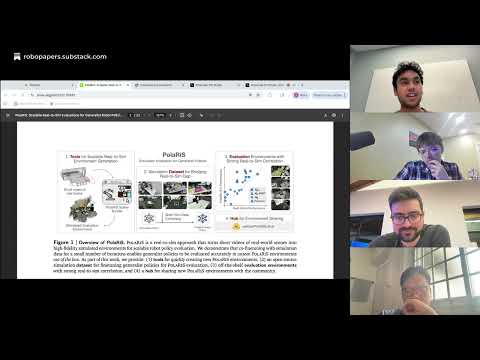
Adopt PolaRiS for rapid, correlated policy iteration. Builders should leverage its real-to-sim environment generation (Gaussian splatting for scenes, generative models for objects) and the "sim co-training" trick to quickly validate policy improvements against real-world performance, especially for pick-and-place tasks. Contribute new environments to the Polaris Hub to expand the collective benchmark.
The future of robotics hinges on fast, reliable evaluation. PolaRiS offers a pragmatic, immediate solution to accelerate policy development by providing high-fidelity, correlated sim environments. Over the next 6-12 months, expect this hybrid approach to become a standard for iterating on generalist robot policies, while fully learned world models continue to improve for more complex, deformable tasks.
The push for generalist robot policies demands scalable, trustworthy evaluation. PolaRiS democratizes high-fidelity sim evaluation, moving robotics closer to rapid iteration cycles seen in other AI fields.
Builders should explore PolaRiS's open-source tools and pre-trained checkpoints to quickly test policies in diverse, real-world-correlated environments. Prioritize visual fidelity and use small, unrelated sim data for alignment.
Rapid, reliable sim evaluation with strong real-world correlation is a significant advancement. This tool enables faster policy iteration, broader generalization, and community-driven benchmarking, setting the stage for the next generation of robot capabilities.
Generalist robot policies demand community-driven, scalable evaluation, mirroring LLM benchmarking. PolaRiS provides the technical foundation by making high-fidelity, correlated sim environments accessible.
Adopt PolaRiS for rapid policy iteration. Use its browser-based scene builder and Gaussian splatting for quick environment creation, incorporating minimal, unrelated sim co-training data for strong real-world correlation.
PolaRiS accelerates robot development with a reliable, scalable simulation tool. This means faster iteration, more robust policies, and a clearer path to real-world deployment for your robot applications over the next 6-12 months.
The era of generalist robot policies demands evaluation tools that can keep pace with rapid development and broad generalization. PolaRiS pushes robotics toward the LLM benchmark paradigm, where models are tested on unseen environments and tasks, rather than being trained on specific benchmarks.
For builders, leverage PolaRiS's browser-based scene builder and Gaussian splatting pipeline to quickly create diverse, high-fidelity evaluation environments from real-world scans. This enables faster policy iteration and more reliable real-world deployment.
PolaRiS offers a pragmatic, scalable path to more effective robot policy development. By providing a tool that makes sim performance a reliable predictor of real-world success, it accelerates the journey from lab to real-world application, especially for pick-and-place tasks, and sets the stage for community-driven benchmarking.
Celebrity capital is evolving from passive endorsements to active, strategic equity investment, transforming athletes and entertainers into powerful venture partners who bring more than just money to the table.
Prioritize building a diverse, expert team that can challenge your assumptions and vet opportunities, especially when entering new sectors like AI or overlooked geographic markets.
Long-term thinking, a willingness to invest in growth, and a focus on strategic partnerships are non-negotiable for building lasting wealth and influence in both traditional and emerging industries over the next 6-12 months.
Survive, Then Thrive. After massive liquidations, the strongest assets and narratives (e.g., privacy plays like Zcash) recover first. Focus capital on names showing relative strength post-wipeout, as they are the first to capture returning liquidity.
Revenue is the New Narrative. The game has changed. The market now demands clear revenue streams and legal structures that align token holders with protocol success. Valueless governance tokens are out; tokens tied to real business operations are in.
On-Chain TradFi is Here. Platforms like Hyperliquid are successfully bringing assets like the NASDAQ on-chain, proving crypto-native demand for traditional markets. This represents a major new frontier for DeFi protocols looking to capture volume.
**Fiscal is the new Fed.** Government spending, not central bank policy, is the dominant force in the economy. Stop looking for a traditional recession; the deficit is the stimulus that won’t quit.
**The Fed is re-opening the liquidity spigot.** The era of Quantitative Tightening is over. A gradual but persistent expansion of the Fed's balance sheet is coming, which will provide a tailwind for assets.
**Own scarce assets.** The long-term debasement of fiat currency is the default path. Alden remains constructive on Bitcoin, viewing its current phase as a prelude to a significant move higher in the coming years.
Security Is No Longer an Afterthought: The Crucible Wallet’s native Ledger integration provides the first hardware-secured, consumer-friendly way to manage TAO and subnet tokens, addressing a major security gap in the ecosystem.
Automated Strategy Beats Day Trading: The "Staking to Core Alpha" feature offers a powerful tool that automatically reinvests yield into a customizable portfolio of subnets, saving users from the overwhelming task of constantly researching and reallocating assets.
Capital Flow is King: The wallet's primary mission is to redirect staked TAO from the root network into deserving subnets, providing them with the capital needed to grow and achieve commercial success, which in turn strengthens the entire Bittensor network.
The Real Metric Is GDP, Not Volume. A million dollars in daily card spending on real-world goods is a far more powerful signal of adoption than hundreds of millions in AMM swap volume. Watch the growth in real economic activity, not just on-chain shuffling.
Infrastructure Is the Bottleneck. The race isn't just to launch another neobank; it's to build the underlying pipes. Protocols like Frax that power multiple stablecoins and neobanks are positioned to capture value from the entire ecosystem's growth.
The End Game Is a Parallel Financial System. Crypto neobanks are the final link needed to close the economic loop. They enable a world where a user can save, earn yield, and spend entirely on-chain, making the concept of a bank account obsolete.
Verticalize or Die. Protocols are aggressively bundling services to capture value and own the user experience. Standalone products are at risk of being outcompeted or acquired cheaply, as seen with Pump's acquisition of Padre.
The Middle-Ground ICO is Hot. Highly anticipated projects like MegaETH are finding success with public sales that sit between illiquid private rounds and expensive public listings. For investors with capital, these offer a compelling risk/reward profile.
Performance Trumps Purity. The debate is shifting. While credible neutrality is a good marketing angle, the rise of high-performance chains like Hyperliquid suggests users and capital will flow to the best product, regardless of its decentralization score.
Every App is a Future Fintech: Major applications will become their own central banks, issuing native stablecoins to control their financial rails, capture yield, and eliminate the platform risk inherent in relying on third-party issuers.
Infrastructure, Not Brands, is the Real Game: The battle isn't over which stablecoin brand wins, but who builds the underlying rails that make a fragmented ecosystem of thousands of dollars feel like one seamless, interoperable network.
The Stablecoin Market is Just Getting Started: Today's ~$300 billion stablecoin float is a "ridiculously small number." Expect a 100x expansion as money migrates from legacy bank ledgers to programmable, on-chain infrastructure.