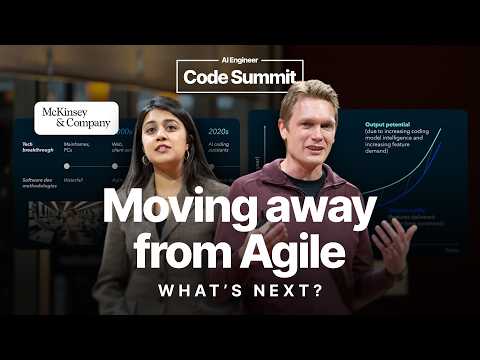
Strategic Implication: The "Agile" era is ending. AI demands a new, more fluid, and context-aware operating model for software development.
Builder/Investor Note: Look for (or build) companies that are fundamentally redesigning their SDLC, team structures, and roles around AI, not just bolting on tools. This includes robust, outcome-based measurement.
The "So What?": The next 6-12 months will separate the AI-native leaders from the laggards. Those who embrace this human and organizational transformation will unlock exponential value; others will be stuck with marginal gains.
Strategic Implication: The market is moving beyond basic "copilot" functionality. The next frontier is proactive, context-aware AI that reduces cognitive load and integrates seamlessly into existing workflows.
Builder/Investor Note: Focus on building or investing in multi-agent architectures that converge context across the entire product lifecycle (code, design, data) and prioritize human-in-the-loop alignment over pure autonomy.
The "So What?": The fundamental patterns of software development (Git, IDEs, even code itself) are ripe for disruption. Don't be afraid to question old ways; the future of how software is built is being invented right now.
**The "Small is Mighty" Paradigm:** Don't underestimate smaller, specialized models. M2 proves that smart engineering, real-world feedback, and iterative reasoning can outperform larger models in specific, high-value domains.
**Builders, Embrace Iteration:** Design your agents with "interleaved thinking." The ability to self-correct and adapt to noisy environments is critical for real-world utility.
**The "So What?":** The next wave of AI agents will be defined by their robustness, cost-effectiveness, and ability to generalize across dynamic environments. M2 is a blueprint for building practical, scalable AI that developers will actually integrate into their daily workflows.
Strategic Shift: The future of human-computer interaction is voice-first, moving from static content to dynamic, personalized, and agentic experiences.
Builder/Investor Note: Defensibility in AI is increasingly found in deep product layers, specialized architectural breakthroughs (especially in audio), and robust ecosystems, not just raw model scale.
The "So What?": Over the next 6-12 months, expect to see significant advancements in proactive AI agents, immersive media, and personalized education, with voice as the core interface.
The AI-Delegation Revolution is Here: Start experimenting with AI tools like ChatGPT for delegation now. The future involves proactive machine assistants deeply integrated into your workflow.
Builders & Investors: Focus on "How to Delegate": The biggest constraint isn't finding assistants, but teaching clients how to delegate effectively. Tools and services that educate delegators will win.
Reclaim Your Ambition: By offloading the mundane, you free up mental bandwidth to think bigger, pursue more ambitious goals, and ultimately, control your most valuable asset: time.
Strategic Implication: The AI bubble is inevitable. Focus on defensible positions: deep product integration, proprietary data, and distribution, rather than just raw model performance.
Builder/Investor Note: The opportunity lies in productizing AI for specific "jobs to be done" within niche industries, creating intuitive UIs, and building in validation, not just building another foundational model.
The "So What?": We're about to figure out the true "job to be done" for many industries. AI will unbundle existing businesses by exposing their hidden inefficiencies or non-obvious defensibilities.
Embrace Parsimony and Self-Consistency: Adopt these principles as guiding forces in AI design. Build models that not only compress data efficiently but also maintain a high degree of self-consistency to ensure accurate and reliable world models.
Focus on Abstraction, Not Just Memorization: Prioritize developing systems that can abstract knowledge beyond mere memorization. Move beyond surface-level compression and aim for models that can discover and reason about the underlying principles of the world.
Understand and Reproduce the Brain’s Mechanisms: Focus on understanding and reproducing the mechanisms in the human brain that enable deductive reasoning, logical thinking, and the creation of new scientific theories to truly push AI to the next level.
**Prioritize AI Safety Research:** Invest aggressively in understanding and mitigating AI risks to safeguard humanity against potential rogue LLMs.
**Support Decentralized AI Alignment:** Champion decentralized platforms like Bit Tensor and initiatives like Trishool that promote open and transparent AI alignment research.
**Embrace Mechanistic Interpretability:** Drive the development of tools that enable us to understand and control the internal workings of AI models, ensuring alignment with human values.
Embrace Delegation as a Foundational Skill: Whether you leverage AI or human support, mastering delegation is paramount for unlocking personal and professional potential.
Prioritize Time Ownership: Recognize time as your most valuable asset and design your life and calendar around your highest goals.
Start Small, Scale Intentionally: Begin with affordable AI tools and gradually incorporate human assistance as your budget and needs evolve, building trust and compounding leverage over time.
Survive, Then Thrive. After massive liquidations, the strongest assets and narratives (e.g., privacy plays like Zcash) recover first. Focus capital on names showing relative strength post-wipeout, as they are the first to capture returning liquidity.
Revenue is the New Narrative. The game has changed. The market now demands clear revenue streams and legal structures that align token holders with protocol success. Valueless governance tokens are out; tokens tied to real business operations are in.
On-Chain TradFi is Here. Platforms like Hyperliquid are successfully bringing assets like the NASDAQ on-chain, proving crypto-native demand for traditional markets. This represents a major new frontier for DeFi protocols looking to capture volume.
**Fiscal is the new Fed.** Government spending, not central bank policy, is the dominant force in the economy. Stop looking for a traditional recession; the deficit is the stimulus that won’t quit.
**The Fed is re-opening the liquidity spigot.** The era of Quantitative Tightening is over. A gradual but persistent expansion of the Fed's balance sheet is coming, which will provide a tailwind for assets.
**Own scarce assets.** The long-term debasement of fiat currency is the default path. Alden remains constructive on Bitcoin, viewing its current phase as a prelude to a significant move higher in the coming years.
Security Is No Longer an Afterthought: The Crucible Wallet’s native Ledger integration provides the first hardware-secured, consumer-friendly way to manage TAO and subnet tokens, addressing a major security gap in the ecosystem.
Automated Strategy Beats Day Trading: The "Staking to Core Alpha" feature offers a powerful tool that automatically reinvests yield into a customizable portfolio of subnets, saving users from the overwhelming task of constantly researching and reallocating assets.
Capital Flow is King: The wallet's primary mission is to redirect staked TAO from the root network into deserving subnets, providing them with the capital needed to grow and achieve commercial success, which in turn strengthens the entire Bittensor network.
The Real Metric Is GDP, Not Volume. A million dollars in daily card spending on real-world goods is a far more powerful signal of adoption than hundreds of millions in AMM swap volume. Watch the growth in real economic activity, not just on-chain shuffling.
Infrastructure Is the Bottleneck. The race isn't just to launch another neobank; it's to build the underlying pipes. Protocols like Frax that power multiple stablecoins and neobanks are positioned to capture value from the entire ecosystem's growth.
The End Game Is a Parallel Financial System. Crypto neobanks are the final link needed to close the economic loop. They enable a world where a user can save, earn yield, and spend entirely on-chain, making the concept of a bank account obsolete.
Verticalize or Die. Protocols are aggressively bundling services to capture value and own the user experience. Standalone products are at risk of being outcompeted or acquired cheaply, as seen with Pump's acquisition of Padre.
The Middle-Ground ICO is Hot. Highly anticipated projects like MegaETH are finding success with public sales that sit between illiquid private rounds and expensive public listings. For investors with capital, these offer a compelling risk/reward profile.
Performance Trumps Purity. The debate is shifting. While credible neutrality is a good marketing angle, the rise of high-performance chains like Hyperliquid suggests users and capital will flow to the best product, regardless of its decentralization score.
Every App is a Future Fintech: Major applications will become their own central banks, issuing native stablecoins to control their financial rails, capture yield, and eliminate the platform risk inherent in relying on third-party issuers.
Infrastructure, Not Brands, is the Real Game: The battle isn't over which stablecoin brand wins, but who builds the underlying rails that make a fragmented ecosystem of thousands of dollars feel like one seamless, interoperable network.
The Stablecoin Market is Just Getting Started: Today's ~$300 billion stablecoin float is a "ridiculously small number." Expect a 100x expansion as money migrates from legacy bank ledgers to programmable, on-chain infrastructure.