The Macro Shift: Celebrity capital is moving from transactional endorsements to strategic equity investments, driven by a desire for long-term wealth creation and the recognition that personal brand power can significantly accelerate startup growth.
The Tactical Edge: Cultivate a diverse network of mentors and partners, prioritizing those who bring complementary expertise and can challenge your assumptions.
The Bottom Line: The future of wealth creation for high-profile individuals and savvy investors lies in strategic, long-term equity plays, supported by strong teams and a willingness to partner.
AI agents with system-level access are shifting the core value proposition of software from discrete applications to fluid, context-aware personal assistants.
Cultivate "agent empathy" by learning to guide AI models effectively, understanding their limitations, and designing projects for agent-first navigation.
The rise of autonomous agents will redefine software's purpose and value.
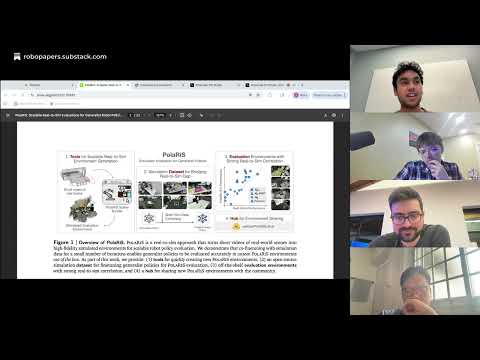
Adopt PolaRiS for rapid policy iteration. Leverage its real-to-sim environment generation and minimal sim data co-training to quickly validate robot policies in diverse, unseen environments before committing to expensive real-world deployments.
The era of generalist robot policies demands a new paradigm for evaluation. The shift is from bespoke, real-world testing to scalable, high-fidelity sim-to-real correlation, enabling faster iteration and broader generalization testing.
Reliable sim-to-real evaluation is the missing link for accelerating robot AI. PolaRiS offers a pragmatic, community-driven path to unlock faster development cycles and more robust generalist robot policies over the next 6-12 months.
Generalist robot policies demand evaluation that tests true generalization across diverse, unseen environments. The shift is from hand-tuned, task-specific benchmarks to scalable, community-driven evaluation suites that can keep pace with rapidly improving model capabilities. This requires tools that make environment creation cheap and ensure real-world predictive power.
Adopt PolaRiS for rapid, correlated policy iteration. Builders should leverage its real-to-sim environment generation (Gaussian splatting for scenes, generative models for objects) and the "sim co-training" trick to quickly validate policy improvements against real-world performance, especially for pick-and-place tasks. Contribute new environments to the Polaris Hub to expand the collective benchmark.
The future of robotics hinges on fast, reliable evaluation. PolaRiS offers a pragmatic, immediate solution to accelerate policy development by providing high-fidelity, correlated sim environments. Over the next 6-12 months, expect this hybrid approach to become a standard for iterating on generalist robot policies, while fully learned world models continue to improve for more complex, deformable tasks.
The push for generalist robot policies demands scalable, trustworthy evaluation. PolaRiS democratizes high-fidelity sim evaluation, moving robotics closer to rapid iteration cycles seen in other AI fields.
Builders should explore PolaRiS's open-source tools and pre-trained checkpoints to quickly test policies in diverse, real-world-correlated environments. Prioritize visual fidelity and use small, unrelated sim data for alignment.
Rapid, reliable sim evaluation with strong real-world correlation is a significant advancement. This tool enables faster policy iteration, broader generalization, and community-driven benchmarking, setting the stage for the next generation of robot capabilities.
Generalist robot policies demand community-driven, scalable evaluation, mirroring LLM benchmarking. PolaRiS provides the technical foundation by making high-fidelity, correlated sim environments accessible.
Adopt PolaRiS for rapid policy iteration. Use its browser-based scene builder and Gaussian splatting for quick environment creation, incorporating minimal, unrelated sim co-training data for strong real-world correlation.
PolaRiS accelerates robot development with a reliable, scalable simulation tool. This means faster iteration, more robust policies, and a clearer path to real-world deployment for your robot applications over the next 6-12 months.
The era of generalist robot policies demands evaluation tools that can keep pace with rapid development and broad generalization. PolaRiS pushes robotics toward the LLM benchmark paradigm, where models are tested on unseen environments and tasks, rather than being trained on specific benchmarks.
For builders, leverage PolaRiS's browser-based scene builder and Gaussian splatting pipeline to quickly create diverse, high-fidelity evaluation environments from real-world scans. This enables faster policy iteration and more reliable real-world deployment.
PolaRiS offers a pragmatic, scalable path to more effective robot policy development. By providing a tool that makes sim performance a reliable predictor of real-world success, it accelerates the journey from lab to real-world application, especially for pick-and-place tasks, and sets the stage for community-driven benchmarking.
Celebrity capital is evolving from passive endorsements to active, strategic equity investment, transforming athletes and entertainers into powerful venture partners who bring more than just money to the table.
Prioritize building a diverse, expert team that can challenge your assumptions and vet opportunities, especially when entering new sectors like AI or overlooked geographic markets.
Long-term thinking, a willingness to invest in growth, and a focus on strategic partnerships are non-negotiable for building lasting wealth and influence in both traditional and emerging industries over the next 6-12 months.
AI Is The Only Game In Town: The crypto market is currently a passenger in a macro environment dictated by AI. Until that capital rotation shifts, crypto will likely remain highly correlated and susceptible to sell-offs when equities show weakness.
Bitcoin’s Handover Is Bullish: Don't mistake consolidation for a bear market. Bitcoin is undergoing a healthy ownership transfer from early believers to new institutions, building a stronger, deeper foundation for its next leg up.
Decentralization Is About Coercion, Not Paralysis: The ability of a chain’s validators to collectively intervene in a catastrophic hack is a feature, not a bug. True decentralization is measured by a network's ability to resist external pressure, not its inability to make collective decisions.
System Over Gut. Max’s systematic models correctly identified the top and signaled a buy on the recent dip. In volatile markets, outsourcing conviction to an algorithm removes emotion and highlights clear entry/exit points.
Turn Losses Into Liquidity. Jonah’s CryptoPunk sale demonstrates a crucial strategy: use tax-loss harvesting to turn underwater positions into immediate, deployable capital. A paper loss can become a real financial gain.
Watch Politics, Not Just Charts. The biggest long-term threat to your portfolio isn’t a broken chart pattern; it’s a political paradigm shift. The rise of redistributionism is a slow-burn risk that could eventually dwarf any market cycle.
ETH's Value is Foundational, Not Fickle. The core investment thesis is ETH as the digital economy's pristine collateral and store of value. Network revenue is just the icing on the cake.
The Real Work is Boring (and Bullish). The next phase of growth depends on integrating Ethereum into the mundane back-office operations of TradFi. This is the key to irreversible adoption.
Privacy is the Next Frontier. Compliant, ZK-powered privacy is the final gateway required to bring massive institutional capital on-chain.
OGs are cashing out. Heavy selling pressure above $120k comes from early Bitcoin whales transferring wealth to "fair-weather" DAT holders, creating a fragile market structure.
Politics now dictate portfolio risk. Zohran Mamdani’s rise signals a shift to redistributionist politics. If this trend goes national, it’s a clear signal to liquidate assets, as redistribution historically crushes asset prices.
Invest in clean assets with real yield. In a market saturated with VC-owned tokens, assets like Hyperliquid (HYPE) stand out due to their airdrop-only distribution and fee-driven buy-and-burn mechanism, creating a direct link between platform usage and token value.
**Privacy Isn't a Feature; It's the Foundation.** For institutions, confidentiality is non-negotiable. Any network aiming to attract serious capital must offer privacy that allows for compliance without broadcasting every move to the world.
**Real Adoption Is a Long Game.** Chasing bull market hype is a losing strategy for enterprise adoption. Canton’s success with partners like Goldman Sachs, DTCC, and Citadel demonstrates the power of prioritizing utility and compliance over a premature token launch.
**The Next Wave Is Tokenizing Everything.** The goal is to move beyond crypto-native assets. The real prize is upgrading the rails for the world's existing financial system—equities, bonds, and treasuries—by making them digitally native, 24/7, and instantly settleable.
Focus or Fade. As the industry matures, companies must shed non-core business units to become world-class at one thing. For Blockworks, that's data, not news.
Buy the Theme. Public market investors will pay a massive premium for the only stock representing a major crypto trend (e.g., Securitize for tokenization), often making it a better trade than trying to pick winners among underlying assets.
Growth is Subsidized. Major L1/L2 foundations are actively paying for enterprise adoption (e.g., Solana and Western Union). This is a standard business practice to kickstart network effects, but the long-term ROI remains unproven.