The rise of autonomous AI agents will fundamentally reshape the app economy, rendering many single-purpose applications obsolete as agents integrate and automate tasks across systems. This forces companies to either become agent-facing APIs or risk irrelevance.
Cultivate "agent empathy" by understanding how models perceive codebases and problems. This skill, combined with a willingness to experiment and "play," is crucial for effectively guiding agents to build and refactor software.
The agentic AI era demands a shift from traditional programming to a builder mindset, where human creativity and strategic guidance become paramount. Investors should seek platforms enabling this shift, and builders must adapt to a world where natural language is the new code.
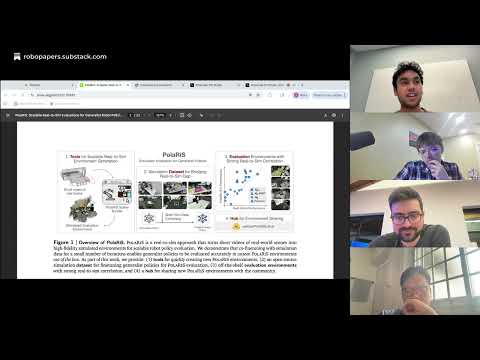
Robotics is moving towards generalist policies, demanding scalable, high-fidelity evaluation tools that mirror the real world, away from task-specific benchmarks.
Adopt PolaRiS for rapid policy iteration and generalization testing, especially for pick-and-place tasks, leveraging easy environment creation and proven real-to-sim correlation.
PolaRiS provides critical infrastructure for accelerating robot learning, enabling builders to quickly validate policies against real-world performance without prohibitive cost.
AI agents are transforming software development from a manual coding craft into an "agentic engineering" discipline, where human builders orchestrate and guide autonomous AI systems. This shift means the value moves from writing boilerplate code to designing agent-friendly architectures and providing high-level strategic direction.
Embrace agentic engineering by learning to "empathize" with AI models, understanding their context limitations, and guiding them with concise, clear prompts. Experiment with open-source agents like OpenClaw to build new tools or automate existing workflows, focusing on the what and why rather than the how.
Personal AI agents will commoditize many existing apps and services, forcing companies to either become agent-facing APIs or risk obsolescence. Investors should identify platforms and infrastructure that enable agent interoperability, while builders should focus on creating agent-native experiences and tools that augment human creativity, rather than replicating existing app functionality.
Robotics is moving beyond isolated tasks to generalist policies, demanding scalable, correlated evaluation methods. This mirrors the LLM world's need for diverse, generalization-focused benchmarks.
Utilize PolaRiS's open-source tools and Hugging Face hub to quickly create and share new evaluation environments. This crowdsourcing approach accelerates community-wide progress in robot policy development.
Investing in tools like PolaRiS that bridge the real-sim gap with high-fidelity visuals and minimal sim co-training is crucial. This enables faster policy iteration and more reliable real-world deployment for the next generation of generalist robots.
The macro shift: Generalist robot policies need generalist evaluation. The shift is from hand-crafted, task-specific sim environments to easily generated, real-world-correlated simulations that test zero-shot generalization, mirroring the rapid benchmark development in LLMs. This allows for a holistic understanding of policy capabilities across diverse, unseen scenarios.
The tactical edge: Adopt PolaRiS for rapid policy iteration. Builders should use its browser-based scene builder and Gaussian Splatting to quickly create new, diverse evaluation environments from real-world scans, then fine-tune policies with small, unrelated sim data to achieve high real-to-sim correlation. This accelerates development cycles and reduces costly real-world testing.
The future of robotics hinges on scalable, trustworthy evaluation. PolaRiS provides a critical tool today to bridge the sim-to-real gap, enabling faster, more reliable development of generalist robot policies. Expect a community-driven explosion of benchmarks, pushing robot capabilities faster than ever over the next 6-12 months.
The robotics community needs to move beyond task-specific benchmarks with provided training data towards a diverse suite of generalization-focused evaluations, mirroring the LLM ecosystem. PolaRiS provides the tools to crowdsource and rapidly deploy these new benchmarks, fostering a more holistic understanding of robot policy capabilities.
For robot policy developers, prioritize tools like PolaRiS that offer high real-to-sim correlation with minimal setup. Leverage its browser-based scene builder and the "visual vaccination" co-training method to quickly iterate on policies for pick-and-place and articulated object tasks, then validate on real hardware.
Scalable, correlated simulation is the missing piece for accelerating generalist robot AI. Over the next 6-12 months, the adoption of tools like PolaRiS will enable faster policy iteration, more robust benchmarking, and ultimately, a quicker path to deploying capable robots in diverse, unstructured environments.
The robotics community is moving from hand-crafted, task-specific simulations to generalist policies that demand scalable, real-world correlated evaluation. PolaRiS enables this by making it cheap and easy to create diverse, high-fidelity sim environments from real scans, allowing for generalization testing akin to LLM benchmarks.
Implement PolaRiS for rapid policy iteration. Use its real-to-sim environment generation and minimal, unrelated sim data co-training to quickly validate robot policies against real-world performance, reducing costly physical robot time.
PolaRiS offers a critical infrastructure upgrade for robot AI development. By providing a fast, reproducible, and highly correlated simulation environment, it allows builders to iterate on generalist robot policies at software speed, significantly de-risking and accelerating the path to real-world deployment and broader robot capabilities over the next 6-12 months.
The drive for generalist robot policies demands scalable, reliable evaluation. PolaRiS pushes robotics toward the community-driven, diverse benchmarking common in LLMs, accelerating the path to truly capable robots.
Adopt PolaRiS for rapid policy iteration and generalization testing. Leverage its easy environment creation and proven real-to-sim correlation to quickly validate new robot behaviors before costly real-world deployment.
PolaRiS is a critical tool for any team building robot policies. It cuts evaluation costs, speeds up development, and provides a trustworthy signal for real-world performance, making it a must-have for your robotics roadmap over the next 6-12 months.
Builders should prioritize hybrid real-to-sim evaluation tools like PolaRiS for rapid policy iteration.
Use minimal, out-of-domain sim data to align policies to the simulation environment, ensuring your sim results accurately predict real-world performance.
Investing in tools that democratize benchmark creation and ensure strong real-to-sim correlation will accelerate robot policy development.
AI Is The Only Game In Town: The crypto market is currently a passenger in a macro environment dictated by AI. Until that capital rotation shifts, crypto will likely remain highly correlated and susceptible to sell-offs when equities show weakness.
Bitcoin’s Handover Is Bullish: Don't mistake consolidation for a bear market. Bitcoin is undergoing a healthy ownership transfer from early believers to new institutions, building a stronger, deeper foundation for its next leg up.
Decentralization Is About Coercion, Not Paralysis: The ability of a chain’s validators to collectively intervene in a catastrophic hack is a feature, not a bug. True decentralization is measured by a network's ability to resist external pressure, not its inability to make collective decisions.
System Over Gut. Max’s systematic models correctly identified the top and signaled a buy on the recent dip. In volatile markets, outsourcing conviction to an algorithm removes emotion and highlights clear entry/exit points.
Turn Losses Into Liquidity. Jonah’s CryptoPunk sale demonstrates a crucial strategy: use tax-loss harvesting to turn underwater positions into immediate, deployable capital. A paper loss can become a real financial gain.
Watch Politics, Not Just Charts. The biggest long-term threat to your portfolio isn’t a broken chart pattern; it’s a political paradigm shift. The rise of redistributionism is a slow-burn risk that could eventually dwarf any market cycle.
ETH's Value is Foundational, Not Fickle. The core investment thesis is ETH as the digital economy's pristine collateral and store of value. Network revenue is just the icing on the cake.
The Real Work is Boring (and Bullish). The next phase of growth depends on integrating Ethereum into the mundane back-office operations of TradFi. This is the key to irreversible adoption.
Privacy is the Next Frontier. Compliant, ZK-powered privacy is the final gateway required to bring massive institutional capital on-chain.
OGs are cashing out. Heavy selling pressure above $120k comes from early Bitcoin whales transferring wealth to "fair-weather" DAT holders, creating a fragile market structure.
Politics now dictate portfolio risk. Zohran Mamdani’s rise signals a shift to redistributionist politics. If this trend goes national, it’s a clear signal to liquidate assets, as redistribution historically crushes asset prices.
Invest in clean assets with real yield. In a market saturated with VC-owned tokens, assets like Hyperliquid (HYPE) stand out due to their airdrop-only distribution and fee-driven buy-and-burn mechanism, creating a direct link between platform usage and token value.
**Privacy Isn't a Feature; It's the Foundation.** For institutions, confidentiality is non-negotiable. Any network aiming to attract serious capital must offer privacy that allows for compliance without broadcasting every move to the world.
**Real Adoption Is a Long Game.** Chasing bull market hype is a losing strategy for enterprise adoption. Canton’s success with partners like Goldman Sachs, DTCC, and Citadel demonstrates the power of prioritizing utility and compliance over a premature token launch.
**The Next Wave Is Tokenizing Everything.** The goal is to move beyond crypto-native assets. The real prize is upgrading the rails for the world's existing financial system—equities, bonds, and treasuries—by making them digitally native, 24/7, and instantly settleable.
Focus or Fade. As the industry matures, companies must shed non-core business units to become world-class at one thing. For Blockworks, that's data, not news.
Buy the Theme. Public market investors will pay a massive premium for the only stock representing a major crypto trend (e.g., Securitize for tokenization), often making it a better trade than trying to pick winners among underlying assets.
Growth is Subsidized. Major L1/L2 foundations are actively paying for enterprise adoption (e.g., Solana and Western Union). This is a standard business practice to kickstart network effects, but the long-term ROI remains unproven.