The digital experience economy is moving from static content to dynamic, AI-driven co-experience platforms, where user interaction data becomes the core asset for training next-generation virtual intelligence.
Invest in platforms that offer robust, cloud-connected infrastructure and proprietary, vectorized user data for AI training, as these will be the engines for future immersive content and agentic AI development.
Roblox's long-term vision, powered by its unique data moat and AI investments, positions it to define the future of virtual co-experience, making it a critical player to watch for investors and builders in the AI and gaming space over the next 6-12 months.
The exponential reduction in the cost of intelligence, coupled with open-source proliferation, is pushing AI into every corner of society, creating a collective action problem where market incentives for "engaging" AI clash with the need for societal safety and control.
Get hands-on with AI now. "Vibe coding" and actively experimenting with AI tools builds "AI muscle," inoculating users against psychosis risks and building a deeper understanding of AI's capabilities and limitations.
AI is here to stay and will redefine work and interaction. Understanding its "hyperobject" nature, advocating for clear regulatory boundaries, and actively engaging with the technology are critical for navigating the near future without falling for its simulated charms.
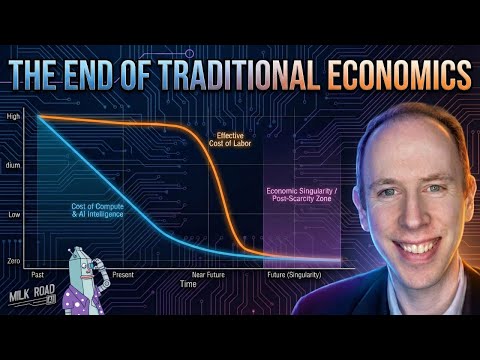
AI-driven hyperdeflation will fundamentally alter economic structures, leading to a post-scarcity future where the primary challenge shifts from production to distribution and the integration of human and machine economies.
Invest in infrastructure that bridges human and AI economies, or prepare for a future where AI agents become a significant, crypto-native economic force.
The next 6-12 months will see continued acceleration of AI capabilities, pushing us closer to a future where traditional labor and intelligence are nearly free. Understanding this change is crucial for navigating the emerging economic landscape and identifying new value creation opportunities.
The era of opaque, black-box AI is ending; the future demands intentionally designed models with human understanding and control. This shift is driven by reliability in high-stakes applications and extracting novel insights.
Investigate interpretability tools (like Goodfire's platform) to gain granular control over model behavior, moving beyond basic fine-tuning for critical applications.
Interpretability is not a niche; it's the missing piece for scaling AI safely into mission-critical domains. Mastering model understanding and intentional design will yield unprecedented capabilities and competitive advantage.
Robotics is moving from bespoke, data-hungry behavior cloning to generalized, human-informed learning via world models. This shift, mirroring the success of LLMs, means robots can use the vast, unstructured data of human experience to acquire new skills.
Invest in platforms and data pipelines that facilitate multi-modal, multi-stage training for humanoid robots. Prioritize systems that can generate synthetic data and use world models for high-throughput, targeted policy evaluation.
World models are the engine for scalable robot intelligence. They promise a future where robots learn faster, generalize wider, and self-improve through iterative simulation, making widespread humanoid deployment a near-term reality.
The Macro Shift: AI is collapsing the time horizon for technological deployment and market dominance, shifting the competitive advantage from pure innovation to a combination of innovation, capital, and rapid infrastructure deployment.
The Tactical Edge: Invest in companies that are not just building AI, but are fundamentally rethinking existing industries with AI-first principles, recognizing that traditional software moats are eroding.
The Bottom Line: The next 12-24 months will see AI's broad impact kick in, creating unprecedented opportunities for those who understand its new "laws of physics" and the critical role of policy in shaping its trajectory.
The healthcare system is moving from reactive, acute care to proactive, preventative interventions, driven by the unsustainable costs of chronic disease and a growing understanding of environmental health.
Build infrastructure that financially incentivizes lifestyle interventions, such as TrueMed's HSA/FSA payment rails for health-promoting products and services.
The next decade will see hundreds of billions of dollars redirected towards preventative health. Companies that bridge the gap between lifestyle choices and healthcare financing will capture significant market share.
The Macro Shift: Global energy demand, driven by AI, forces a strategic re-evaluation of nuclear power. This creates a window for nations to re-shore critical energy infrastructure, moving from reliance on adversaries to domestic, cost-competitive solutions.
The Tactical Edge: Investigate companies addressing foundational supply chain gaps in critical industries like energy. Look for teams with a "first principles" engineering approach and a track record of commercializing hard tech.
The Bottom Line: America's energy independence and its ability to power future technological growth, like AI, hinge on rebuilding domestic nuclear fuel enrichment. This is not just an industrial opportunity; it is a national security imperative.
The Old Playbooks Are Obsolete. This isn't your 2021 bull run. The four-year cycle is broken, institutional flows have altered market dynamics, and historical patterns are no longer reliable predictors of future performance.
Ethereum Is Entering Hyper-Scale. A relentless upgrade cadence is simultaneously scaling both L1 (via gas limit increases) and L2s (via blob scaling), even before the ZK revolution delivers another 100x+ throughput boost to the mainnet.
Adaptability Is the Ultimate Security. Existential threats like quantum computing are moving from science fiction to near-term reality. Ethereum's culture of continuous improvement is its greatest defense, while chains resistant to change face a brewing crisis.
**ETH is Overvalued and Avoidable.** Its fundamentals do not justify its sky-high valuation. View it as a flawed asset, not a mandatory portfolio holding for crypto investors.
**Farm, Don't Trade.** The most reliable retail edge isn't trading, but airdrop farming. It allows you to acquire assets from overvalued launches without providing exit liquidity.
**Cash is a Position.** In a market defined by negative reflexivity and dwindling liquidity, the winning strategy is capital preservation. Avoid the casino, raise cash, and wait for the market to present clear, undervalued opportunities.
Stop Obsessing Over the Halving. The four-year cycle is a narrative, not a driver. The real signal is the macro business cycle, driven by debt refinancing and central bank liquidity. Track the ISM index: historically, buying below 50 and selling above 57 has been a winning strategy.
Invest in Networks, Not Spreadsheets. Value crypto protocols based on network effects (active users and transaction value), not discounted cash flows. The long-term bet is on the growth of the network itself, as this is where wealth has compounded most dramatically.
Survive to Compound. Structure your portfolio to withstand volatility. Have external cash flow so you’re never a forced seller, and take "lifestyle chips" off the table during rallies to manage psychological stress. Drawdowns are a feature, not a bug—use them to add to your long-term positions.
**The Trend is Up, The Cycle is Peaking.** Relentless government spending ensures long-term monetary inflation, making assets like Bitcoin and gold essential core holdings. However, the 65-month cycle is nearing its peak, signaling a time to reduce risk and prepare for turbulence.
**Own Both Sides of the Capital War.** The future is a bipolar monetary world. An optimal portfolio holds both Bitcoin (representing the US digital collateral system) and gold (representing China’s hard money strategy) to hedge against persistent inflation from both sides.
**Watch the Repo Market for the Spark.** The immediate flashing red light is in the repo markets, where interest rate spreads are blowing out. An unwind of leveraged positions here could be the catalyst that ends the current cycle, creating a prime buying opportunity for patient, long-term investors.
Fundamentals Are Coming Home to Roost. Valuations for Layer 1s are untethered from reality. Scrutinize value-capture mechanisms and stop treating staking rewards as revenue.
Follow the Smart Money's Feet, Not Their Mouths. While headlines scream adoption, crypto VCs are quietly pivoting to AI and fintech. This "disbelief" phase in venture often precedes a broader market bottom.
Macro Is the Main Character. Crypto is still on the far end of the risk curve. The sell-off is a macro-driven flight to safety, not a crypto-specific crisis. Until liquidity returns, expect continued correlation with traditional markets.
The Four-Year Cycle is Dead. The market is no longer driven by simple cyclical hype. Macro headwinds and competition for attention from AI mean investors must focus on projects with demonstrable utility, not just memetic potential.
Ethereum Gets Pragmatic. The Ethereum ecosystem is ditching idealism for execution, re-focusing on scaling its core infrastructure (L1) and building products with clear, real-world use cases for both consumers and institutions.
Institutions are Buying the Dip. Don't mistake retail fear for institutional exit. From Harvard's massive ETF allocation to Kraken's IPO plans, smart money is using the downturn to secure its position in the industry's foundational layers.