The automotive industry is undergoing a significant architectural change, moving from fragmented, hardware-centric systems to vertically integrated, AI-powered software-defined vehicles. This demands re-platforming, making legacy automakers vulnerable.
Invest in or build companies controlling their full technology stack: custom silicon, sensor arrays, data collection, AI model training. Vertical integration is key to cost efficiency and rapid iteration for mass-market AI autonomy.
The next few years will see dramatic divergence. Companies mastering AI-driven autonomy and software-defined architectures, like Rivian with its R2, will capture significant market share by offering compelling, continuously improving vehicles at scale. Others face obsolescence.
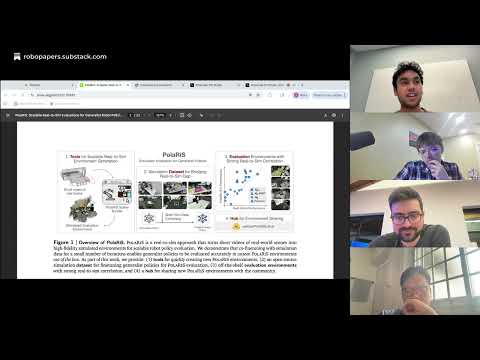
The robotics community is moving beyond task-specific benchmarks towards generalist policy evaluation, mirroring the LLM trend of testing off-the-shelf models on unseen tasks. This demands scalable, high-fidelity simulation tools that can quickly generate diverse test environments.
Builders and researchers should prioritize evaluation tools that offer strong real-to-sim correlation, even if it means a hybrid approach (like PolaRiS) over purely data-driven world models. Utilize real-to-sim environment generation (Gaussian splatting) and strategic sim data co-training to accelerate policy iteration.
PolaRiS offers a path to community-driven, crowdsourced robot benchmarks, making policy development faster and more robust. Expect a future where robot policies are evaluated across a broad suite of easily created, diverse simulated environments, pushing the boundaries of generalization and real-world applicability.
Generalist robot policies need robust, scalable evaluation. The shift is from bespoke, real-world-only testing to a hybrid real-to-sim approach that leverages modern 3D reconstruction and minimal sim data to create highly correlated, reproducible benchmarks.
Builders should adopt PolaRiS's real-to-sim environment generation and "sim co-training" methodology. This allows for rapid, cost-effective iteration on robot policies, ensuring that improvements in simulation translate directly to real-world gains.
Over the next 6-12 months, the ability to quickly and reliably evaluate robot policies in simulation will be a critical differentiator. PolaRiS provides the tools to build diverse, generalization-focused benchmarks, moving robotics closer to the rapid iteration cycles of other AI fields.
Tesla's core identity shifted from EV maker to autonomous AI and robotics. Its cars are devices for deploying its advanced AI brain; competitors miss this.
Tesla's 8 million cars collect real-world driving data. This massive dataset, combined with in-house AI processing, creates an unparalleled moat impossible for competitors to replicate.
This convergence creates an abundance of labor and transportation, driving down costs. Robo-taxis and humanoid robots automate tasks, making goods and services cheaper, even as Tesla's profitability soars.
Robotics is moving towards generalist policies that need broad, diverse evaluation. PolaRiS enables this by making it easy to create and share new, correlated benchmarks, cultivating a community-driven evaluation ecosystem similar to LLMs.
Adopt PolaRiS for rapid policy iteration on pick-and-place and articulated object tasks. Use its browser-based scene builder and existing assets to quickly create new evaluation environments, then fine-tune policies with a small amount of unrelated sim data to boost real-to-sim correlation.
Investing in tools like PolaRiS now means faster development cycles and more reliable policy improvements. This accelerates the path to robust, real-world robot deployment by providing a scalable, trustworthy intermediate testing ground.
PolaRiS enables a shift towards LLM-style generalization benchmarks, where models are tested on unseen environments and tasks, accelerating robot capabilities.
Use its browser-based scene builder and Gaussian splatting to quickly create diverse, real-world correlated evaluation environments, significantly reducing the cost and time of real robot testing.
Cheap, reliable robot policy evaluation in simulation, with strong real-world correlation, means faster development cycles, more robust generalist robots, and a path to crowdsourced, diverse benchmarks that will push the entire field forward.
AI is forcing a fundamental architectural change in automotive, moving from fragmented, rules-based systems to vertically integrated, neural network-powered platforms. This technical reality dictates market survival, favoring companies that control their entire software and hardware stack to build a continuous data flywheel.
Invest in or partner with companies demonstrating deep vertical integration in AI hardware and software for mobility. Prioritize those with a clear path to mass-market data collection and rapid iteration cycles.
Autonomy will be a must-have feature in cars within the next few years. Companies without a software-defined architecture and a vertically integrated AI stack will struggle to compete, creating a market share shift towards those few players who can deliver true self-driving at scale.
The automotive industry is undergoing a fundamental re-architecture, moving from hardware-centric, rules-based systems to software-defined, AI-powered platforms. This shift favors companies with deep vertical integration and proprietary data flywheels.
Invest in companies demonstrating full-stack control over their vehicle's software, hardware, and AI training data. This verticality is the moat against commoditization and the engine for rapid, continuous improvement.
Autonomy will be a non-negotiable feature by 2030, making software-defined vehicles the only viable path for mass-market automakers. Companies that fail to build or acquire this capability will face market irrelevance.
Tesla's core business is AI and autonomous robotics. This means its value comes from its software and data moat, not just vehicle sales.
Tesla is sunsetting Model S and X production to convert factories for humanoid robots. This signals a full commitment to autonomous devices beyond cars.
Unsupervised FSD is expected in select US states by Q2. This will enable cars to operate without human oversight, unlocking the robo-taxi network.
**Memecoins Were a Trojan Horse:** The speculative frenzy was a catalyst that massively accelerated DEX adoption and forced millions of users to finally learn how to use self-custody wallets and on-chain tools.
**Prepare for Thousands of Stablecoins:** Every company with deposits will likely issue its own "branded money." The next major infrastructure battle will be building the interoperability layers—the "Visa for stablecoins"—to manage this fragmented liquidity.
**The Real Stablecoin Opportunity is Global:** The next frontier isn't another USD competitor, but non-USD stablecoins tied to high-yield foreign currencies, which will unlock the creation of on-chain foreign exchange (FX) markets.
DEXs are Eating the World. The on-chain asset explosion has permanently shifted trading gravity. Centralized exchanges must now integrate with DeFi or risk becoming irrelevant islands.
Stablecoins are the New Gift Cards. The move to "branded money" will create a fragmented landscape. The next billion-dollar opportunity is not in issuing another stablecoin, but in building the interoperability rails that make them all work together seamlessly.
Distribution is the New Defensibility. As stablecoin issuance becomes commoditized, the winners will be those with massive distribution networks (like Stripe) who can embed their currency into everyday user flows.
FHE is crypto’s HTTPS moment. Just as HTTPS made secure browsing the default, FHE is positioned to bring end-to-end encryption to all blockchain transactions, solving a fundamental flaw without forcing users to change their behavior.
Privacy is coming for your wallet, not a new chain. The "holy grail" is integrating confidentiality directly into the user's existing workflow on mainnet Ethereum. Forget bridging; the future is an "incognito mode" for your current assets.
Institutional demand will drive retail privacy. The need for financial institutions like JPMorgan to protect their trades on-chain is the catalyst that will finally make robust privacy tools a standard feature for everyone.
**Stop Applying Linear Valuations to Exponential Tech.** Judging Ethereum on its P/E ratio is like criticizing Amazon in 1999 for its lack of profits. It’s a category error. Value chains based on their probability of capturing a piece of a future trillion-dollar system.
**The Prize Is Worth Winning.** The entire investment case for new L1s hinges on the belief that incumbents like Ethereum and Solana are immensely valuable. If they are, then a small probability of becoming the next one justifies a multi-billion dollar valuation today.
**Zoom Out and Believe.** The current market is trapped in short-term cynicism. The real alpha comes from adopting a Silicon Valley mindset over a Wall Street one, recognizing that you are living through a technological revolution on par with the early internet.
Weaponize cringe for distribution. The ‘Choose Rich Nick’ model proves that being the butt of the joke is a powerful growth hack. Manufacturing moments that invite mockery creates a viral loop of outrage and engagement that funnels attention to the core business.
Authenticity is a liability. The most successful stunts are meticulously planned fabrications. From fake girlfriends to staged yacht expulsions, the goal isn't to be real but to create a compelling narrative that the internet can’t ignore.
Success hinges on ambiguity. The content is designed to polarize. Its virality depends on a split audience: one half gets the joke and celebrates the performance, while the other half takes it at face value, fueling the outrage machine that drives impressions.
Fintech is the New On-Ramp. Giants like Klarna are adopting stablecoins for economic utility, not speculation. This signals a new wave of adoption driven by real-world efficiency gains.
Re-evaluate Your Valuations. The massive valuation gap between a fintech like Klarna and an L1 like Solana forces a critical question: will value accrue to the rails or the businesses that use them to serve hundreds of millions of customers?
Distribution is Undefeated. Robinhood’s move to sideline its partner Kalshi proves that owning the customer relationship is the ultimate moat, a crucial lesson for infrastructure projects reliant on third-party distribution.