The Macro Shift: Celebrity capital is moving from transactional endorsements to strategic equity investments, driven by a desire for long-term wealth creation and the recognition that personal brand power can significantly accelerate startup growth.
The Tactical Edge: Cultivate a diverse network of mentors and partners, prioritizing those who bring complementary expertise and can challenge your assumptions.
The Bottom Line: The future of wealth creation for high-profile individuals and savvy investors lies in strategic, long-term equity plays, supported by strong teams and a willingness to partner.
AI agents with system-level access are shifting the core value proposition of software from discrete applications to fluid, context-aware personal assistants.
Cultivate "agent empathy" by learning to guide AI models effectively, understanding their limitations, and designing projects for agent-first navigation.
The rise of autonomous agents will redefine software's purpose and value.
Adopt PolaRiS for rapid policy iteration. Leverage its real-to-sim environment generation and minimal sim data co-training to quickly validate robot policies in diverse, unseen environments before committing to expensive real-world deployments.
The era of generalist robot policies demands a new paradigm for evaluation. The shift is from bespoke, real-world testing to scalable, high-fidelity sim-to-real correlation, enabling faster iteration and broader generalization testing.
Reliable sim-to-real evaluation is the missing link for accelerating robot AI. PolaRiS offers a pragmatic, community-driven path to unlock faster development cycles and more robust generalist robot policies over the next 6-12 months.
Generalist robot policies demand evaluation that tests true generalization across diverse, unseen environments. The shift is from hand-tuned, task-specific benchmarks to scalable, community-driven evaluation suites that can keep pace with rapidly improving model capabilities. This requires tools that make environment creation cheap and ensure real-world predictive power.
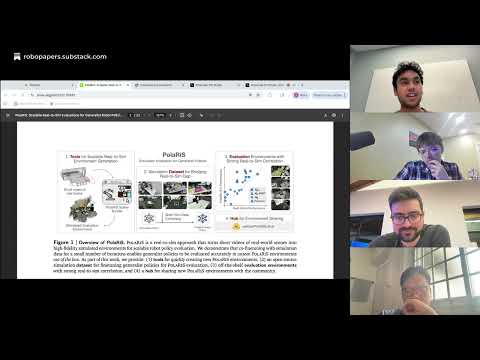
Adopt PolaRiS for rapid, correlated policy iteration. Builders should leverage its real-to-sim environment generation (Gaussian splatting for scenes, generative models for objects) and the "sim co-training" trick to quickly validate policy improvements against real-world performance, especially for pick-and-place tasks. Contribute new environments to the Polaris Hub to expand the collective benchmark.
The future of robotics hinges on fast, reliable evaluation. PolaRiS offers a pragmatic, immediate solution to accelerate policy development by providing high-fidelity, correlated sim environments. Over the next 6-12 months, expect this hybrid approach to become a standard for iterating on generalist robot policies, while fully learned world models continue to improve for more complex, deformable tasks.
The push for generalist robot policies demands scalable, trustworthy evaluation. PolaRiS democratizes high-fidelity sim evaluation, moving robotics closer to rapid iteration cycles seen in other AI fields.
Builders should explore PolaRiS's open-source tools and pre-trained checkpoints to quickly test policies in diverse, real-world-correlated environments. Prioritize visual fidelity and use small, unrelated sim data for alignment.
Rapid, reliable sim evaluation with strong real-world correlation is a significant advancement. This tool enables faster policy iteration, broader generalization, and community-driven benchmarking, setting the stage for the next generation of robot capabilities.
Generalist robot policies demand community-driven, scalable evaluation, mirroring LLM benchmarking. PolaRiS provides the technical foundation by making high-fidelity, correlated sim environments accessible.
Adopt PolaRiS for rapid policy iteration. Use its browser-based scene builder and Gaussian splatting for quick environment creation, incorporating minimal, unrelated sim co-training data for strong real-world correlation.
PolaRiS accelerates robot development with a reliable, scalable simulation tool. This means faster iteration, more robust policies, and a clearer path to real-world deployment for your robot applications over the next 6-12 months.
The era of generalist robot policies demands evaluation tools that can keep pace with rapid development and broad generalization. PolaRiS pushes robotics toward the LLM benchmark paradigm, where models are tested on unseen environments and tasks, rather than being trained on specific benchmarks.
For builders, leverage PolaRiS's browser-based scene builder and Gaussian splatting pipeline to quickly create diverse, high-fidelity evaluation environments from real-world scans. This enables faster policy iteration and more reliable real-world deployment.
PolaRiS offers a pragmatic, scalable path to more effective robot policy development. By providing a tool that makes sim performance a reliable predictor of real-world success, it accelerates the journey from lab to real-world application, especially for pick-and-place tasks, and sets the stage for community-driven benchmarking.
Celebrity capital is evolving from passive endorsements to active, strategic equity investment, transforming athletes and entertainers into powerful venture partners who bring more than just money to the table.
Prioritize building a diverse, expert team that can challenge your assumptions and vet opportunities, especially when entering new sectors like AI or overlooked geographic markets.
Long-term thinking, a willingness to invest in growth, and a focus on strategic partnerships are non-negotiable for building lasting wealth and influence in both traditional and emerging industries over the next 6-12 months.
**Memecoins Were a Trojan Horse:** The speculative frenzy was a catalyst that massively accelerated DEX adoption and forced millions of users to finally learn how to use self-custody wallets and on-chain tools.
**Prepare for Thousands of Stablecoins:** Every company with deposits will likely issue its own "branded money." The next major infrastructure battle will be building the interoperability layers—the "Visa for stablecoins"—to manage this fragmented liquidity.
**The Real Stablecoin Opportunity is Global:** The next frontier isn't another USD competitor, but non-USD stablecoins tied to high-yield foreign currencies, which will unlock the creation of on-chain foreign exchange (FX) markets.
DEXs are Eating the World. The on-chain asset explosion has permanently shifted trading gravity. Centralized exchanges must now integrate with DeFi or risk becoming irrelevant islands.
Stablecoins are the New Gift Cards. The move to "branded money" will create a fragmented landscape. The next billion-dollar opportunity is not in issuing another stablecoin, but in building the interoperability rails that make them all work together seamlessly.
Distribution is the New Defensibility. As stablecoin issuance becomes commoditized, the winners will be those with massive distribution networks (like Stripe) who can embed their currency into everyday user flows.
FHE is crypto’s HTTPS moment. Just as HTTPS made secure browsing the default, FHE is positioned to bring end-to-end encryption to all blockchain transactions, solving a fundamental flaw without forcing users to change their behavior.
Privacy is coming for your wallet, not a new chain. The "holy grail" is integrating confidentiality directly into the user's existing workflow on mainnet Ethereum. Forget bridging; the future is an "incognito mode" for your current assets.
Institutional demand will drive retail privacy. The need for financial institutions like JPMorgan to protect their trades on-chain is the catalyst that will finally make robust privacy tools a standard feature for everyone.
**Stop Applying Linear Valuations to Exponential Tech.** Judging Ethereum on its P/E ratio is like criticizing Amazon in 1999 for its lack of profits. It’s a category error. Value chains based on their probability of capturing a piece of a future trillion-dollar system.
**The Prize Is Worth Winning.** The entire investment case for new L1s hinges on the belief that incumbents like Ethereum and Solana are immensely valuable. If they are, then a small probability of becoming the next one justifies a multi-billion dollar valuation today.
**Zoom Out and Believe.** The current market is trapped in short-term cynicism. The real alpha comes from adopting a Silicon Valley mindset over a Wall Street one, recognizing that you are living through a technological revolution on par with the early internet.
Weaponize cringe for distribution. The ‘Choose Rich Nick’ model proves that being the butt of the joke is a powerful growth hack. Manufacturing moments that invite mockery creates a viral loop of outrage and engagement that funnels attention to the core business.
Authenticity is a liability. The most successful stunts are meticulously planned fabrications. From fake girlfriends to staged yacht expulsions, the goal isn't to be real but to create a compelling narrative that the internet can’t ignore.
Success hinges on ambiguity. The content is designed to polarize. Its virality depends on a split audience: one half gets the joke and celebrates the performance, while the other half takes it at face value, fueling the outrage machine that drives impressions.
Fintech is the New On-Ramp. Giants like Klarna are adopting stablecoins for economic utility, not speculation. This signals a new wave of adoption driven by real-world efficiency gains.
Re-evaluate Your Valuations. The massive valuation gap between a fintech like Klarna and an L1 like Solana forces a critical question: will value accrue to the rails or the businesses that use them to serve hundreds of millions of customers?
Distribution is Undefeated. Robinhood’s move to sideline its partner Kalshi proves that owning the customer relationship is the ultimate moat, a crucial lesson for infrastructure projects reliant on third-party distribution.