The digital experience economy is moving from static content to dynamic, AI-driven co-experience platforms, where user interaction data becomes the core asset for training next-generation virtual intelligence.
Invest in platforms that offer robust, cloud-connected infrastructure and proprietary, vectorized user data for AI training, as these will be the engines for future immersive content and agentic AI development.
Roblox's long-term vision, powered by its unique data moat and AI investments, positions it to define the future of virtual co-experience, making it a critical player to watch for investors and builders in the AI and gaming space over the next 6-12 months.
The exponential reduction in the cost of intelligence, coupled with open-source proliferation, is pushing AI into every corner of society, creating a collective action problem where market incentives for "engaging" AI clash with the need for societal safety and control.
Get hands-on with AI now. "Vibe coding" and actively experimenting with AI tools builds "AI muscle," inoculating users against psychosis risks and building a deeper understanding of AI's capabilities and limitations.
AI is here to stay and will redefine work and interaction. Understanding its "hyperobject" nature, advocating for clear regulatory boundaries, and actively engaging with the technology are critical for navigating the near future without falling for its simulated charms.
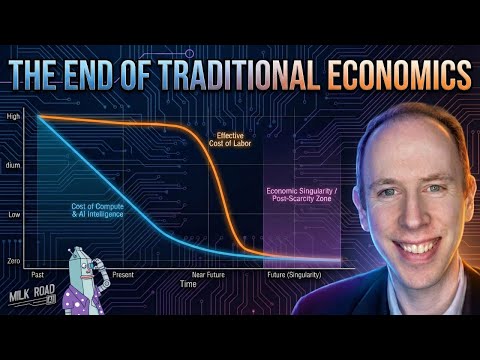
AI-driven hyperdeflation will fundamentally alter economic structures, leading to a post-scarcity future where the primary challenge shifts from production to distribution and the integration of human and machine economies.
Invest in infrastructure that bridges human and AI economies, or prepare for a future where AI agents become a significant, crypto-native economic force.
The next 6-12 months will see continued acceleration of AI capabilities, pushing us closer to a future where traditional labor and intelligence are nearly free. Understanding this change is crucial for navigating the emerging economic landscape and identifying new value creation opportunities.
The era of opaque, black-box AI is ending; the future demands intentionally designed models with human understanding and control. This shift is driven by reliability in high-stakes applications and extracting novel insights.
Investigate interpretability tools (like Goodfire's platform) to gain granular control over model behavior, moving beyond basic fine-tuning for critical applications.
Interpretability is not a niche; it's the missing piece for scaling AI safely into mission-critical domains. Mastering model understanding and intentional design will yield unprecedented capabilities and competitive advantage.
Robotics is moving from bespoke, data-hungry behavior cloning to generalized, human-informed learning via world models. This shift, mirroring the success of LLMs, means robots can use the vast, unstructured data of human experience to acquire new skills.
Invest in platforms and data pipelines that facilitate multi-modal, multi-stage training for humanoid robots. Prioritize systems that can generate synthetic data and use world models for high-throughput, targeted policy evaluation.
World models are the engine for scalable robot intelligence. They promise a future where robots learn faster, generalize wider, and self-improve through iterative simulation, making widespread humanoid deployment a near-term reality.
The Macro Shift: AI is collapsing the time horizon for technological deployment and market dominance, shifting the competitive advantage from pure innovation to a combination of innovation, capital, and rapid infrastructure deployment.
The Tactical Edge: Invest in companies that are not just building AI, but are fundamentally rethinking existing industries with AI-first principles, recognizing that traditional software moats are eroding.
The Bottom Line: The next 12-24 months will see AI's broad impact kick in, creating unprecedented opportunities for those who understand its new "laws of physics" and the critical role of policy in shaping its trajectory.
The healthcare system is moving from reactive, acute care to proactive, preventative interventions, driven by the unsustainable costs of chronic disease and a growing understanding of environmental health.
Build infrastructure that financially incentivizes lifestyle interventions, such as TrueMed's HSA/FSA payment rails for health-promoting products and services.
The next decade will see hundreds of billions of dollars redirected towards preventative health. Companies that bridge the gap between lifestyle choices and healthcare financing will capture significant market share.
The Macro Shift: Global energy demand, driven by AI, forces a strategic re-evaluation of nuclear power. This creates a window for nations to re-shore critical energy infrastructure, moving from reliance on adversaries to domestic, cost-competitive solutions.
The Tactical Edge: Investigate companies addressing foundational supply chain gaps in critical industries like energy. Look for teams with a "first principles" engineering approach and a track record of commercializing hard tech.
The Bottom Line: America's energy independence and its ability to power future technological growth, like AI, hinge on rebuilding domestic nuclear fuel enrichment. This is not just an industrial opportunity; it is a national security imperative.
**Memecoins Were a Trojan Horse:** The speculative frenzy was a catalyst that massively accelerated DEX adoption and forced millions of users to finally learn how to use self-custody wallets and on-chain tools.
**Prepare for Thousands of Stablecoins:** Every company with deposits will likely issue its own "branded money." The next major infrastructure battle will be building the interoperability layers—the "Visa for stablecoins"—to manage this fragmented liquidity.
**The Real Stablecoin Opportunity is Global:** The next frontier isn't another USD competitor, but non-USD stablecoins tied to high-yield foreign currencies, which will unlock the creation of on-chain foreign exchange (FX) markets.
DEXs are Eating the World. The on-chain asset explosion has permanently shifted trading gravity. Centralized exchanges must now integrate with DeFi or risk becoming irrelevant islands.
Stablecoins are the New Gift Cards. The move to "branded money" will create a fragmented landscape. The next billion-dollar opportunity is not in issuing another stablecoin, but in building the interoperability rails that make them all work together seamlessly.
Distribution is the New Defensibility. As stablecoin issuance becomes commoditized, the winners will be those with massive distribution networks (like Stripe) who can embed their currency into everyday user flows.
FHE is crypto’s HTTPS moment. Just as HTTPS made secure browsing the default, FHE is positioned to bring end-to-end encryption to all blockchain transactions, solving a fundamental flaw without forcing users to change their behavior.
Privacy is coming for your wallet, not a new chain. The "holy grail" is integrating confidentiality directly into the user's existing workflow on mainnet Ethereum. Forget bridging; the future is an "incognito mode" for your current assets.
Institutional demand will drive retail privacy. The need for financial institutions like JPMorgan to protect their trades on-chain is the catalyst that will finally make robust privacy tools a standard feature for everyone.
**Stop Applying Linear Valuations to Exponential Tech.** Judging Ethereum on its P/E ratio is like criticizing Amazon in 1999 for its lack of profits. It’s a category error. Value chains based on their probability of capturing a piece of a future trillion-dollar system.
**The Prize Is Worth Winning.** The entire investment case for new L1s hinges on the belief that incumbents like Ethereum and Solana are immensely valuable. If they are, then a small probability of becoming the next one justifies a multi-billion dollar valuation today.
**Zoom Out and Believe.** The current market is trapped in short-term cynicism. The real alpha comes from adopting a Silicon Valley mindset over a Wall Street one, recognizing that you are living through a technological revolution on par with the early internet.
Weaponize cringe for distribution. The ‘Choose Rich Nick’ model proves that being the butt of the joke is a powerful growth hack. Manufacturing moments that invite mockery creates a viral loop of outrage and engagement that funnels attention to the core business.
Authenticity is a liability. The most successful stunts are meticulously planned fabrications. From fake girlfriends to staged yacht expulsions, the goal isn't to be real but to create a compelling narrative that the internet can’t ignore.
Success hinges on ambiguity. The content is designed to polarize. Its virality depends on a split audience: one half gets the joke and celebrates the performance, while the other half takes it at face value, fueling the outrage machine that drives impressions.
Fintech is the New On-Ramp. Giants like Klarna are adopting stablecoins for economic utility, not speculation. This signals a new wave of adoption driven by real-world efficiency gains.
Re-evaluate Your Valuations. The massive valuation gap between a fintech like Klarna and an L1 like Solana forces a critical question: will value accrue to the rails or the businesses that use them to serve hundreds of millions of customers?
Distribution is Undefeated. Robinhood’s move to sideline its partner Kalshi proves that owning the customer relationship is the ultimate moat, a crucial lesson for infrastructure projects reliant on third-party distribution.