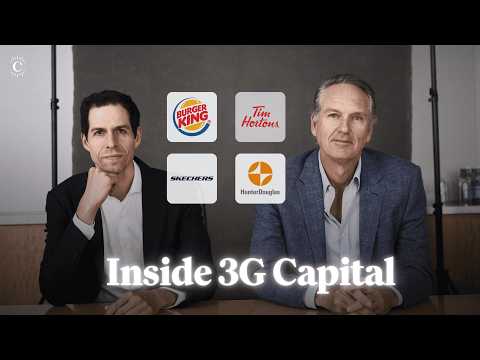
3G commits to one investment per fund, deploying significant internal capital alongside partners. This focus allows for rigorous downside analysis and patience, ensuring only truly exceptional businesses are acquired.
3G partners are seasoned operators who step into businesses, aligning incentives with ownership. This hands-on approach ensures decisions serve the business's long-term health, not just short-term management goals.
3G prioritizes businesses that directly own their customer relationships, like Burger King or Hunter Douglas. This direct connection reduces disintermediation risk from retailers or new technologies.
As capital markets become increasingly efficient and competitive, the edge moves from financial engineering to deep operational expertise and long-term, owner-aligned management.
Prioritize identifying and enabling high-potential individuals early in their careers, granting them significant responsibility and ownership.
Disciplined focus, patient relationship building, and an unwavering commitment to operational excellence in established, defensible businesses can still yield generational wealth.
The Macro Trend: In a world obsessed with digital disruption, 3G Capital's success with "atoms over bits" businesses highlights a strategic pivot: enduring value often resides in established brands with proprietary customer relationships, where operational excellence and long-term thinking create moats against fleeting tech trends.
The Tactical Edge: Identify businesses with strong, direct customer relationships and a clear path for operational improvement, even if they appear "boring." Prioritize deep, hands-on involvement to drive value, rather than relying solely on financial engineering.
The Bottom Line: The future of outsized returns may not be in chasing the next big tech wave, but in patiently acquiring and meticulously operating businesses that own their customer relationships, leveraging technology to enhance, not redefine, their core value. This strategy offers a more predictable, less volatile path to compounding capital.
The Macro Shift: In a world obsessed with digital disruption, 3G Capital's success highlights the enduring power of "hard" businesses with strong customer relationships. Their focus on foundational consumer brands, managed by operator-investors who prioritize long-term ownership and disciplined execution, offers a robust counter-narrative to the "bits over atoms" trend.
The Tactical Edge: Cultivate an extreme ownership culture by aligning incentives deeply, empowering young talent with real responsibility, and fostering a relentless bias for action.
The Bottom Line: For investors and builders, the lesson is clear: patience, deep operational involvement, and a fanatical focus on talent in defensible, "boring" businesses can yield extraordinary, long-term value, even in expensive markets.
Extreme Focus: 3G Capital commits to one investment per fund, deploying significant internal capital alongside partners. This singular focus forces rigorous downside analysis and patience, ensuring they only pursue truly exceptional opportunities.
Owner Operators: 3G partners are seasoned operators who step into businesses, aligning incentives with ownership. This means leaders act like shareholders, making decisions for the business's long-term health, not just short-term management goals.
Disruption Defense: 3G prioritizes businesses with strong customer relationships and physical components, making them less susceptible to digital disintermediation. They seek enduring brands like Hunter Douglas, where the sun will always rise and set, ensuring a consistent need for their product.
In an era of rapid technological change, businesses with strong, direct customer relationships and physical moats are increasingly valuable. 3G's focus on these "atoms" businesses, enhanced by strategic tech adoption, provides a blueprint for durable value creation.
Cultivate an ownership culture by aligning incentives deeply, empowering young talent with real responsibility, and prioritizing long-term value over short-term gains.
The future belongs to patient, operator-led investors who can identify and transform enduring businesses by focusing on fundamental quality, people, and strategic technological integration, rather than chasing fleeting trends.
3G Capital's model counters this by doubling down on "atoms" businesses with strong customer relationships and defensible positions, then applying rigorous operational excellence.
Cultivate an owner-operator mindset within your organization, even if you are not a private equity firm. Identify and back high-potential young talent with significant responsibility and aligned incentives, providing mentorship to maximize their success.
In a world obsessed with speed and diversification, 3G Capital proves that deep, patient, operator-led concentration on high-quality, defensible businesses, combined with a culture of ownership and meritocracy, remains a powerful engine for outsized value creation.
The era of celebrity endorsements is evolving into one of celebrity ownership, driven by a growing understanding of equity's compounding power and enabled by new technologies that lower the barrier to business creation.
Prioritize building a diverse, expert team and actively seek out "boring" businesses or underserved markets with clear, unmet demand.
The next 6-12 months will see an acceleration of talent leveraging their brand for equity stakes, particularly in tech-enabled ventures. Position yourself to either participate in these deals or build the tools that empower this new class of owner-operators.
**Memecoins Were a Trojan Horse:** The speculative frenzy was a catalyst that massively accelerated DEX adoption and forced millions of users to finally learn how to use self-custody wallets and on-chain tools.
**Prepare for Thousands of Stablecoins:** Every company with deposits will likely issue its own "branded money." The next major infrastructure battle will be building the interoperability layers—the "Visa for stablecoins"—to manage this fragmented liquidity.
**The Real Stablecoin Opportunity is Global:** The next frontier isn't another USD competitor, but non-USD stablecoins tied to high-yield foreign currencies, which will unlock the creation of on-chain foreign exchange (FX) markets.
DEXs are Eating the World. The on-chain asset explosion has permanently shifted trading gravity. Centralized exchanges must now integrate with DeFi or risk becoming irrelevant islands.
Stablecoins are the New Gift Cards. The move to "branded money" will create a fragmented landscape. The next billion-dollar opportunity is not in issuing another stablecoin, but in building the interoperability rails that make them all work together seamlessly.
Distribution is the New Defensibility. As stablecoin issuance becomes commoditized, the winners will be those with massive distribution networks (like Stripe) who can embed their currency into everyday user flows.
FHE is crypto’s HTTPS moment. Just as HTTPS made secure browsing the default, FHE is positioned to bring end-to-end encryption to all blockchain transactions, solving a fundamental flaw without forcing users to change their behavior.
Privacy is coming for your wallet, not a new chain. The "holy grail" is integrating confidentiality directly into the user's existing workflow on mainnet Ethereum. Forget bridging; the future is an "incognito mode" for your current assets.
Institutional demand will drive retail privacy. The need for financial institutions like JPMorgan to protect their trades on-chain is the catalyst that will finally make robust privacy tools a standard feature for everyone.
**Stop Applying Linear Valuations to Exponential Tech.** Judging Ethereum on its P/E ratio is like criticizing Amazon in 1999 for its lack of profits. It’s a category error. Value chains based on their probability of capturing a piece of a future trillion-dollar system.
**The Prize Is Worth Winning.** The entire investment case for new L1s hinges on the belief that incumbents like Ethereum and Solana are immensely valuable. If they are, then a small probability of becoming the next one justifies a multi-billion dollar valuation today.
**Zoom Out and Believe.** The current market is trapped in short-term cynicism. The real alpha comes from adopting a Silicon Valley mindset over a Wall Street one, recognizing that you are living through a technological revolution on par with the early internet.
Weaponize cringe for distribution. The ‘Choose Rich Nick’ model proves that being the butt of the joke is a powerful growth hack. Manufacturing moments that invite mockery creates a viral loop of outrage and engagement that funnels attention to the core business.
Authenticity is a liability. The most successful stunts are meticulously planned fabrications. From fake girlfriends to staged yacht expulsions, the goal isn't to be real but to create a compelling narrative that the internet can’t ignore.
Success hinges on ambiguity. The content is designed to polarize. Its virality depends on a split audience: one half gets the joke and celebrates the performance, while the other half takes it at face value, fueling the outrage machine that drives impressions.
Fintech is the New On-Ramp. Giants like Klarna are adopting stablecoins for economic utility, not speculation. This signals a new wave of adoption driven by real-world efficiency gains.
Re-evaluate Your Valuations. The massive valuation gap between a fintech like Klarna and an L1 like Solana forces a critical question: will value accrue to the rails or the businesses that use them to serve hundreds of millions of customers?
Distribution is Undefeated. Robinhood’s move to sideline its partner Kalshi proves that owning the customer relationship is the ultimate moat, a crucial lesson for infrastructure projects reliant on third-party distribution.