The Macro Shift: The Great Re-Shoring. National security now depends on domestic production of critical minerals and semiconductors.
The Tactical Edge: Build for Scale. Prioritize manufacturing competence over pure software features to win government contracts.
The Bottom Line: The defense industrial base is being rebuilt from the ground up. The next decade belongs to the builders who can merge Silicon Valley speed with the Pentagon's scale.
The Macro Trend: Biological Sovereignty. As global systems destabilize, the Amazon remains the most critical piece of biological infrastructure on the planet.
The Tactical Edge: Support Jungle Keepers. Direct capital to organizations that convert loggers into rangers to secure land concessions.
The Amazon is a finite asset under active siege. Protecting it requires a blend of primitive survival skills and high-tech surveillance over the next 18 months.
The Macro Pivot: As generative AI masters simulation, the physical world becomes a high-fidelity playground for software.
The Tactical Edge: Invest in the "brain" layer rather than the "limb" layer. Software that can generalize across different hardware forms will capture the most value.
The next decade belongs to embodied AI that reasons in real time. If you are waiting for the hardware to look perfect before paying attention, you will miss the moment the software takes over the physical world.
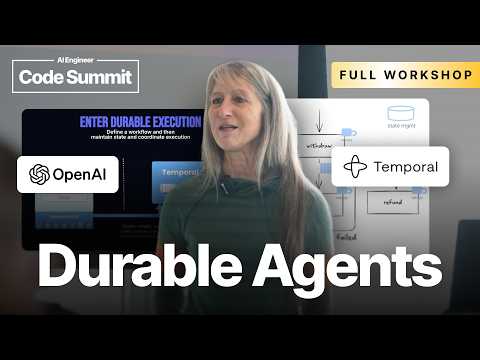
The industry is moving from "Agent as a Script" to "Agent as a Durable Service" where state management is handled by the infrastructure.
Wrap your existing API tools in the `activity_as_tool` function to gain automatic retries and execution history.
Reliability is the only moat in the agentic economy. If your agent cannot survive a server restart during a three-day task, it is not ready for the enterprise.
The Macro Trend: The move from fragmented content libraries to integrated health systems where AI synthesizes biomarkers and movement.
The Tactical Edge: Construct internal LLM tools to categorize qualitative feedback. This turns thousands of raw reviews into a precise roadmap.
The Bottom Line: Building a $100M ARR consumer app requires mastery of both growth loops and product retention. Solve for the daily habit to win the long game.
The transition from general-purpose AI to specialized application layers. As foundation models commoditize, value migrates to the "fat tail" of human-centric complexity.
Prioritize building or investing in "DNA of the future" companies that incumbents must eventually acquire to survive. Focus on winning the "point of attack" by staying deep in the technical details.
We are in a unique market where demand growth justifies high valuations. Success over the next year depends on identifying founders who are the absolute best in the world at one specific thing.
Strategic Shift: The Perp DEX market is maturing beyond raw volume. Sustainable competitive advantages will come from transparent economics, innovative collateral, and robust on-chain security.
Builder/Investor Note: Focus on projects solving the retail onboarding problem and those building sophisticated, yield-bearing, or cross-asset collateral systems with sound liquidation mechanics.
The "So What?": Expect market consolidation over the next 5 years, with a handful of dominant Perp DEXs emerging, mirroring the CeFi landscape. Innovation in core primitives, not just new markets, will define the winners.
ETH is positioned for a potential resurgence fueled by technological advancements, institutional investment, and a shift in market sentiment away from solely favoring Solana, mimicking Bitcoin’s rise in the 2021 cycle.
ZK technology is fundamentally changing the Layer 2 landscape, unifying liquidity and enabling seamless interaction with Layer 1, which may lead to standardized infrastructure and increased institutional adoption.
Regulatory winds are shifting, with agencies embracing crypto, banks legitimizing Bitcoin as collateral, and the potential passage of the Clarity Act paving the way for Wall Street's tokenization efforts.
Enterprise blockchains are making a comeback by embracing crypto, not avoiding it, marking a significant shift from the failed attempts of 2018.
The success of corporate chains hinges on strategic focus, prioritizing ecosystems and BD, over trying to dominate the entire value chain, as too much control can stifle innovation.
Public, permissionless blockchains must remain relevant by continually finding product-market fit in emerging segments to maintain their monetary premium amid increasing competition from verticalized corporate chains.
**ICOs are evolving:** The return of ICOs marks a shift from hype-driven raises to more sustainable models focused on established projects and fair price discovery.
**Ethereum is primed for capital formation:** With its stablecoin liquidity, auction mechanisms, and tokenization narrative, Ethereum is positioned to become a central hub for internet capital markets.
**Regulatory clarity is crucial:** The industry must continue to pursue regulatory clarity to foster innovation and attract institutional investment in tokenized assets.